

58
S. Kerbstadt et al.
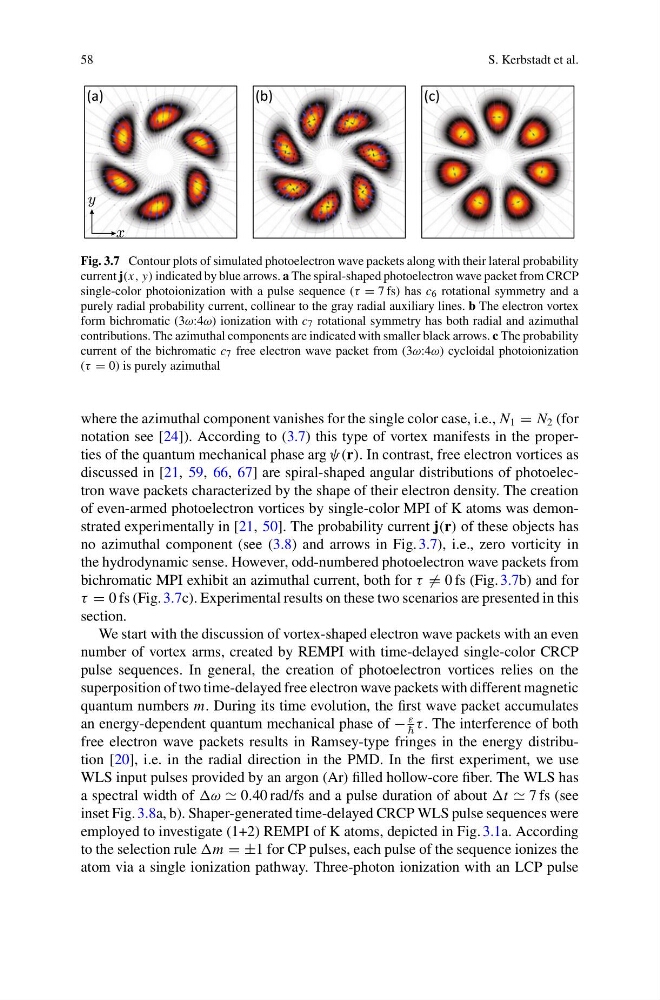
Fig. 3.7 Contour plots of simulated photoelectron wave packets along with their lateral probability
current j(x, y) indicated by blue arrows. a The spiral-shaped photoelectron wave packet from CRCP
single-color photoionization with a pulse sequence (τ = 7 fs) has c 6 rotational symmetry and a
purely radial probability current, collinear to the gray radial auxiliary lines. b The electron vortex
form bichromatic (3ω:4ω) ionization with c 7 rotational symmetry has both radial and azimuthal
contributions. The azimuthal components are indicated with smaller black arrows. c The probability
current of the bichromatic c 7 free electron wave packet from (3ω:4ω) cycloidal photoionization
(τ = 0) is purely azimuthal
where the azimuthal component vanishes for the single color case, i.e., N 1 = N 2 (for
notation see [24]). According to (3.7) this type of vortex manifests in the properties of the quantum mechanical phase arg ψ(r). In contrast, free electron vortices as
discussed in [21, 59, 66, 67] are spiral-shaped angular distributions of photoelectron wave packets characterized by the shape of their electron density. The creation
of even-armed photoelectron vortices by single-color MPI of K atoms was demonstrated experimentally in [21, 50]. The probability current j(r) of these objects has
no azimuthal component (see (3.8) and arrows in Fig. 3.7), i.e., zero vorticity in
the hydrodynamic sense. However, odd-numbered photoelectron wave packets from
bichromatic MPI exhibit an azimuthal current, both for τ = 0 fs (Fig. 3.7b) and for
τ = 0 fs (Fig. 3.7c). Experimental results on these two scenarios are presented in this
section.
We start with the discussion of vortex-shaped electron wave packets with an even
number of vortex arms, created by REMPI with time-delayed single-color CRCP
pulse sequences. In general, the creation of photoelectron vortices relies on the
superposition of two time-delayed free electron wave packets with different magnetic
quantum numbers m. During its time evolution, the first wave packet accumulates
an energy-dependent quantum mechanical phase of −
ε
τ . The interference of both
free electron wave packets results in Ramsey-type fringes in the energy distribution [20], i.e. in the radial direction in the PMD. In the first experiment, we use
WLS input pulses provided by an argon (Ar) filled hollow-core fiber. The WLS has
a spectral width of 0.40 rad/fs and a pulse duration of about 7 fs (see
inset Fig. 3.8a, b). Shaper-generated time-delayed CRCP WLS pulse sequences were
employed to investigate (1+2) REMPI of K atoms, depicted in Fig. 3.1a. According
to the selection rule = ±1 for CP pulses, each pulse of the sequence ionizes the
atom via a single ionization pathway. Three-photon ionization with an LCP pulse
S. Kerbstadt et al.
Fig. 3.7 Contour plots of simulated photoelectron wave packets along with their lateral probability
current j(x, y) indicated by blue arrows. a The spiral-shaped photoelectron wave packet from CRCP
single-color photoionization with a pulse sequence (τ = 7 fs) has c 6 rotational symmetry and a
purely radial probability current, collinear to the gray radial auxiliary lines. b The electron vortex
form bichromatic (3ω:4ω) ionization with c 7 rotational symmetry has both radial and azimuthal
contributions. The azimuthal components are indicated with smaller black arrows. c The probability
current of the bichromatic c 7 free electron wave packet from (3ω:4ω) cycloidal photoionization
(τ = 0) is purely azimuthal
where the azimuthal component vanishes for the single color case, i.e., N 1 = N 2 (for
notation see [24]). According to (3.7) this type of vortex manifests in the properties of the quantum mechanical phase arg ψ(r). In contrast, free electron vortices as
discussed in [21, 59, 66, 67] are spiral-shaped angular distributions of photoelectron wave packets characterized by the shape of their electron density. The creation
of even-armed photoelectron vortices by single-color MPI of K atoms was demonstrated experimentally in [21, 50]. The probability current j(r) of these objects has
no azimuthal component (see (3.8) and arrows in Fig. 3.7), i.e., zero vorticity in
the hydrodynamic sense. However, odd-numbered photoelectron wave packets from
bichromatic MPI exhibit an azimuthal current, both for τ = 0 fs (Fig. 3.7b) and for
τ = 0 fs (Fig. 3.7c). Experimental results on these two scenarios are presented in this
section.
We start with the discussion of vortex-shaped electron wave packets with an even
number of vortex arms, created by REMPI with time-delayed single-color CRCP
pulse sequences. In general, the creation of photoelectron vortices relies on the
superposition of two time-delayed free electron wave packets with different magnetic
quantum numbers m. During its time evolution, the first wave packet accumulates
an energy-dependent quantum mechanical phase of −
ε
τ . The interference of both
free electron wave packets results in Ramsey-type fringes in the energy distribution [20], i.e. in the radial direction in the PMD. In the first experiment, we use
WLS input pulses provided by an argon (Ar) filled hollow-core fiber. The WLS has
a spectral width of 0.40 rad/fs and a pulse duration of about 7 fs (see
inset Fig. 3.8a, b). Shaper-generated time-delayed CRCP WLS pulse sequences were
employed to investigate (1+2) REMPI of K atoms, depicted in Fig. 3.1a. According
to the selection rule = ±1 for CP pulses, each pulse of the sequence ionizes the
atom via a single ionization pathway. Three-photon ionization with an LCP pulse