

166
M. F. Ciappina et al.
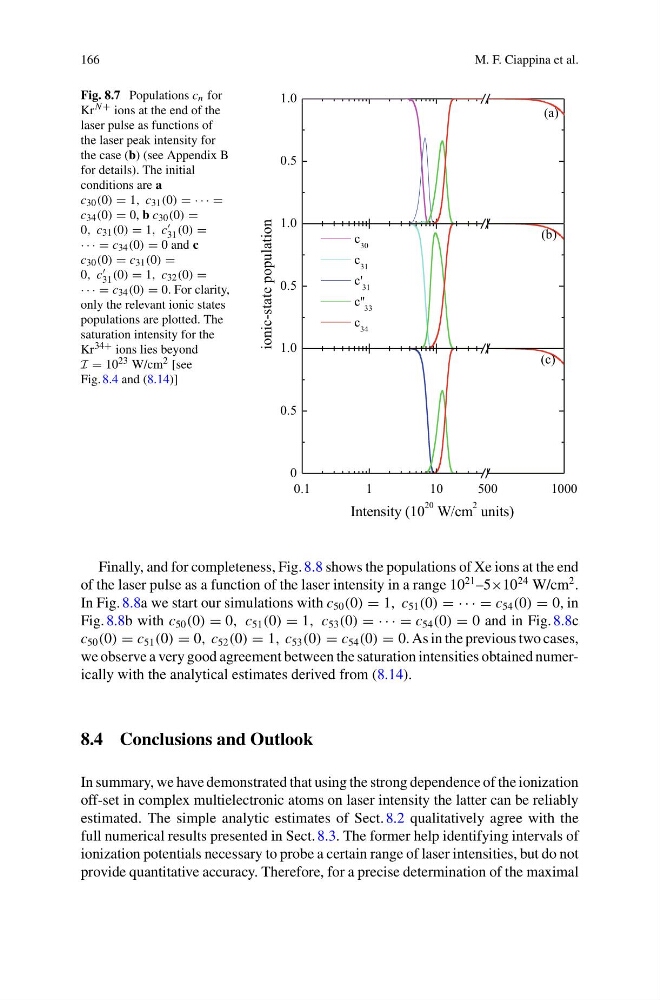
Fig. 8.7 Populations c n for
Kr N + ions at the end of the
laser pulse as functions of
the laser peak intensity for
the case (b) (see Appendix B
for details). The initial
conditions are a
c 30 (0) = 1, c 31 (0) = · · · =
c 34 (0) = 0, b c 30 (0) =
0, c 31 (0) = 1, c
31 (0) =
· · · = c 34 (0) = 0 and c
c 30 (0) = c 31 (0) =
0, c
31 (0) = 1, c 32 (0) =
· · · = c 34 (0) = 0. For clarity,
only the relevant ionic states
populations are plotted. The
saturation intensity for the
Kr 34+ ions lies beyond
I = 10 23 W/cm 2 [see
Fig. 8.4 and (8.14)]
0.5
1.0
(c)
(b)
c 30
c 31
c' 31
c'' 33
c 34
(a)
0.5
1.0
0.1
1
10
500
1000
0
0.5
1.0
Intensity (10
20 W/cm
2 units)
ionic-state population
Finally, and for completeness, Fig. 8.8 shows the populations of Xe ions at the end
of the laser pulse as a function of the laser intensity in a range 10
21 –5×10
24 W/cm
2 .
In Fig. 8.8a we start our simulations with c 50 (0) = 1, c 51 (0) = · · · = c 54 (0) = 0, in
Fig. 8.8b with c 50 (0) = 0, c 51 (0) = 1, c 53 (0) = · · · = c 54 (0) = 0 and in Fig. 8.8c
c 50 (0) = c 51 (0) = 0, c 52 (0) = 1, c 53 (0) = c 54 (0) = 0. As in the previous two cases,
we observe a very good agreement between the saturation intensities obtained numerically with the analytical estimates derived from (8.14).
8.4 Conclusions and Outlook
In summary, we have demonstrated that using the strong dependence of the ionization
off-set in complex multielectronic atoms on laser intensity the latter can be reliably
estimated. The simple analytic estimates of Sect. 8.2 qualitatively agree with the
full numerical results presented in Sect. 8.3. The former help identifying intervals of
ionization potentials necessary to probe a certain range of laser intensities, but do not
provide quantitative accuracy. Therefore, for a precise determination of the maximal
M. F. Ciappina et al.
Fig. 8.7 Populations c n for
Kr N + ions at the end of the
laser pulse as functions of
the laser peak intensity for
the case (b) (see Appendix B
for details). The initial
conditions are a
c 30 (0) = 1, c 31 (0) = · · · =
c 34 (0) = 0, b c 30 (0) =
0, c 31 (0) = 1, c
31 (0) =
· · · = c 34 (0) = 0 and c
c 30 (0) = c 31 (0) =
0, c
31 (0) = 1, c 32 (0) =
· · · = c 34 (0) = 0. For clarity,
only the relevant ionic states
populations are plotted. The
saturation intensity for the
Kr 34+ ions lies beyond
I = 10 23 W/cm 2 [see
Fig. 8.4 and (8.14)]
0.5
1.0
(c)
(b)
c 30
c 31
c' 31
c'' 33
c 34
(a)
0.5
1.0
0.1
1
10
500
1000
0
0.5
1.0
Intensity (10
20 W/cm
2 units)
ionic-state population
Finally, and for completeness, Fig. 8.8 shows the populations of Xe ions at the end
of the laser pulse as a function of the laser intensity in a range 10
21 –5×10
24 W/cm
2 .
In Fig. 8.8a we start our simulations with c 50 (0) = 1, c 51 (0) = · · · = c 54 (0) = 0, in
Fig. 8.8b with c 50 (0) = 0, c 51 (0) = 1, c 53 (0) = · · · = c 54 (0) = 0 and in Fig. 8.8c
c 50 (0) = c 51 (0) = 0, c 52 (0) = 1, c 53 (0) = c 54 (0) = 0. As in the previous two cases,
we observe a very good agreement between the saturation intensities obtained numerically with the analytical estimates derived from (8.14).
8.4 Conclusions and Outlook
In summary, we have demonstrated that using the strong dependence of the ionization
off-set in complex multielectronic atoms on laser intensity the latter can be reliably
estimated. The simple analytic estimates of Sect. 8.2 qualitatively agree with the
full numerical results presented in Sect. 8.3. The former help identifying intervals of
ionization potentials necessary to probe a certain range of laser intensities, but do not
provide quantitative accuracy. Therefore, for a precise determination of the maximal