

8 Towards Laser Intensity Calibration Using High-Field Ionization
167
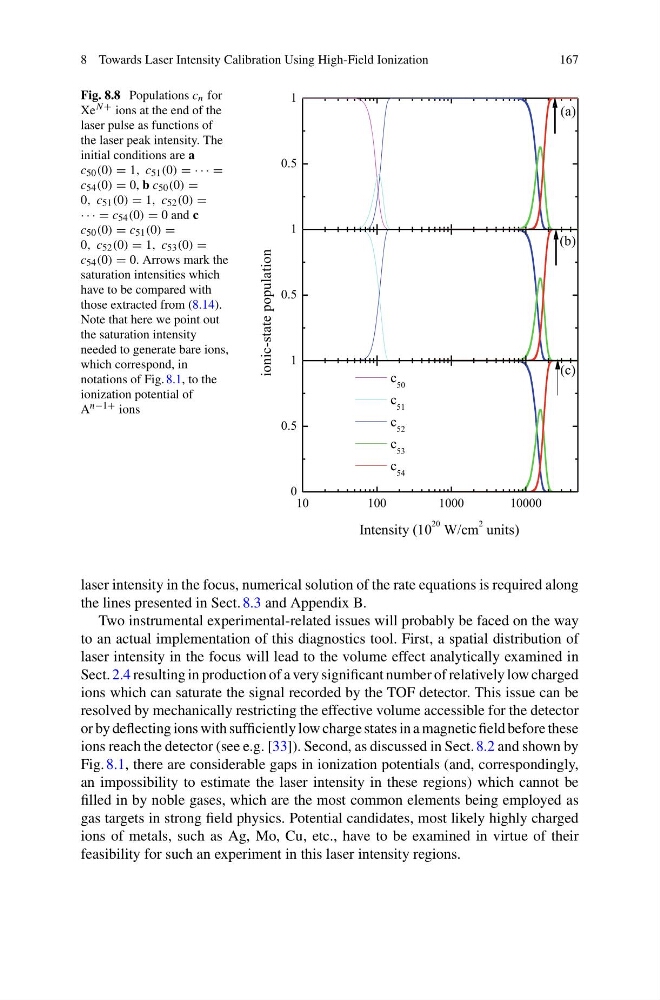
Fig. 8.8 Populations c n for
Xe N + ions at the end of the
laser pulse as functions of
the laser peak intensity. The
initial conditions are a
c 50 (0) = 1, c 51 (0) = · · · =
c 54 (0) = 0, b c 50 (0) =
0, c 51 (0) = 1, c 52 (0) =
· · · = c 54 (0) = 0 and c
c 50 (0) = c 51 (0) =
0, c 52 (0) = 1, c 53 (0) =
c 54 (0) = 0. Arrows mark the
saturation intensities which
have to be compared with
those extracted from (8.14).
Note that here we point out
the saturation intensity
needed to generate bare ions,
which correspond, in
notations of Fig. 8.1, to the
ionization potential of
A n−1+ ions
0.5
1
(c)
(b)
c 50
c 51
c 52
c 53
c 54
(a)
0.5
1
ionic-state population
10
100
1000
10000
0
0.5
1
Intensity (10
20 W/cm
2 units)
laser intensity in the focus, numerical solution of the rate equations is required along
the lines presented in Sect. 8.3 and Appendix B.
Two instrumental experimental-related issues will probably be faced on the way
to an actual implementation of this diagnostics tool. First, a spatial distribution of
laser intensity in the focus will lead to the volume effect analytically examined in
Sect. 2.4 resulting in production of a very significant number of relatively low charged
ions which can saturate the signal recorded by the TOF detector. This issue can be
resolved by mechanically restricting the effective volume accessible for the detector
or by deflecting ions with sufficiently low charge states in a magnetic field before these
ions reach the detector (see e.g. [33]). Second, as discussed in Sect. 8.2 and shown by
Fig. 8.1, there are considerable gaps in ionization potentials (and, correspondingly,
an impossibility to estimate the laser intensity in these regions) which cannot be
filled in by noble gases, which are the most common elements being employed as
gas targets in strong field physics. Potential candidates, most likely highly charged
ions of metals, such as Ag, Mo, Cu, etc., have to be examined in virtue of their
feasibility for such an experiment in this laser intensity regions.
167
Fig. 8.8 Populations c n for
Xe N + ions at the end of the
laser pulse as functions of
the laser peak intensity. The
initial conditions are a
c 50 (0) = 1, c 51 (0) = · · · =
c 54 (0) = 0, b c 50 (0) =
0, c 51 (0) = 1, c 52 (0) =
· · · = c 54 (0) = 0 and c
c 50 (0) = c 51 (0) =
0, c 52 (0) = 1, c 53 (0) =
c 54 (0) = 0. Arrows mark the
saturation intensities which
have to be compared with
those extracted from (8.14).
Note that here we point out
the saturation intensity
needed to generate bare ions,
which correspond, in
notations of Fig. 8.1, to the
ionization potential of
A n−1+ ions
0.5
1
(c)
(b)
c 50
c 51
c 52
c 53
c 54
(a)
0.5
1
ionic-state population
10
100
1000
10000
0
0.5
1
Intensity (10
20 W/cm
2 units)
laser intensity in the focus, numerical solution of the rate equations is required along
the lines presented in Sect. 8.3 and Appendix B.
Two instrumental experimental-related issues will probably be faced on the way
to an actual implementation of this diagnostics tool. First, a spatial distribution of
laser intensity in the focus will lead to the volume effect analytically examined in
Sect. 2.4 resulting in production of a very significant number of relatively low charged
ions which can saturate the signal recorded by the TOF detector. This issue can be
resolved by mechanically restricting the effective volume accessible for the detector
or by deflecting ions with sufficiently low charge states in a magnetic field before these
ions reach the detector (see e.g. [33]). Second, as discussed in Sect. 8.2 and shown by
Fig. 8.1, there are considerable gaps in ionization potentials (and, correspondingly,
an impossibility to estimate the laser intensity in these regions) which cannot be
filled in by noble gases, which are the most common elements being employed as
gas targets in strong field physics. Potential candidates, most likely highly charged
ions of metals, such as Ag, Mo, Cu, etc., have to be examined in virtue of their
feasibility for such an experiment in this laser intensity regions.