

164
M. F. Ciappina et al.
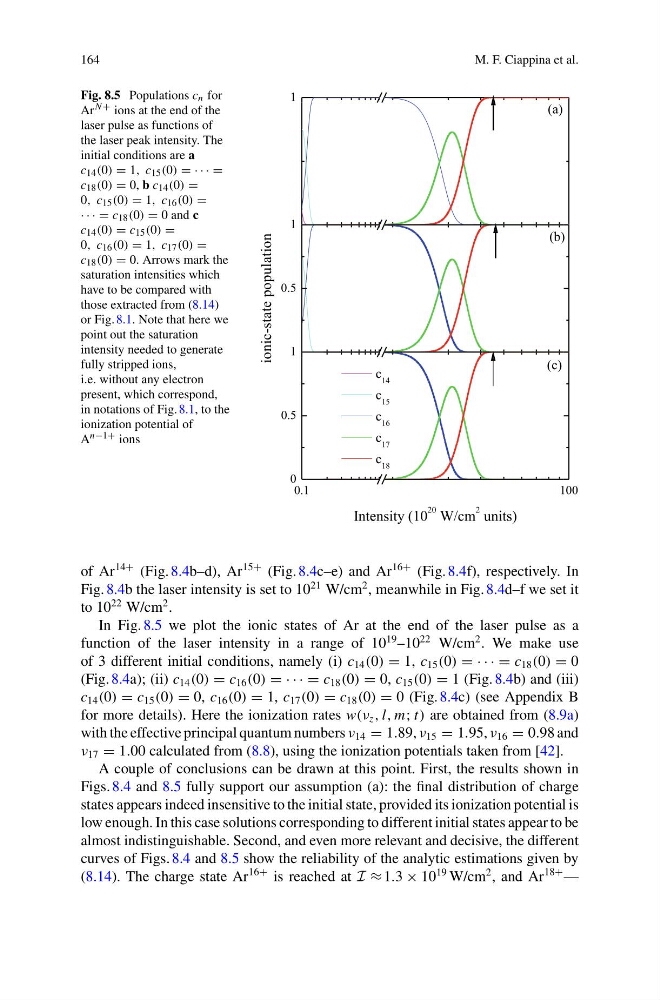
Fig. 8.5 Populations c n for
Ar N + ions at the end of the
laser pulse as functions of
the laser peak intensity. The
initial conditions are a
c 14 (0) = 1, c 15 (0) = · · · =
c 18 (0) = 0, b c 14 (0) =
0, c 15 (0) = 1, c 16 (0) =
· · · = c 18 (0) = 0 and c
c 14 (0) = c 15 (0) =
0, c 16 (0) = 1, c 17 (0) =
c 18 (0) = 0. Arrows mark the
saturation intensities which
have to be compared with
those extracted from (8.14)
or Fig. 8.1. Note that here we
point out the saturation
intensity needed to generate
fully stripped ions,
i.e. without any electron
present, which correspond,
in notations of Fig. 8.1, to the
ionization potential of
A n−1+ ions
1
(c)
(b)
c 14
c 15
c 16
c 17
c 18
(a)
0.5
1
ionic-state population
0.1
100
0
0.5
1
Intensity (10
20 W/cm
2 units)
of Ar
14+ (Fig. 8.4b–d), Ar
15+ (Fig. 8.4c–e) and Ar
16+ (Fig. 8.4f), respectively. In
Fig. 8.4b the laser intensity is set to 10
21 W/cm
2 , meanwhile in Fig. 8.4d–f we set it
to 10
22 W/cm
2 .
In Fig. 8.5 we plot the ionic states of Ar at the end of the laser pulse as a
function of the laser intensity in a range of 10
19 –10
22 W/cm
2 . We make use
of 3 different initial conditions, namely (i) c 14 (0) = 1, c 15 (0) = · · · = c 18 (0) = 0
(Fig. 8.4a); (ii) c 14 (0) = c 16 (0) = · · · = c 18 (0) = 0, c 15 (0) = 1 (Fig. 8.4b) and (iii)
c 14 (0) = c 15 (0) = 0, c 16 (0) = 1, c 17 (0) = c 18 (0) = 0 (Fig. 8.4c) (see Appendix B
for more details). Here the ionization rates w(ν z , l, m; t) are obtained from (8.9a)
with the effective principal quantum numbers ν 14 = 1.89, ν 15 = 1.95, ν 16 = 0.98 and
ν 17 = 1.00 calculated from (8.8), using the ionization potentials taken from [42].
A couple of conclusions can be drawn at this point. First, the results shown in
Figs. 8.4 and 8.5 fully support our assumption (a): the final distribution of charge
states appears indeed insensitive to the initial state, provided its ionization potential is
low enough. In this case solutions corresponding to different initial states appear to be
almost indistinguishable. Second, and even more relevant and decisive, the different
curves of Figs. 8.4 and 8.5 show the reliability of the analytic estimations given by
(8.14). The charge state Ar
16+ is reached at I ≈ 1.3 × 10
19 W/cm
2 , and Ar
18+ —
M. F. Ciappina et al.
Fig. 8.5 Populations c n for
Ar N + ions at the end of the
laser pulse as functions of
the laser peak intensity. The
initial conditions are a
c 14 (0) = 1, c 15 (0) = · · · =
c 18 (0) = 0, b c 14 (0) =
0, c 15 (0) = 1, c 16 (0) =
· · · = c 18 (0) = 0 and c
c 14 (0) = c 15 (0) =
0, c 16 (0) = 1, c 17 (0) =
c 18 (0) = 0. Arrows mark the
saturation intensities which
have to be compared with
those extracted from (8.14)
or Fig. 8.1. Note that here we
point out the saturation
intensity needed to generate
fully stripped ions,
i.e. without any electron
present, which correspond,
in notations of Fig. 8.1, to the
ionization potential of
A n−1+ ions
1
(c)
(b)
c 14
c 15
c 16
c 17
c 18
(a)
0.5
1
ionic-state population
0.1
100
0
0.5
1
Intensity (10
20 W/cm
2 units)
of Ar
14+ (Fig. 8.4b–d), Ar
15+ (Fig. 8.4c–e) and Ar
16+ (Fig. 8.4f), respectively. In
Fig. 8.4b the laser intensity is set to 10
21 W/cm
2 , meanwhile in Fig. 8.4d–f we set it
to 10
22 W/cm
2 .
In Fig. 8.5 we plot the ionic states of Ar at the end of the laser pulse as a
function of the laser intensity in a range of 10
19 –10
22 W/cm
2 . We make use
of 3 different initial conditions, namely (i) c 14 (0) = 1, c 15 (0) = · · · = c 18 (0) = 0
(Fig. 8.4a); (ii) c 14 (0) = c 16 (0) = · · · = c 18 (0) = 0, c 15 (0) = 1 (Fig. 8.4b) and (iii)
c 14 (0) = c 15 (0) = 0, c 16 (0) = 1, c 17 (0) = c 18 (0) = 0 (Fig. 8.4c) (see Appendix B
for more details). Here the ionization rates w(ν z , l, m; t) are obtained from (8.9a)
with the effective principal quantum numbers ν 14 = 1.89, ν 15 = 1.95, ν 16 = 0.98 and
ν 17 = 1.00 calculated from (8.8), using the ionization potentials taken from [42].
A couple of conclusions can be drawn at this point. First, the results shown in
Figs. 8.4 and 8.5 fully support our assumption (a): the final distribution of charge
states appears indeed insensitive to the initial state, provided its ionization potential is
low enough. In this case solutions corresponding to different initial states appear to be
almost indistinguishable. Second, and even more relevant and decisive, the different
curves of Figs. 8.4 and 8.5 show the reliability of the analytic estimations given by
(8.14). The charge state Ar
16+ is reached at I ≈ 1.3 × 10
19 W/cm
2 , and Ar
18+ —