

8 Towards Laser Intensity Calibration Using High-Field Ionization
163
-200
-100
0
100
200
(f)
(e)
(d)
E(t) (a.u.)
(c)
(b)
(a)
10
-2
10
-1
1
10
-3
10
-2
10
-1
1
I=10
22 W/cm
2
I=10
22 W/cm
2
I=10
22 W/cm
2
I=10
21 W/cm
2
c 14
c 15
c 16
c 17
c 18
I=10
21 W/cm
2
10
-2
10
-1
1
0
200
400
600
800 1000 1200 1400
10
-3
10
-2
10
-1
1
ionic-state population
Time (a.u.)
0
200
400
600
800 1000 1200 1400
10
-3
10
-2
10
-1
1
ionic-state population
Time (a.u.)
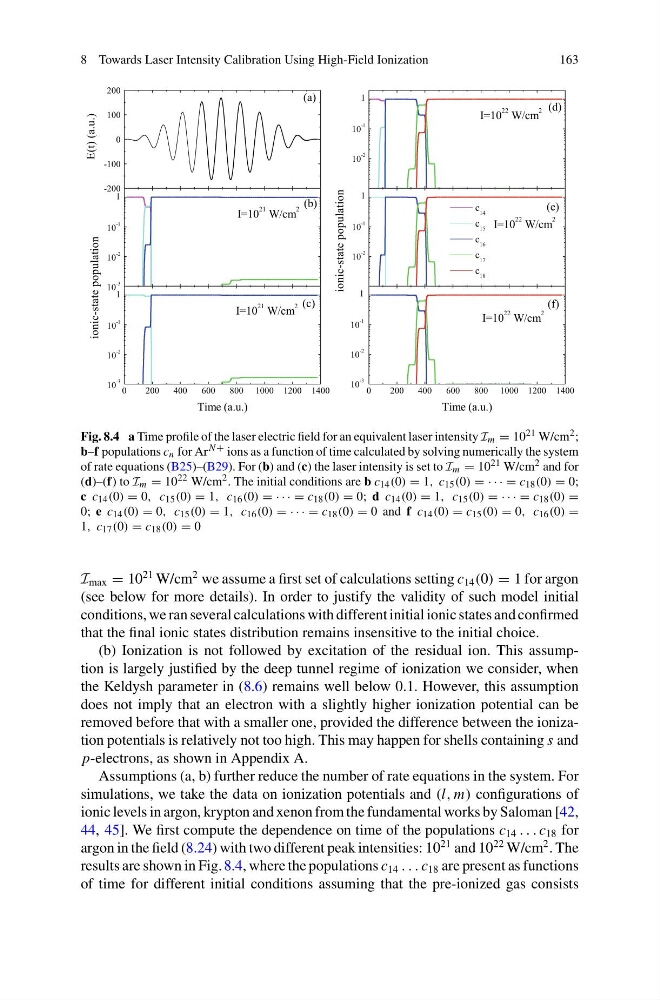
Fig. 8.4 a Time profile of the laser electric field for an equivalent laser intensity I m = 10 21 W/cm 2 ;
b–f populations c n for Ar N + ions as a function of time calculated by solving numerically the system
of rate equations (B25)–(B29). For (b) and (c) the laser intensity is set to I m = 10 21 W/cm 2 and for
(d)–(f) to I m = 10 22 W/cm 2 . The initial conditions are b c 14 (0) = 1, c 15 (0) = · · · = c 18 (0) = 0;
c c 14 (0) = 0, c 15 (0) = 1, c 16 (0) = · · · = c 18 (0) = 0; d c 14 (0) = 1, c 15 (0) = · · · = c 18 (0) =
0; e c 14 (0) = 0, c 15 (0) = 1, c 16 (0) = · · · = c 18 (0) = 0 and f c 14 (0) = c 15 (0) = 0, c 16 (0) =
1, c 17 (0) = c 18 (0) = 0
I max = 10
21 W/cm
2 we assume a first set of calculations setting c 14 (0) = 1 for argon
(see below for more details). In order to justify the validity of such model initial
conditions, we ran several calculations with different initial ionic states and confirmed
that the final ionic states distribution remains insensitive to the initial choice.
(b) Ionization is not followed by excitation of the residual ion. This assumption is largely justified by the deep tunnel regime of ionization we consider, when
the Keldysh parameter in (8.6) remains well below 0.1. However, this assumption
does not imply that an electron with a slightly higher ionization potential can be
removed before that with a smaller one, provided the difference between the ionization potentials is relatively not too high. This may happen for shells containing s and
p-electrons, as shown in Appendix A.
Assumptions (a, b) further reduce the number of rate equations in the system. For
simulations, we take the data on ionization potentials and (l, m) configurations of
ionic levels in argon, krypton and xenon from the fundamental works by Saloman [42,
44, 45]. We first compute the dependence on time of the populations c 14 . . . c 18 for
argon in the field (8.24) with two different peak intensities: 10
21 and 10
22 W/cm
2 . The
results are shown in Fig. 8.4, where the populations c 14 . . . c 18 are present as functions
of time for different initial conditions assuming that the pre-ionized gas consists
163
-200
-100
0
100
200
(f)
(e)
(d)
E(t) (a.u.)
(c)
(b)
(a)
10
-2
10
-1
1
10
-3
10
-2
10
-1
1
I=10
22 W/cm
2
I=10
22 W/cm
2
I=10
22 W/cm
2
I=10
21 W/cm
2
c 14
c 15
c 16
c 17
c 18
I=10
21 W/cm
2
10
-2
10
-1
1
0
200
400
600
800 1000 1200 1400
10
-3
10
-2
10
-1
1
ionic-state population
Time (a.u.)
0
200
400
600
800 1000 1200 1400
10
-3
10
-2
10
-1
1
ionic-state population
Time (a.u.)
Fig. 8.4 a Time profile of the laser electric field for an equivalent laser intensity I m = 10 21 W/cm 2 ;
b–f populations c n for Ar N + ions as a function of time calculated by solving numerically the system
of rate equations (B25)–(B29). For (b) and (c) the laser intensity is set to I m = 10 21 W/cm 2 and for
(d)–(f) to I m = 10 22 W/cm 2 . The initial conditions are b c 14 (0) = 1, c 15 (0) = · · · = c 18 (0) = 0;
c c 14 (0) = 0, c 15 (0) = 1, c 16 (0) = · · · = c 18 (0) = 0; d c 14 (0) = 1, c 15 (0) = · · · = c 18 (0) =
0; e c 14 (0) = 0, c 15 (0) = 1, c 16 (0) = · · · = c 18 (0) = 0 and f c 14 (0) = c 15 (0) = 0, c 16 (0) =
1, c 17 (0) = c 18 (0) = 0
I max = 10
21 W/cm
2 we assume a first set of calculations setting c 14 (0) = 1 for argon
(see below for more details). In order to justify the validity of such model initial
conditions, we ran several calculations with different initial ionic states and confirmed
that the final ionic states distribution remains insensitive to the initial choice.
(b) Ionization is not followed by excitation of the residual ion. This assumption is largely justified by the deep tunnel regime of ionization we consider, when
the Keldysh parameter in (8.6) remains well below 0.1. However, this assumption
does not imply that an electron with a slightly higher ionization potential can be
removed before that with a smaller one, provided the difference between the ionization potentials is relatively not too high. This may happen for shells containing s and
p-electrons, as shown in Appendix A.
Assumptions (a, b) further reduce the number of rate equations in the system. For
simulations, we take the data on ionization potentials and (l, m) configurations of
ionic levels in argon, krypton and xenon from the fundamental works by Saloman [42,
44, 45]. We first compute the dependence on time of the populations c 14 . . . c 18 for
argon in the field (8.24) with two different peak intensities: 10
21 and 10
22 W/cm
2 . The
results are shown in Fig. 8.4, where the populations c 14 . . . c 18 are present as functions
of time for different initial conditions assuming that the pre-ionized gas consists