

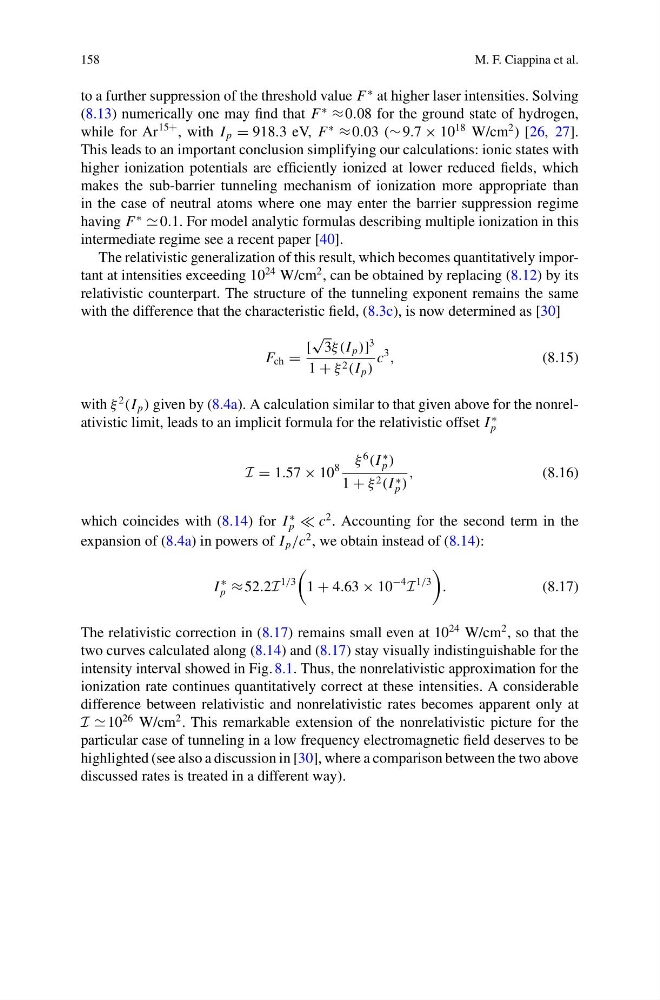
158
M. F. Ciappina et al.
to a further suppression of the threshold value F
∗ at higher laser intensities. Solving
(8.13) numerically one may find that F
∗
≈ 0.08 for the ground state of hydrogen,
while for Ar
15+ , with I p = 918.3 eV, F
∗
≈ 0.03 (∼ 9.7 × 10
18 W/cm
2 ) [26, 27].
This leads to an important conclusion simplifying our calculations: ionic states with
higher ionization potentials are efficiently ionized at lower reduced fields, which
makes the sub-barrier tunneling mechanism of ionization more appropriate than
in the case of neutral atoms where one may enter the barrier suppression regime
having F
∗
0.1. For model analytic formulas describing multiple ionization in this
intermediate regime see a recent paper [40].
The relativistic generalization of this result, which becomes quantitatively important at intensities exceeding 10
24 W/cm
2 , can be obtained by replacing (8.12) by its
relativistic counterpart. The structure of the tunneling exponent remains the same
with the difference that the characteristic field, (8.3c), is now determined as [30]
F ch =
[
√
3ξ(I p )]
3
1 + ξ 2 (I p )
c
3
,
(8.15)
with ξ
2
(I p ) given by (8.4a). A calculation similar to that given above for the nonrelativistic limit, leads to an implicit formula for the relativistic offset I
∗
p
I = 1.57 × 10
8
ξ
6
(I
∗
p )
1 + ξ 2 (I ∗
p )
,
(8.16)
which coincides with (8.14) for I
∗
p c
2 . Accounting for the second term in the
expansion of (8.4a) in powers of I p /c
2 , we obtain instead of (8.14):
I
∗
p ≈ 52.2I
1/3
1 + 4.63 × 10
−4
I
1/3
.
(8.17)
The relativistic correction in (8.17) remains small even at 10
24 W/cm
2 , so that the
two curves calculated along (8.14) and (8.17) stay visually indistinguishable for the
intensity interval showed in Fig. 8.1. Thus, the nonrelativistic approximation for the
ionization rate continues quantitatively correct at these intensities. A considerable
difference between relativistic and nonrelativistic rates becomes apparent only at
I 10
26 W/cm
2 . This remarkable extension of the nonrelativistic picture for the
particular case of tunneling in a low frequency electromagnetic field deserves to be
highlighted (see also a discussion in [30], where a comparison between the two above
discussed rates is treated in a different way).
M. F. Ciappina et al.
to a further suppression of the threshold value F
∗ at higher laser intensities. Solving
(8.13) numerically one may find that F
∗
≈ 0.08 for the ground state of hydrogen,
while for Ar
15+ , with I p = 918.3 eV, F
∗
≈ 0.03 (∼ 9.7 × 10
18 W/cm
2 ) [26, 27].
This leads to an important conclusion simplifying our calculations: ionic states with
higher ionization potentials are efficiently ionized at lower reduced fields, which
makes the sub-barrier tunneling mechanism of ionization more appropriate than
in the case of neutral atoms where one may enter the barrier suppression regime
having F
∗
0.1. For model analytic formulas describing multiple ionization in this
intermediate regime see a recent paper [40].
The relativistic generalization of this result, which becomes quantitatively important at intensities exceeding 10
24 W/cm
2 , can be obtained by replacing (8.12) by its
relativistic counterpart. The structure of the tunneling exponent remains the same
with the difference that the characteristic field, (8.3c), is now determined as [30]
F ch =
[
√
3ξ(I p )]
3
1 + ξ 2 (I p )
c
3
,
(8.15)
with ξ
2
(I p ) given by (8.4a). A calculation similar to that given above for the nonrelativistic limit, leads to an implicit formula for the relativistic offset I
∗
p
I = 1.57 × 10
8
ξ
6
(I
∗
p )
1 + ξ 2 (I ∗
p )
,
(8.16)
which coincides with (8.14) for I
∗
p c
2 . Accounting for the second term in the
expansion of (8.4a) in powers of I p /c
2 , we obtain instead of (8.14):
I
∗
p ≈ 52.2I
1/3
1 + 4.63 × 10
−4
I
1/3
.
(8.17)
The relativistic correction in (8.17) remains small even at 10
24 W/cm
2 , so that the
two curves calculated along (8.14) and (8.17) stay visually indistinguishable for the
intensity interval showed in Fig. 8.1. Thus, the nonrelativistic approximation for the
ionization rate continues quantitatively correct at these intensities. A considerable
difference between relativistic and nonrelativistic rates becomes apparent only at
I 10
26 W/cm
2 . This remarkable extension of the nonrelativistic picture for the
particular case of tunneling in a low frequency electromagnetic field deserves to be
highlighted (see also a discussion in [30], where a comparison between the two above
discussed rates is treated in a different way).