

142
M. Kanasaki et al.
7.3 Application of CR-39 Detectors to Measurements of
Laser-Accelerated Ions
Utilizing the explained analysis methods for etch pits in CR-39 detectors, this section
introduces the application of CR-39 detectors to measurements of laser-accelerated
ions from a cluster-gas target based on a previously published paper by the authors’
group [25].
7.3.1 Experiments
Laser-driven ion acceleration experiments using a cluster-gas target have been conducted with the J-KAREN laser at the Kansai Photon Science Institute (KPSI). JKAREN is an intense Ti:sapphire laser system that utilizes the optical parametric
chirped pulse amplification (OPCPA) technique [26]. In the present experiment, 40
fs pulses with a pulse energy of 1 J were delivered to the experimental chamber.
The laser pulses were focused with an off-axis parabolic mirror with focal length of
475 mm, leading to a peak intensity of 1 × 10
19 W/cm
2 in vacuum. The cluster-gas
target was produced by expanding a 6 MPa mixture of 70% H 2 and 30% CO 2 gas
into vacuum using a pulsed valve connected with a special nozzle consisting of three
truncated cones with different apex angles [27]. The nozzle has the capability to
produce CO 2 clusters with an average diameter of 250 nm [28]. The laser beam was
focused at the centre and entrance of the gas jet, 1.5 mm above the nozzle orifice.
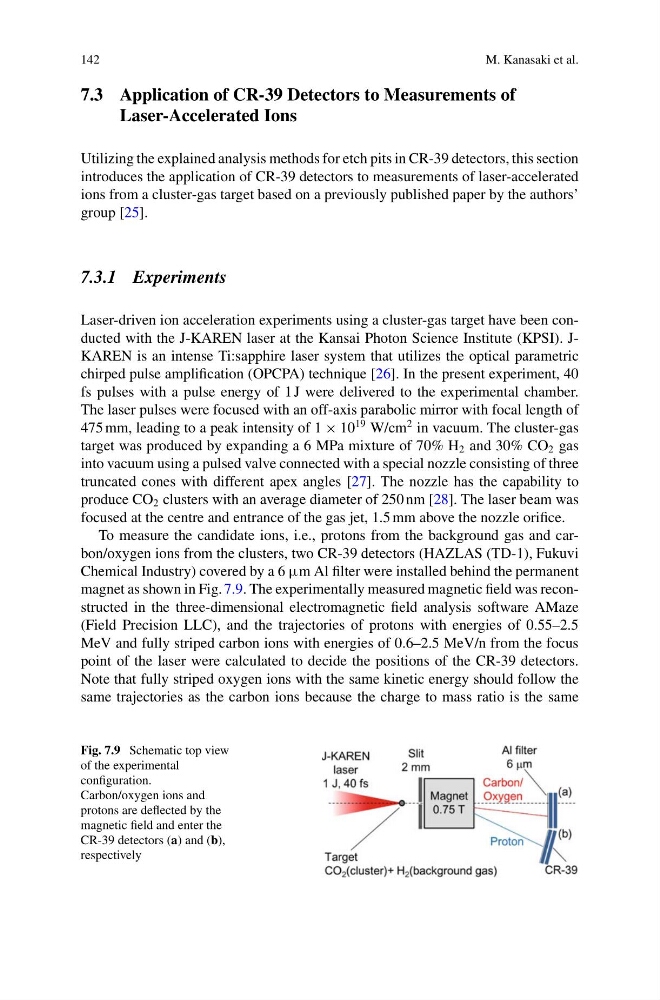
To measure the candidate ions, i.e., protons from the background gas and carbon/oxygen ions from the clusters, two CR-39 detectors (HAZLAS (TD-1), Fukuvi
Chemical Industry) covered by a 6 µm Al filter were installed behind the permanent
magnet as shown in Fig. 7.9. The experimentally measured magnetic field was reconstructed in the three-dimensional electromagnetic field analysis software AMaze
(Field Precision LLC), and the trajectories of protons with energies of 0.55–2.5
MeV and fully striped carbon ions with energies of 0.6–2.5 MeV/n from the focus
point of the laser were calculated to decide the positions of the CR-39 detectors.
Note that fully striped oxygen ions with the same kinetic energy should follow the
same trajectories as the carbon ions because the charge to mass ratio is the same
Fig. 7.9 Schematic top view
of the experimental
configuration.
Carbon/oxygen ions and
protons are deflected by the
magnetic field and enter the
CR-39 detectors (a) and (b),
respectively
M. Kanasaki et al.
7.3 Application of CR-39 Detectors to Measurements of
Laser-Accelerated Ions
Utilizing the explained analysis methods for etch pits in CR-39 detectors, this section
introduces the application of CR-39 detectors to measurements of laser-accelerated
ions from a cluster-gas target based on a previously published paper by the authors’
group [25].
7.3.1 Experiments
Laser-driven ion acceleration experiments using a cluster-gas target have been conducted with the J-KAREN laser at the Kansai Photon Science Institute (KPSI). JKAREN is an intense Ti:sapphire laser system that utilizes the optical parametric
chirped pulse amplification (OPCPA) technique [26]. In the present experiment, 40
fs pulses with a pulse energy of 1 J were delivered to the experimental chamber.
The laser pulses were focused with an off-axis parabolic mirror with focal length of
475 mm, leading to a peak intensity of 1 × 10
19 W/cm
2 in vacuum. The cluster-gas
target was produced by expanding a 6 MPa mixture of 70% H 2 and 30% CO 2 gas
into vacuum using a pulsed valve connected with a special nozzle consisting of three
truncated cones with different apex angles [27]. The nozzle has the capability to
produce CO 2 clusters with an average diameter of 250 nm [28]. The laser beam was
focused at the centre and entrance of the gas jet, 1.5 mm above the nozzle orifice.
To measure the candidate ions, i.e., protons from the background gas and carbon/oxygen ions from the clusters, two CR-39 detectors (HAZLAS (TD-1), Fukuvi
Chemical Industry) covered by a 6 µm Al filter were installed behind the permanent
magnet as shown in Fig. 7.9. The experimentally measured magnetic field was reconstructed in the three-dimensional electromagnetic field analysis software AMaze
(Field Precision LLC), and the trajectories of protons with energies of 0.55–2.5
MeV and fully striped carbon ions with energies of 0.6–2.5 MeV/n from the focus
point of the laser were calculated to decide the positions of the CR-39 detectors.
Note that fully striped oxygen ions with the same kinetic energy should follow the
same trajectories as the carbon ions because the charge to mass ratio is the same
Fig. 7.9 Schematic top view
of the experimental
configuration.
Carbon/oxygen ions and
protons are deflected by the
magnetic field and enter the
CR-39 detectors (a) and (b),
respectively