

6 Coherent Control of Nonadiabatic Dynamics of Electron-Phonon …
125
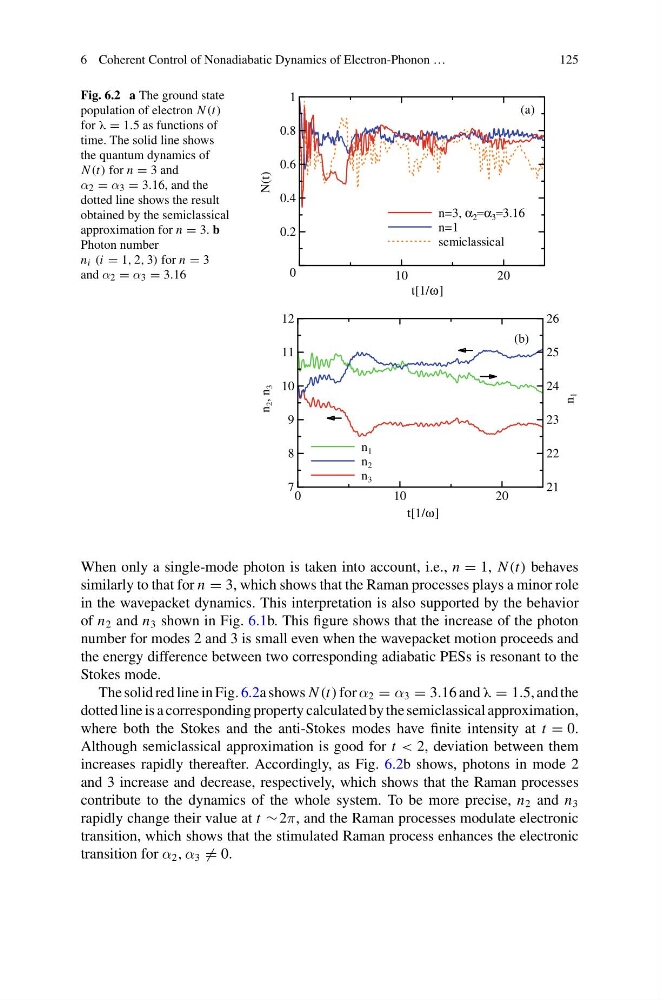
Fig. 6.2 a The ground state
population of electron N (t)
for λ = 1.5 as functions of
time. The solid line shows
the quantum dynamics of
N (t) for n = 3 and
α 2 = α 3 = 3.16, and the
dotted line shows the result
obtained by the semiclassical
approximation for n = 3. b
Photon number
n i (i = 1, 2, 3) for n = 3
and α 2 = α 3 = 3.16
t[1/ω]
n=3, α 2 =α 3 =3.16
n=1
semiclassical
(a)
N(t)
0
10
20
0.2
0.4
0.6
0.8
1
t[1/ω]
(b)
n
2 , n
3
n
1
n 1
n 2
n 3
0
10
20
7
8
9
10
11
12
21
22
23
24
25
26
When only a single-mode photon is taken into account, i.e., n = 1, N (t) behaves
similarly to that for n = 3, which shows that the Raman processes plays a minor role
in the wavepacket dynamics. This interpretation is also supported by the behavior
of n 2 and n 3 shown in Fig. 6.1b. This figure shows that the increase of the photon
number for modes 2 and 3 is small even when the wavepacket motion proceeds and
the energy difference between two corresponding adiabatic PESs is resonant to the
Stokes mode.
The solid red line in Fig. 6.2a shows N (t) for α 2 = α 3 = 3.16 and λ = 1.5, and the
dotted line is a corresponding property calculated by the semiclassical approximation,
where both the Stokes and the anti-Stokes modes have finite intensity at t = 0.
Although semiclassical approximation is good for t < 2, deviation between them
increases rapidly thereafter. Accordingly, as Fig. 6.2b shows, photons in mode 2
and 3 increase and decrease, respectively, which shows that the Raman processes
contribute to the dynamics of the whole system. To be more precise, n 2 and n 3
rapidly change their value at t ∼ 2π, and the Raman processes modulate electronic
transition, which shows that the stimulated Raman process enhances the electronic
transition for α 2 , α 3 = 0.
125
Fig. 6.2 a The ground state
population of electron N (t)
for λ = 1.5 as functions of
time. The solid line shows
the quantum dynamics of
N (t) for n = 3 and
α 2 = α 3 = 3.16, and the
dotted line shows the result
obtained by the semiclassical
approximation for n = 3. b
Photon number
n i (i = 1, 2, 3) for n = 3
and α 2 = α 3 = 3.16
t[1/ω]
n=3, α 2 =α 3 =3.16
n=1
semiclassical
(a)
N(t)
0
10
20
0.2
0.4
0.6
0.8
1
t[1/ω]
(b)
n
2 , n
3
n
1
n 1
n 2
n 3
0
10
20
7
8
9
10
11
12
21
22
23
24
25
26
When only a single-mode photon is taken into account, i.e., n = 1, N (t) behaves
similarly to that for n = 3, which shows that the Raman processes plays a minor role
in the wavepacket dynamics. This interpretation is also supported by the behavior
of n 2 and n 3 shown in Fig. 6.1b. This figure shows that the increase of the photon
number for modes 2 and 3 is small even when the wavepacket motion proceeds and
the energy difference between two corresponding adiabatic PESs is resonant to the
Stokes mode.
The solid red line in Fig. 6.2a shows N (t) for α 2 = α 3 = 3.16 and λ = 1.5, and the
dotted line is a corresponding property calculated by the semiclassical approximation,
where both the Stokes and the anti-Stokes modes have finite intensity at t = 0.
Although semiclassical approximation is good for t < 2, deviation between them
increases rapidly thereafter. Accordingly, as Fig. 6.2b shows, photons in mode 2
and 3 increase and decrease, respectively, which shows that the Raman processes
contribute to the dynamics of the whole system. To be more precise, n 2 and n 3
rapidly change their value at t ∼ 2π, and the Raman processes modulate electronic
transition, which shows that the stimulated Raman process enhances the electronic
transition for α 2 , α 3 = 0.