

126
K. Ishida
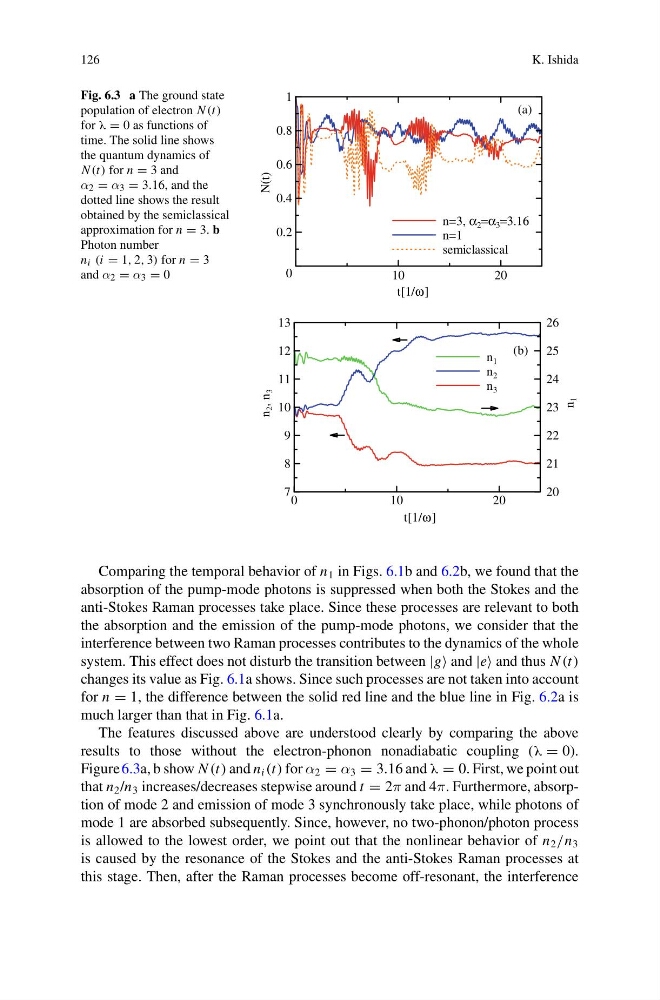
Fig. 6.3 a The ground state
population of electron N (t)
for λ = 0 as functions of
time. The solid line shows
the quantum dynamics of
N (t) for n = 3 and
α 2 = α 3 = 3.16, and the
dotted line shows the result
obtained by the semiclassical
approximation for n = 3. b
Photon number
n i (i = 1, 2, 3) for n = 3
and α 2 = α 3 = 0
t[1/ω]
n=3, α 2 =α 3 =3.16
n=1
semiclassical
(a)
N(t)
0
10
20
0.2
0.4
0.6
0.8
1
t[1/ω]
(b)
n
2 , n
3
n
1
n 1
n 2
n 3
0
1 0
2 0
7
8
9
10
11
12
13
20
21
22
23
24
25
26
Comparing the temporal behavior of n 1 in Figs. 6.1b and 6.2b, we found that the
absorption of the pump-mode photons is suppressed when both the Stokes and the
anti-Stokes Raman processes take place. Since these processes are relevant to both
the absorption and the emission of the pump-mode photons, we consider that the
interference between two Raman processes contributes to the dynamics of the whole
system. This effect does not disturb the transition between |g and |e and thus N (t)
changes its value as Fig. 6.1a shows. Since such processes are not taken into account
for n = 1, the difference between the solid red line and the blue line in Fig. 6.2a is
much larger than that in Fig. 6.1a.
The features discussed above are understood clearly by comparing the above
results to those without the electron-phonon nonadiabatic coupling (λ = 0).
Figure 6.3a, b show N (t) and n i (t) for α 2 = α 3 = 3.16 and λ = 0. First, we point out
that n 2 /n 3 increases/decreases stepwise around t = 2π and 4π. Furthermore, absorption of mode 2 and emission of mode 3 synchronously take place, while photons of
mode 1 are absorbed subsequently. Since, however, no two-phonon/photon process
is allowed to the lowest order, we point out that the nonlinear behavior of n 2 /n 3
is caused by the resonance of the Stokes and the anti-Stokes Raman processes at
this stage. Then, after the Raman processes become off-resonant, the interference
K. Ishida
Fig. 6.3 a The ground state
population of electron N (t)
for λ = 0 as functions of
time. The solid line shows
the quantum dynamics of
N (t) for n = 3 and
α 2 = α 3 = 3.16, and the
dotted line shows the result
obtained by the semiclassical
approximation for n = 3. b
Photon number
n i (i = 1, 2, 3) for n = 3
and α 2 = α 3 = 0
t[1/ω]
n=3, α 2 =α 3 =3.16
n=1
semiclassical
(a)
N(t)
0
10
20
0.2
0.4
0.6
0.8
1
t[1/ω]
(b)
n
2 , n
3
n
1
n 1
n 2
n 3
0
1 0
2 0
7
8
9
10
11
12
13
20
21
22
23
24
25
26
Comparing the temporal behavior of n 1 in Figs. 6.1b and 6.2b, we found that the
absorption of the pump-mode photons is suppressed when both the Stokes and the
anti-Stokes Raman processes take place. Since these processes are relevant to both
the absorption and the emission of the pump-mode photons, we consider that the
interference between two Raman processes contributes to the dynamics of the whole
system. This effect does not disturb the transition between |g and |e and thus N (t)
changes its value as Fig. 6.1a shows. Since such processes are not taken into account
for n = 1, the difference between the solid red line and the blue line in Fig. 6.2a is
much larger than that in Fig. 6.1a.
The features discussed above are understood clearly by comparing the above
results to those without the electron-phonon nonadiabatic coupling (λ = 0).
Figure 6.3a, b show N (t) and n i (t) for α 2 = α 3 = 3.16 and λ = 0. First, we point out
that n 2 /n 3 increases/decreases stepwise around t = 2π and 4π. Furthermore, absorption of mode 2 and emission of mode 3 synchronously take place, while photons of
mode 1 are absorbed subsequently. Since, however, no two-phonon/photon process
is allowed to the lowest order, we point out that the nonlinear behavior of n 2 /n 3
is caused by the resonance of the Stokes and the anti-Stokes Raman processes at
this stage. Then, after the Raman processes become off-resonant, the interference