

124
K. Ishida
( 1 = 13.5). Mode 2 (Stokes mode; 2 = 12.5) and mode 3 (anti-Stokes mode;
3 = 14.5) are taken into account in the latter case.
While the internal vibration mode of the material system is always quantized in
the present study, we also calculated the dynamics of the material system treating the
electromagnetic field as a classical external field for reference, and call this method
a semiclassical approximation in the rest of the paper.
6.3 Calculated Results
Since our interest lies in the dynamics of the electron-phonon-photon systems, we
first discuss the “diagonal” matrix elements of relevant physical properties, i.e.,
population of the electronic ground state N (t) = = + σ z )/2| and photon
number in each mode n i (t) = =
†
i c i |
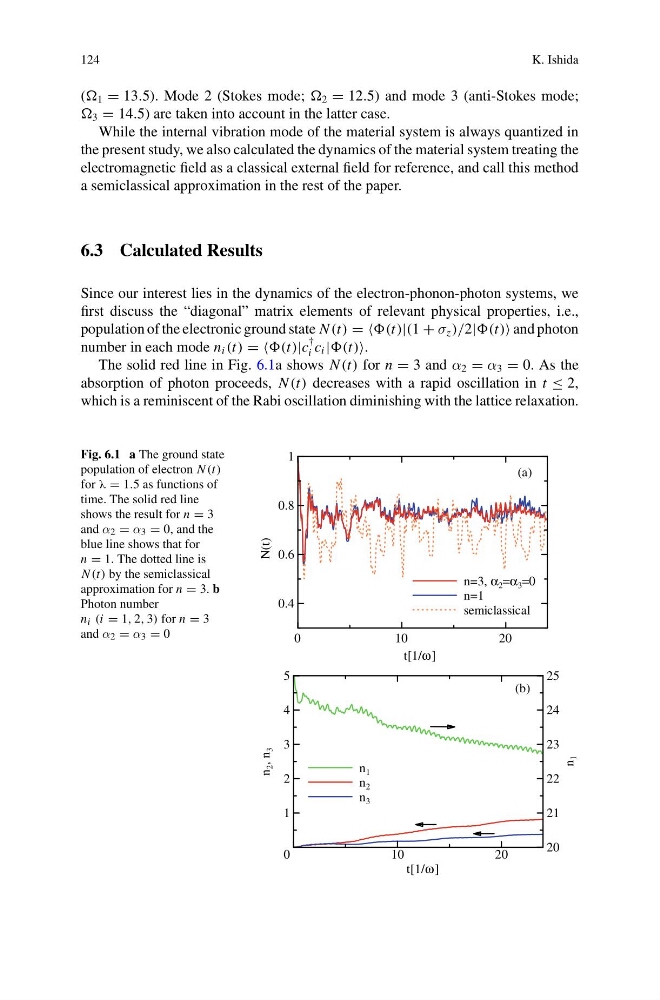
The solid red line in Fig. 6.1a shows N (t) for n = 3 and α 2 = α 3 = 0. As the
absorption of photon proceeds, N (t) decreases with a rapid oscillation in t ≤ 2,
which is a reminiscent of the Rabi oscillation diminishing with the lattice relaxation.
Fig. 6.1 a The ground state
population of electron N (t)
for λ = 1.5 as functions of
time. The solid red line
shows the result for n = 3
and α 2 = α 3 = 0, and the
blue line shows that for
n = 1. The dotted line is
N (t) by the semiclassical
approximation for n = 3. b
Photon number
n i (i = 1, 2, 3) for n = 3
and α 2 = α 3 = 0
t[1/ω]
N(t)
(a)
n=3, α 2 =α 3 =0
n=1
semiclassical
0
1 0
2 0
0.4
0.6
0.8
1
t[1/ω]
n
2 , n
3
(b)
n
1
n 1
n 2
n 3
0
1 0
2 0
1
2
3
4
5
20
21
22
23
24
25
K. Ishida
( 1 = 13.5). Mode 2 (Stokes mode; 2 = 12.5) and mode 3 (anti-Stokes mode;
3 = 14.5) are taken into account in the latter case.
While the internal vibration mode of the material system is always quantized in
the present study, we also calculated the dynamics of the material system treating the
electromagnetic field as a classical external field for reference, and call this method
a semiclassical approximation in the rest of the paper.
6.3 Calculated Results
Since our interest lies in the dynamics of the electron-phonon-photon systems, we
first discuss the “diagonal” matrix elements of relevant physical properties, i.e.,
population of the electronic ground state N (t) = = + σ z )/2| and photon
number in each mode n i (t) = =
†
i c i |
The solid red line in Fig. 6.1a shows N (t) for n = 3 and α 2 = α 3 = 0. As the
absorption of photon proceeds, N (t) decreases with a rapid oscillation in t ≤ 2,
which is a reminiscent of the Rabi oscillation diminishing with the lattice relaxation.
Fig. 6.1 a The ground state
population of electron N (t)
for λ = 1.5 as functions of
time. The solid red line
shows the result for n = 3
and α 2 = α 3 = 0, and the
blue line shows that for
n = 1. The dotted line is
N (t) by the semiclassical
approximation for n = 3. b
Photon number
n i (i = 1, 2, 3) for n = 3
and α 2 = α 3 = 0
t[1/ω]
N(t)
(a)
n=3, α 2 =α 3 =0
n=1
semiclassical
0
1 0
2 0
0.4
0.6
0.8
1
t[1/ω]
n
2 , n
3
(b)
n
1
n 1
n 2
n 3
0
1 0
2 0
1
2
3
4
5
20
21
22
23
24
25