

6 Coherent Control of Nonadiabatic Dynamics of Electron-Phonon …
123
6.2 Model and Method
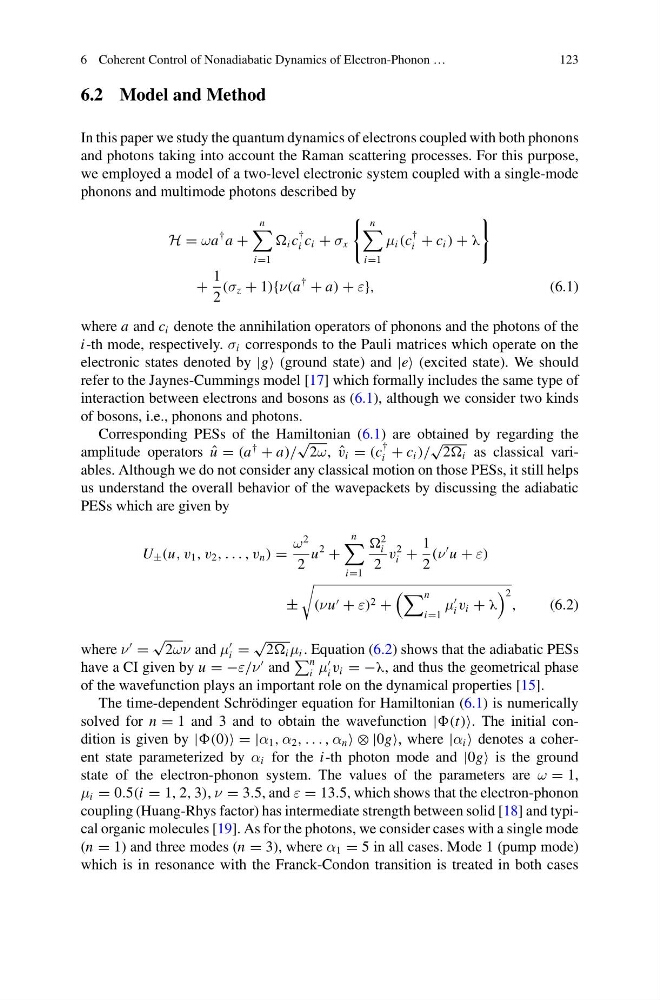
In this paper we study the quantum dynamics of electrons coupled with both phonons
and photons taking into account the Raman scattering processes. For this purpose,
we employed a model of a two-level electronic system coupled with a single-mode
phonons and multimode photons described by
H = ωa
† a +
n
i=1
i c
†
i c i + σ x
n
i=1
μ i (c
†
i + c i ) + λ
+
1
2
(σ z + 1){ν(a
†
+ a) + ε},
(6.1)
where a and c i denote the annihilation operators of phonons and the photons of the
i-th mode, respectively. σ i corresponds to the Pauli matrices which operate on the
electronic states denoted by |g (ground state) and |e (excited state). We should
refer to the Jaynes-Cummings model [17] which formally includes the same type of
interaction between electrons and bosons as (6.1), although we consider two kinds
of bosons, i.e., phonons and photons.
Corresponding PESs of the Hamiltonian (6.1) are obtained by regarding the
amplitude operators ˆ
u = (a
†
+ a)/
√
2ω, ˆ
v i = (c
†
i + c i )/
√
2 i as classical variables. Although we do not consider any classical motion on those PESs, it still helps
us understand the overall behavior of the wavepackets by discussing the adiabatic
PESs which are given by
U ± (u, v 1 , v 2 , . . . , v n ) =
ω
2
2
u
2
+
n
i=1
2
i
2
v
2
i +
1
2
(ν
u + ε)
±
(νu + ε) 2 +
n
i=1
μ
i v i + λ
2 ,
(6.2)
where ν
=
√
2ων and μ
i =
√
2 i μ i . Equation (6.2) shows that the adiabatic PESs
have a CI given by u = −ε/ν
and
n
i μ
i v i = −λ, and thus the geometrical phase
of the wavefunction plays an important role on the dynamical properties [15].
The time-dependent Schrödinger equation for Hamiltonian (6.1) is numerically
solved for n = 1 and 3 and to obtain the wavefunction |(t). The initial condition is given by |(0) = |α 1 , α 2 , . . . , α n ⊗ |0g, where |α i denotes a coherent state parameterized by α i for the i-th photon mode and |0g is the ground
state of the electron-phonon system. The values of the parameters are ω = 1,
μ i = 0.5(i = 1, 2, 3), ν = 3.5, and ε = 13.5, which shows that the electron-phonon
coupling (Huang-Rhys factor) has intermediate strength between solid [18] and typical organic molecules [19]. As for the photons, we consider cases with a single mode
(n = 1) and three modes (n = 3), where α 1 = 5 in all cases. Mode 1 (pump mode)
which is in resonance with the Franck-Condon transition is treated in both cases
123
6.2 Model and Method
In this paper we study the quantum dynamics of electrons coupled with both phonons
and photons taking into account the Raman scattering processes. For this purpose,
we employed a model of a two-level electronic system coupled with a single-mode
phonons and multimode photons described by
H = ωa
† a +
n
i=1
i c
†
i c i + σ x
n
i=1
μ i (c
†
i + c i ) + λ
+
1
2
(σ z + 1){ν(a
†
+ a) + ε},
(6.1)
where a and c i denote the annihilation operators of phonons and the photons of the
i-th mode, respectively. σ i corresponds to the Pauli matrices which operate on the
electronic states denoted by |g (ground state) and |e (excited state). We should
refer to the Jaynes-Cummings model [17] which formally includes the same type of
interaction between electrons and bosons as (6.1), although we consider two kinds
of bosons, i.e., phonons and photons.
Corresponding PESs of the Hamiltonian (6.1) are obtained by regarding the
amplitude operators ˆ
u = (a
†
+ a)/
√
2ω, ˆ
v i = (c
†
i + c i )/
√
2 i as classical variables. Although we do not consider any classical motion on those PESs, it still helps
us understand the overall behavior of the wavepackets by discussing the adiabatic
PESs which are given by
U ± (u, v 1 , v 2 , . . . , v n ) =
ω
2
2
u
2
+
n
i=1
2
i
2
v
2
i +
1
2
(ν
u + ε)
±
(νu + ε) 2 +
n
i=1
μ
i v i + λ
2 ,
(6.2)
where ν
=
√
2ων and μ
i =
√
2 i μ i . Equation (6.2) shows that the adiabatic PESs
have a CI given by u = −ε/ν
and
n
i μ
i v i = −λ, and thus the geometrical phase
of the wavefunction plays an important role on the dynamical properties [15].
The time-dependent Schrödinger equation for Hamiltonian (6.1) is numerically
solved for n = 1 and 3 and to obtain the wavefunction |(t). The initial condition is given by |(0) = |α 1 , α 2 , . . . , α n ⊗ |0g, where |α i denotes a coherent state parameterized by α i for the i-th photon mode and |0g is the ground
state of the electron-phonon system. The values of the parameters are ω = 1,
μ i = 0.5(i = 1, 2, 3), ν = 3.5, and ε = 13.5, which shows that the electron-phonon
coupling (Huang-Rhys factor) has intermediate strength between solid [18] and typical organic molecules [19]. As for the photons, we consider cases with a single mode
(n = 1) and three modes (n = 3), where α 1 = 5 in all cases. Mode 1 (pump mode)
which is in resonance with the Franck-Condon transition is treated in both cases