

254
R. Tesser et al.
8.5.8 Epoxidation Methods
The term ‘epoxides’ is usually referred to as oxiranes, organic compounds constituted
by cyclic ethers with a three-membered ring, which are very reactive. For this reason,
they are susceptible to ring-opening reaction, through different reactions like ketone
rearrangements.
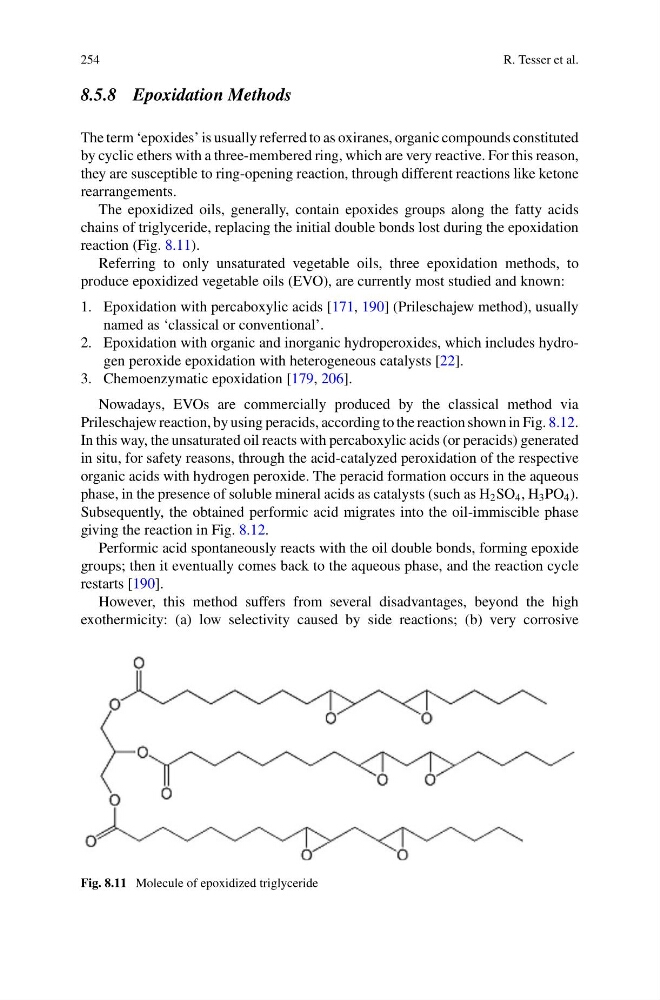
The epoxidized oils, generally, contain epoxides groups along the fatty acids
chains of triglyceride, replacing the initial double bonds lost during the epoxidation
reaction (Fig. 8.11).
Referring to only unsaturated vegetable oils, three epoxidation methods, to
produce epoxidized vegetable oils (EVO), are currently most studied and known:
1. Epoxidation with percaboxylic acids [171, 190] (Prileschajew method), usually
named as ‘classical or conventional’.
2. Epoxidation with organic and inorganic hydroperoxides, which includes hydrogen peroxide epoxidation with heterogeneous catalysts [22].
3. Chemoenzymatic epoxidation [179, 206].
Nowadays, EVOs are commercially produced by the classical method via
Prileschajew reaction, by using peracids, according to the reaction shown in Fig. 8.12.
In this way, the unsaturated oil reacts with percaboxylic acids (or peracids) generated
in situ, for safety reasons, through the acid-catalyzed peroxidation of the respective
organic acids with hydrogen peroxide. The peracid formation occurs in the aqueous
phase, in the presence of soluble mineral acids as catalysts (such as H 2 SO 4 , H 3 PO 4 ).
Subsequently, the obtained performic acid migrates into the oil-immiscible phase
giving the reaction in Fig. 8.12.
Performic acid spontaneously reacts with the oil double bonds, forming epoxide
groups; then it eventually comes back to the aqueous phase, and the reaction cycle
restarts [190].
However, this method suffers from several disadvantages, beyond the high
exothermicity: (a) low selectivity caused by side reactions; (b) very corrosive
Fig. 8.11 Molecule of epoxidized triglyceride
R. Tesser et al.
8.5.8 Epoxidation Methods
The term ‘epoxides’ is usually referred to as oxiranes, organic compounds constituted
by cyclic ethers with a three-membered ring, which are very reactive. For this reason,
they are susceptible to ring-opening reaction, through different reactions like ketone
rearrangements.
The epoxidized oils, generally, contain epoxides groups along the fatty acids
chains of triglyceride, replacing the initial double bonds lost during the epoxidation
reaction (Fig. 8.11).
Referring to only unsaturated vegetable oils, three epoxidation methods, to
produce epoxidized vegetable oils (EVO), are currently most studied and known:
1. Epoxidation with percaboxylic acids [171, 190] (Prileschajew method), usually
named as ‘classical or conventional’.
2. Epoxidation with organic and inorganic hydroperoxides, which includes hydrogen peroxide epoxidation with heterogeneous catalysts [22].
3. Chemoenzymatic epoxidation [179, 206].
Nowadays, EVOs are commercially produced by the classical method via
Prileschajew reaction, by using peracids, according to the reaction shown in Fig. 8.12.
In this way, the unsaturated oil reacts with percaboxylic acids (or peracids) generated
in situ, for safety reasons, through the acid-catalyzed peroxidation of the respective
organic acids with hydrogen peroxide. The peracid formation occurs in the aqueous
phase, in the presence of soluble mineral acids as catalysts (such as H 2 SO 4 , H 3 PO 4 ).
Subsequently, the obtained performic acid migrates into the oil-immiscible phase
giving the reaction in Fig. 8.12.
Performic acid spontaneously reacts with the oil double bonds, forming epoxide
groups; then it eventually comes back to the aqueous phase, and the reaction cycle
restarts [190].
However, this method suffers from several disadvantages, beyond the high
exothermicity: (a) low selectivity caused by side reactions; (b) very corrosive
Fig. 8.11 Molecule of epoxidized triglyceride