

234
R. Tesser et al.
32%
17%
24%
27%
COATING MARKET GROWTH IN 2017
DecoraƟve Auto OEM Auto Refinish Other Industrial
A
45%
24%
6%
18%
7%
GLOBAL COATING MARKETS IN 2017
Asia
Europe
Middle East &
Africa
North America
LaƟn America
B
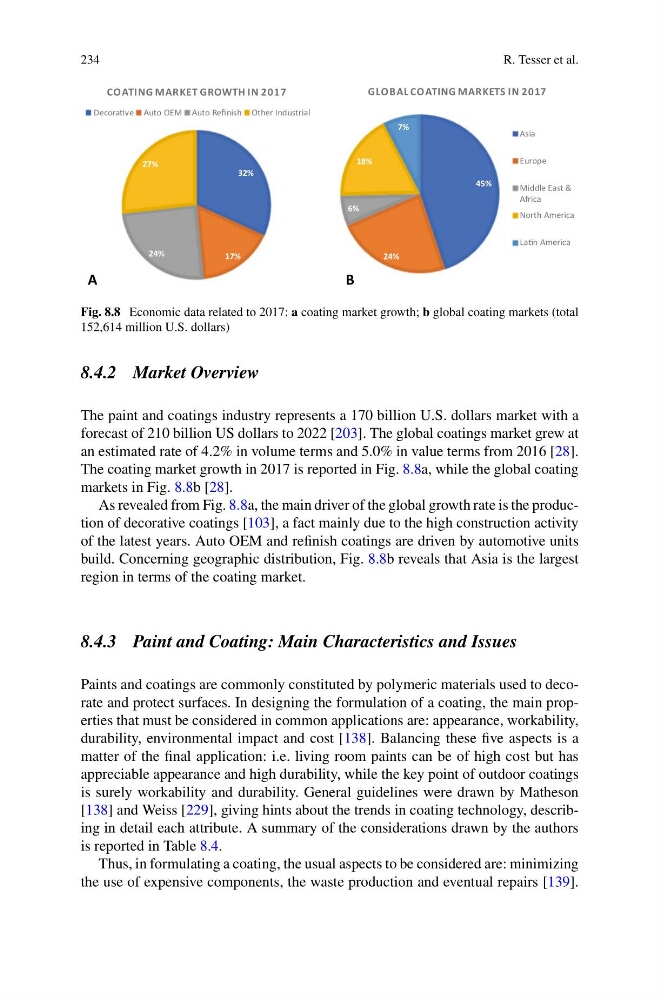
Fig. 8.8 Economic data related to 2017: a coating market growth; b global coating markets (total
152,614 million U.S. dollars)
8.4.2 Market Overview
The paint and coatings industry represents a 170 billion U.S. dollars market with a
forecast of 210 billion US dollars to 2022 [203]. The global coatings market grew at
an estimated rate of 4.2% in volume terms and 5.0% in value terms from 2016 [28].
The coating market growth in 2017 is reported in Fig. 8.8a, while the global coating
markets in Fig. 8.8b [28].
As revealed from Fig. 8.8a, the main driver of the global growth rate is the production of decorative coatings [103], a fact mainly due to the high construction activity
of the latest years. Auto OEM and refinish coatings are driven by automotive units
build. Concerning geographic distribution, Fig. 8.8b reveals that Asia is the largest
region in terms of the coating market.
8.4.3 Paint and Coating: Main Characteristics and Issues
Paints and coatings are commonly constituted by polymeric materials used to decorate and protect surfaces. In designing the formulation of a coating, the main properties that must be considered in common applications are: appearance, workability,
durability, environmental impact and cost [138]. Balancing these five aspects is a
matter of the final application: i.e. living room paints can be of high cost but has
appreciable appearance and high durability, while the key point of outdoor coatings
is surely workability and durability. General guidelines were drawn by Matheson
[138] and Weiss [229], giving hints about the trends in coating technology, describing in detail each attribute. A summary of the considerations drawn by the authors
is reported in Table 8.4.
Thus, in formulating a coating, the usual aspects to be considered are: minimizing
the use of expensive components, the waste production and eventual repairs [139].
R. Tesser et al.
32%
17%
24%
27%
COATING MARKET GROWTH IN 2017
DecoraƟve Auto OEM Auto Refinish Other Industrial
A
45%
24%
6%
18%
7%
GLOBAL COATING MARKETS IN 2017
Asia
Europe
Middle East &
Africa
North America
LaƟn America
B
Fig. 8.8 Economic data related to 2017: a coating market growth; b global coating markets (total
152,614 million U.S. dollars)
8.4.2 Market Overview
The paint and coatings industry represents a 170 billion U.S. dollars market with a
forecast of 210 billion US dollars to 2022 [203]. The global coatings market grew at
an estimated rate of 4.2% in volume terms and 5.0% in value terms from 2016 [28].
The coating market growth in 2017 is reported in Fig. 8.8a, while the global coating
markets in Fig. 8.8b [28].
As revealed from Fig. 8.8a, the main driver of the global growth rate is the production of decorative coatings [103], a fact mainly due to the high construction activity
of the latest years. Auto OEM and refinish coatings are driven by automotive units
build. Concerning geographic distribution, Fig. 8.8b reveals that Asia is the largest
region in terms of the coating market.
8.4.3 Paint and Coating: Main Characteristics and Issues
Paints and coatings are commonly constituted by polymeric materials used to decorate and protect surfaces. In designing the formulation of a coating, the main properties that must be considered in common applications are: appearance, workability,
durability, environmental impact and cost [138]. Balancing these five aspects is a
matter of the final application: i.e. living room paints can be of high cost but has
appreciable appearance and high durability, while the key point of outdoor coatings
is surely workability and durability. General guidelines were drawn by Matheson
[138] and Weiss [229], giving hints about the trends in coating technology, describing in detail each attribute. A summary of the considerations drawn by the authors
is reported in Table 8.4.
Thus, in formulating a coating, the usual aspects to be considered are: minimizing
the use of expensive components, the waste production and eventual repairs [139].