

8 Oleochemistry Products
235
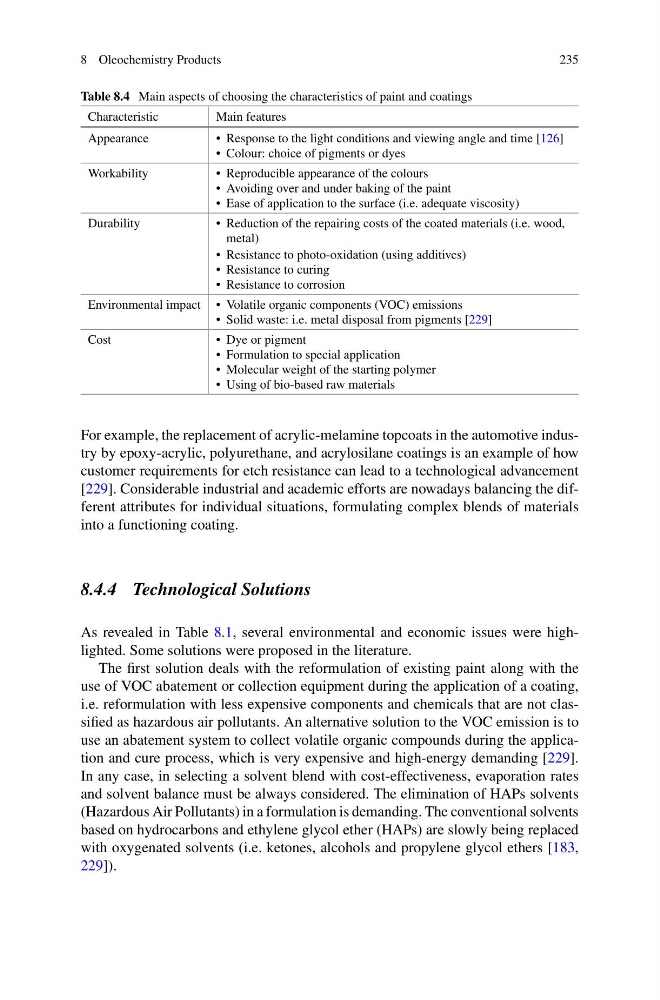
Table 8.4 Main aspects of choosing the characteristics of paint and coatings
Characteristic
Main features
Appearance
• Response to the light conditions and viewing angle and time [126]
• Colour: choice of pigments or dyes
Workability
• Reproducible appearance of the colours
• Avoiding over and under baking of the paint
• Ease of application to the surface (i.e. adequate viscosity)
Durability
• Reduction of the repairing costs of the coated materials (i.e. wood,
metal)
• Resistance to photo-oxidation (using additives)
• Resistance to curing
• Resistance to corrosion
Environmental impact • Volatile organic components (VOC) emissions
• Solid waste: i.e. metal disposal from pigments [229]
Cost
• Dye or pigment
• Formulation to special application
• Molecular weight of the starting polymer
• Using of bio-based raw materials
For example, the replacement of acrylic-melamine topcoats in the automotive industry by epoxy-acrylic, polyurethane, and acrylosilane coatings is an example of how
customer requirements for etch resistance can lead to a technological advancement
[229]. Considerable industrial and academic efforts are nowadays balancing the different attributes for individual situations, formulating complex blends of materials
into a functioning coating.
8.4.4 Technological Solutions
As revealed in Table 8.1, several environmental and economic issues were highlighted. Some solutions were proposed in the literature.
The first solution deals with the reformulation of existing paint along with the
use of VOC abatement or collection equipment during the application of a coating,
i.e. reformulation with less expensive components and chemicals that are not classified as hazardous air pollutants. An alternative solution to the VOC emission is to
use an abatement system to collect volatile organic compounds during the application and cure process, which is very expensive and high-energy demanding [229].
In any case, in selecting a solvent blend with cost-effectiveness, evaporation rates
and solvent balance must be always considered. The elimination of HAPs solvents
(Hazardous Air Pollutants) in a formulation is demanding. The conventional solvents
based on hydrocarbons and ethylene glycol ether (HAPs) are slowly being replaced
with oxygenated solvents (i.e. ketones, alcohols and propylene glycol ethers [183,
229]).
235
Table 8.4 Main aspects of choosing the characteristics of paint and coatings
Characteristic
Main features
Appearance
• Response to the light conditions and viewing angle and time [126]
• Colour: choice of pigments or dyes
Workability
• Reproducible appearance of the colours
• Avoiding over and under baking of the paint
• Ease of application to the surface (i.e. adequate viscosity)
Durability
• Reduction of the repairing costs of the coated materials (i.e. wood,
metal)
• Resistance to photo-oxidation (using additives)
• Resistance to curing
• Resistance to corrosion
Environmental impact • Volatile organic components (VOC) emissions
• Solid waste: i.e. metal disposal from pigments [229]
Cost
• Dye or pigment
• Formulation to special application
• Molecular weight of the starting polymer
• Using of bio-based raw materials
For example, the replacement of acrylic-melamine topcoats in the automotive industry by epoxy-acrylic, polyurethane, and acrylosilane coatings is an example of how
customer requirements for etch resistance can lead to a technological advancement
[229]. Considerable industrial and academic efforts are nowadays balancing the different attributes for individual situations, formulating complex blends of materials
into a functioning coating.
8.4.4 Technological Solutions
As revealed in Table 8.1, several environmental and economic issues were highlighted. Some solutions were proposed in the literature.
The first solution deals with the reformulation of existing paint along with the
use of VOC abatement or collection equipment during the application of a coating,
i.e. reformulation with less expensive components and chemicals that are not classified as hazardous air pollutants. An alternative solution to the VOC emission is to
use an abatement system to collect volatile organic compounds during the application and cure process, which is very expensive and high-energy demanding [229].
In any case, in selecting a solvent blend with cost-effectiveness, evaporation rates
and solvent balance must be always considered. The elimination of HAPs solvents
(Hazardous Air Pollutants) in a formulation is demanding. The conventional solvents
based on hydrocarbons and ethylene glycol ether (HAPs) are slowly being replaced
with oxygenated solvents (i.e. ketones, alcohols and propylene glycol ethers [183,
229]).