

7 Technologies for Conversion Bio-Lubricant …
197
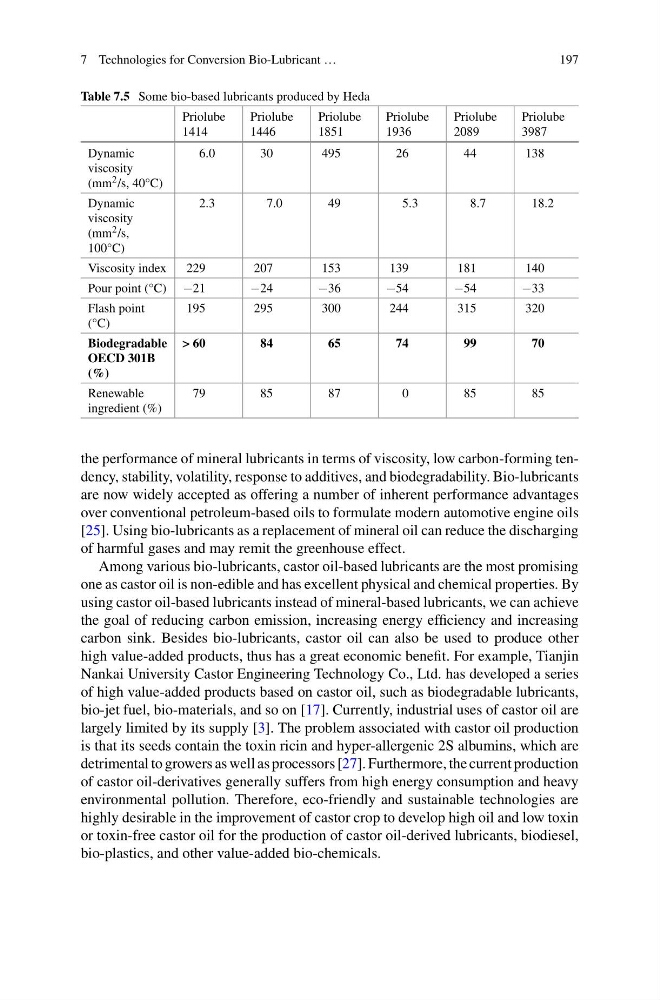
Table 7.5 Some bio-based lubricants produced by Heda
Priolube
1414
Priolube
1446
Priolube
1851
Priolube
1936
Priolube
2089
Priolube
3987
Dynamic
viscosity
(mm 2 /s, 40°C)
6.0
30
495
26
44
138
Dynamic
viscosity
(mm 2 /s,
100°C)
2.3
7.0
49
5.3
8.7
18.2
Viscosity index
229
207
153
139
181
140
Pour point (°C) −21
−24
−36
−54
−54
−33
Flash point
(°C)
195
295
300
244
315
320
Biodegradable
OECD 301B
(%)
> 60
84
65
74
99
70
Renewable
ingredient (%)
79
85
87
0
85
85
the performance of mineral lubricants in terms of viscosity, low carbon-forming tendency, stability, volatility, response to additives, and biodegradability. Bio-lubricants
are now widely accepted as offering a number of inherent performance advantages
over conventional petroleum-based oils to formulate modern automotive engine oils
[25]. Using bio-lubricants as a replacement of mineral oil can reduce the discharging
of harmful gases and may remit the greenhouse effect.
Among various bio-lubricants, castor oil-based lubricants are the most promising
one as castor oil is non-edible and has excellent physical and chemical properties. By
using castor oil-based lubricants instead of mineral-based lubricants, we can achieve
the goal of reducing carbon emission, increasing energy efficiency and increasing
carbon sink. Besides bio-lubricants, castor oil can also be used to produce other
high value-added products, thus has a great economic benefit. For example, Tianjin
Nankai University Castor Engineering Technology Co., Ltd. has developed a series
of high value-added products based on castor oil, such as biodegradable lubricants,
bio-jet fuel, bio-materials, and so on [17]. Currently, industrial uses of castor oil are
largely limited by its supply [3]. The problem associated with castor oil production
is that its seeds contain the toxin ricin and hyper-allergenic 2S albumins, which are
detrimental to growers as well as processors [27]. Furthermore, the current production
of castor oil-derivatives generally suffers from high energy consumption and heavy
environmental pollution. Therefore, eco-friendly and sustainable technologies are
highly desirable in the improvement of castor crop to develop high oil and low toxin
or toxin-free castor oil for the production of castor oil-derived lubricants, biodiesel,
bio-plastics, and other value-added bio-chemicals.
197
Table 7.5 Some bio-based lubricants produced by Heda
Priolube
1414
Priolube
1446
Priolube
1851
Priolube
1936
Priolube
2089
Priolube
3987
Dynamic
viscosity
(mm 2 /s, 40°C)
6.0
30
495
26
44
138
Dynamic
viscosity
(mm 2 /s,
100°C)
2.3
7.0
49
5.3
8.7
18.2
Viscosity index
229
207
153
139
181
140
Pour point (°C) −21
−24
−36
−54
−54
−33
Flash point
(°C)
195
295
300
244
315
320
Biodegradable
OECD 301B
(%)
> 60
84
65
74
99
70
Renewable
ingredient (%)
79
85
87
0
85
85
the performance of mineral lubricants in terms of viscosity, low carbon-forming tendency, stability, volatility, response to additives, and biodegradability. Bio-lubricants
are now widely accepted as offering a number of inherent performance advantages
over conventional petroleum-based oils to formulate modern automotive engine oils
[25]. Using bio-lubricants as a replacement of mineral oil can reduce the discharging
of harmful gases and may remit the greenhouse effect.
Among various bio-lubricants, castor oil-based lubricants are the most promising
one as castor oil is non-edible and has excellent physical and chemical properties. By
using castor oil-based lubricants instead of mineral-based lubricants, we can achieve
the goal of reducing carbon emission, increasing energy efficiency and increasing
carbon sink. Besides bio-lubricants, castor oil can also be used to produce other
high value-added products, thus has a great economic benefit. For example, Tianjin
Nankai University Castor Engineering Technology Co., Ltd. has developed a series
of high value-added products based on castor oil, such as biodegradable lubricants,
bio-jet fuel, bio-materials, and so on [17]. Currently, industrial uses of castor oil are
largely limited by its supply [3]. The problem associated with castor oil production
is that its seeds contain the toxin ricin and hyper-allergenic 2S albumins, which are
detrimental to growers as well as processors [27]. Furthermore, the current production
of castor oil-derivatives generally suffers from high energy consumption and heavy
environmental pollution. Therefore, eco-friendly and sustainable technologies are
highly desirable in the improvement of castor crop to develop high oil and low toxin
or toxin-free castor oil for the production of castor oil-derived lubricants, biodiesel,
bio-plastics, and other value-added bio-chemicals.