

196
Y. Cao et al.
Table 7.3 Fire-resistant hydraulic oils-pentaerythritol oleate
Items
National standard requirements Result
Testing method
Dynamic viscosity (mm 2 /s,
40 °C)
62–68
63
GB/T 265
Acid value (mg KOH/g)
≤0.8
0.47
GB/T 7304
Iodine value (g I 2 /100 g)
85–100
102
AOCS CD1-25
Hydroxyl value (mg KOH/g)
≤10.0
6.2
GB13482
Flash point (°C)
≥300
338
GB/T 3536
Pour point (°C)
≤–21
−23
GB/T 3535
Demulsibility
≤25
19
GB/T 7305
Chroma
≤2
1
GB/T 1722
Moisture
≤0.05
0.05
07033.053
Table 7.4 Fire-resistant hydraulic oils-trimethylolpropane oleate
Items
National standard requirements Result
Testing method
Dynamic viscosity (mm 2 /s,
40 °C)
≤53
46
GB/T 265
Acid value (mg KOH/g)
≤1.0
0.42
GB/T 7304
Iodine value (g I 2 /100 g)
75–90
86.4
AOCS CD1-25
Hydroxyl value (mg KOH/g)
≤7
6.6
GB13482
Flash point (°C)
≥300
324
GB/T 3536
Pour point (°C)
≤−39
−45
GB/T 3535
Demulsibility
≤25
18
GB/T 7305
Chroma
≤2
1
GB/T 1722
Moisture
≤0.1
0.03
07033.053
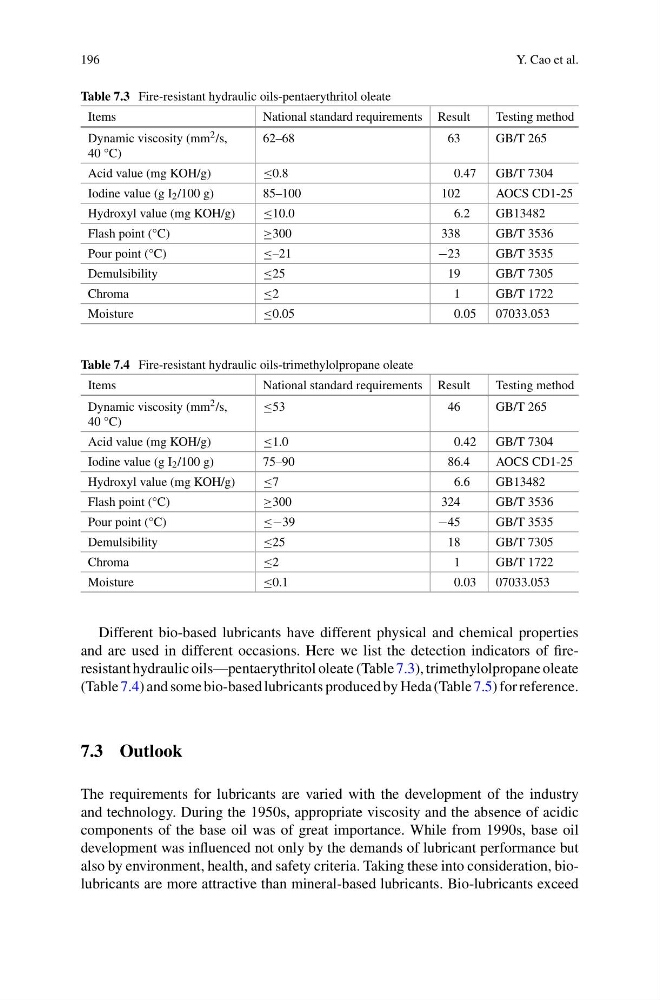
Different bio-based lubricants have different physical and chemical properties
and are used in different occasions. Here we list the detection indicators of fireresistant hydraulic oils—pentaerythritol oleate (Table 7.3), trimethylolpropane oleate
(Table 7.4) and some bio-based lubricants produced by Heda (Table 7.5) for reference.
7.3 Outlook
The requirements for lubricants are varied with the development of the industry
and technology. During the 1950s, appropriate viscosity and the absence of acidic
components of the base oil was of great importance. While from 1990s, base oil
development was influenced not only by the demands of lubricant performance but
also by environment, health, and safety criteria. Taking these into consideration, biolubricants are more attractive than mineral-based lubricants. Bio-lubricants exceed
Y. Cao et al.
Table 7.3 Fire-resistant hydraulic oils-pentaerythritol oleate
Items
National standard requirements Result
Testing method
Dynamic viscosity (mm 2 /s,
40 °C)
62–68
63
GB/T 265
Acid value (mg KOH/g)
≤0.8
0.47
GB/T 7304
Iodine value (g I 2 /100 g)
85–100
102
AOCS CD1-25
Hydroxyl value (mg KOH/g)
≤10.0
6.2
GB13482
Flash point (°C)
≥300
338
GB/T 3536
Pour point (°C)
≤–21
−23
GB/T 3535
Demulsibility
≤25
19
GB/T 7305
Chroma
≤2
1
GB/T 1722
Moisture
≤0.05
0.05
07033.053
Table 7.4 Fire-resistant hydraulic oils-trimethylolpropane oleate
Items
National standard requirements Result
Testing method
Dynamic viscosity (mm 2 /s,
40 °C)
≤53
46
GB/T 265
Acid value (mg KOH/g)
≤1.0
0.42
GB/T 7304
Iodine value (g I 2 /100 g)
75–90
86.4
AOCS CD1-25
Hydroxyl value (mg KOH/g)
≤7
6.6
GB13482
Flash point (°C)
≥300
324
GB/T 3536
Pour point (°C)
≤−39
−45
GB/T 3535
Demulsibility
≤25
18
GB/T 7305
Chroma
≤2
1
GB/T 1722
Moisture
≤0.1
0.03
07033.053
Different bio-based lubricants have different physical and chemical properties
and are used in different occasions. Here we list the detection indicators of fireresistant hydraulic oils—pentaerythritol oleate (Table 7.3), trimethylolpropane oleate
(Table 7.4) and some bio-based lubricants produced by Heda (Table 7.5) for reference.
7.3 Outlook
The requirements for lubricants are varied with the development of the industry
and technology. During the 1950s, appropriate viscosity and the absence of acidic
components of the base oil was of great importance. While from 1990s, base oil
development was influenced not only by the demands of lubricant performance but
also by environment, health, and safety criteria. Taking these into consideration, biolubricants are more attractive than mineral-based lubricants. Bio-lubricants exceed