

7 Technologies for Conversion Bio-Lubricant …
195
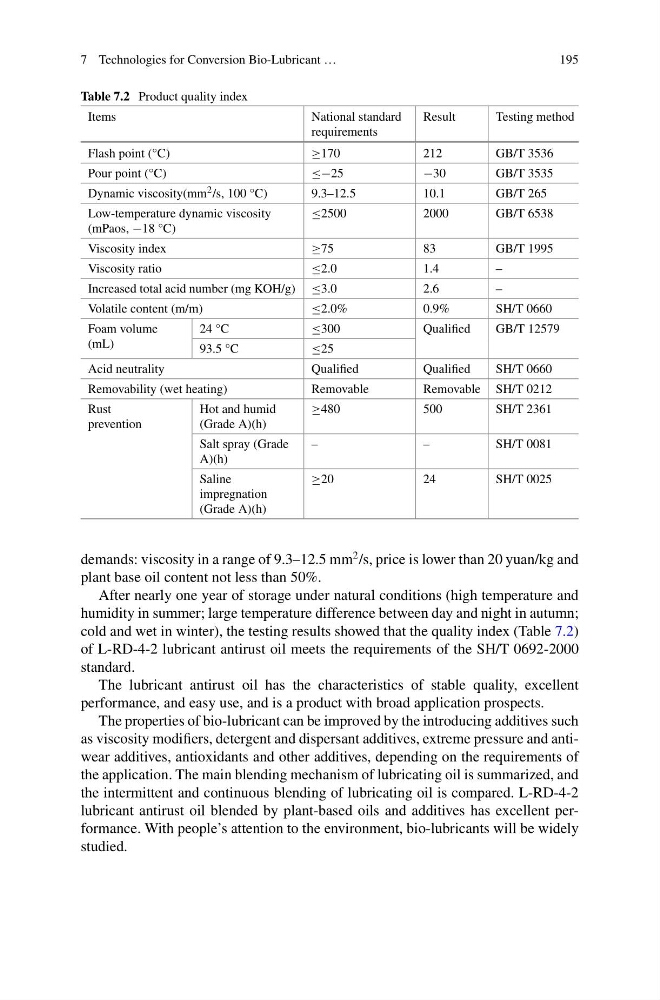
Table 7.2 Product quality index
Items
National standard
requirements
Result
Testing method
Flash point (°C)
≥170
212
GB/T 3536
Pour point (°C)
≤−25
−30
GB/T 3535
Dynamic viscosity(mm 2 /s, 100 °C)
9.3–12.5
10.1
GB/T 265
Low-temperature dynamic viscosity
(mPaos, −18 °C)
≤2500
2000
GB/T 6538
Viscosity index
≥75
83
GB/T 1995
Viscosity ratio
≤2.0
1.4
–
Increased total acid number (mg KOH/g) ≤3.0
2.6
–
Volatile content (m/m)
≤2.0%
0.9%
SH/T 0660
Foam volume
(mL)
24 °C
≤300
Qualified
GB/T 12579
93.5 °C
≤25
Acid neutrality
Qualified
Qualified
SH/T 0660
Removability (wet heating)
Removable
Removable SH/T 0212
Rust
prevention
Hot and humid
(Grade A)(h)
≥480
500
SH/T 2361
Salt spray (Grade
A)(h)
–
–
SH/T 0081
Saline
impregnation
(Grade A)(h)
≥20
24
SH/T 0025
demands: viscosity in a range of 9.3–12.5 mm
2 /s, price is lower than 20 yuan/kg and
plant base oil content not less than 50%.
After nearly one year of storage under natural conditions (high temperature and
humidity in summer; large temperature difference between day and night in autumn;
cold and wet in winter), the testing results showed that the quality index (Table 7.2)
of L-RD-4-2 lubricant antirust oil meets the requirements of the SH/T 0692-2000
standard.
The lubricant antirust oil has the characteristics of stable quality, excellent
performance, and easy use, and is a product with broad application prospects.
The properties of bio-lubricant can be improved by the introducing additives such
as viscosity modifiers, detergent and dispersant additives, extreme pressure and antiwear additives, antioxidants and other additives, depending on the requirements of
the application. The main blending mechanism of lubricating oil is summarized, and
the intermittent and continuous blending of lubricating oil is compared. L-RD-4-2
lubricant antirust oil blended by plant-based oils and additives has excellent performance. With people’s attention to the environment, bio-lubricants will be widely
studied.
195
Table 7.2 Product quality index
Items
National standard
requirements
Result
Testing method
Flash point (°C)
≥170
212
GB/T 3536
Pour point (°C)
≤−25
−30
GB/T 3535
Dynamic viscosity(mm 2 /s, 100 °C)
9.3–12.5
10.1
GB/T 265
Low-temperature dynamic viscosity
(mPaos, −18 °C)
≤2500
2000
GB/T 6538
Viscosity index
≥75
83
GB/T 1995
Viscosity ratio
≤2.0
1.4
–
Increased total acid number (mg KOH/g) ≤3.0
2.6
–
Volatile content (m/m)
≤2.0%
0.9%
SH/T 0660
Foam volume
(mL)
24 °C
≤300
Qualified
GB/T 12579
93.5 °C
≤25
Acid neutrality
Qualified
Qualified
SH/T 0660
Removability (wet heating)
Removable
Removable SH/T 0212
Rust
prevention
Hot and humid
(Grade A)(h)
≥480
500
SH/T 2361
Salt spray (Grade
A)(h)
–
–
SH/T 0081
Saline
impregnation
(Grade A)(h)
≥20
24
SH/T 0025
demands: viscosity in a range of 9.3–12.5 mm
2 /s, price is lower than 20 yuan/kg and
plant base oil content not less than 50%.
After nearly one year of storage under natural conditions (high temperature and
humidity in summer; large temperature difference between day and night in autumn;
cold and wet in winter), the testing results showed that the quality index (Table 7.2)
of L-RD-4-2 lubricant antirust oil meets the requirements of the SH/T 0692-2000
standard.
The lubricant antirust oil has the characteristics of stable quality, excellent
performance, and easy use, and is a product with broad application prospects.
The properties of bio-lubricant can be improved by the introducing additives such
as viscosity modifiers, detergent and dispersant additives, extreme pressure and antiwear additives, antioxidants and other additives, depending on the requirements of
the application. The main blending mechanism of lubricating oil is summarized, and
the intermittent and continuous blending of lubricating oil is compared. L-RD-4-2
lubricant antirust oil blended by plant-based oils and additives has excellent performance. With people’s attention to the environment, bio-lubricants will be widely
studied.