

194
Y. Cao et al.
Table 7.1 Additives in
antirust oil
Ingredients
Quality/g Effect
Barium petroleum
sulfonate
5.00
Corrosion inhibitor
Benzotriazole
0.02
Diisooctyl sebacate
5.00
Solubilizers
Dibutyl phthalate
0.10
2,6-di-tert-butyl
p-cresol
0.20
Antioxidants
Methyl paraben
0.20
Preservatives and
antioxidants
Propylparaben
0.10
Silicone oil
0.10
Defoamer
mechanical stirring or pump circulation stirring. Continuous blending requires that
base oils and additives are fed into the mixer in a defined ratio. When the process is
completed, the physical and chemical properties of mixed oil can meet the demands,
and the oil can be directly filled or entered into the product tank for storage. Compared
with continuous blending, the intermittent blending process equipment is relatively
simple. This blending process eliminates the need for accurate flow meters, highly
reliable automatic controls, and online quality inspection methods. Therefore, the
investment required to build such a blending device is low and it is easy to implement.
The production capacity of such a blending device is limited by the capacity of the
tank. As long as a suitable blending tank is selected, it can meet a certain demand for
production capacity, but the labor intensity is huge. Continuous blending requires
meters and controls to accurately measure and control the flow of each component, as
well as on-line quality analysis instruments and computer control systems. Since this
method of blending has advanced equipment and means mentioned above, continuous
blending can achieve optimal control, rational use of resources, thereby reducing
costs. Continuous blending production capacity depends on the size of the blending
tank. The efficiency of equipment and the quality of components in the blending
process directly affect the quality of the oil.
Bio-Lubricant Blending Examples
With the development of environment-friendly lubrication antirust oil as the starting point, L-RD-4-2 lubricant antirust oil that has been developed is used for steel
corrosion protection.
The base oil and additive are confected using the polar corner design method.
The base oil in the lubricant is a mixture of hydraulic oil, rapeseed oil, castor oil,
and Span-85, and was mixed at a ratio of 1:1:1:1, accounting for about 80–95%
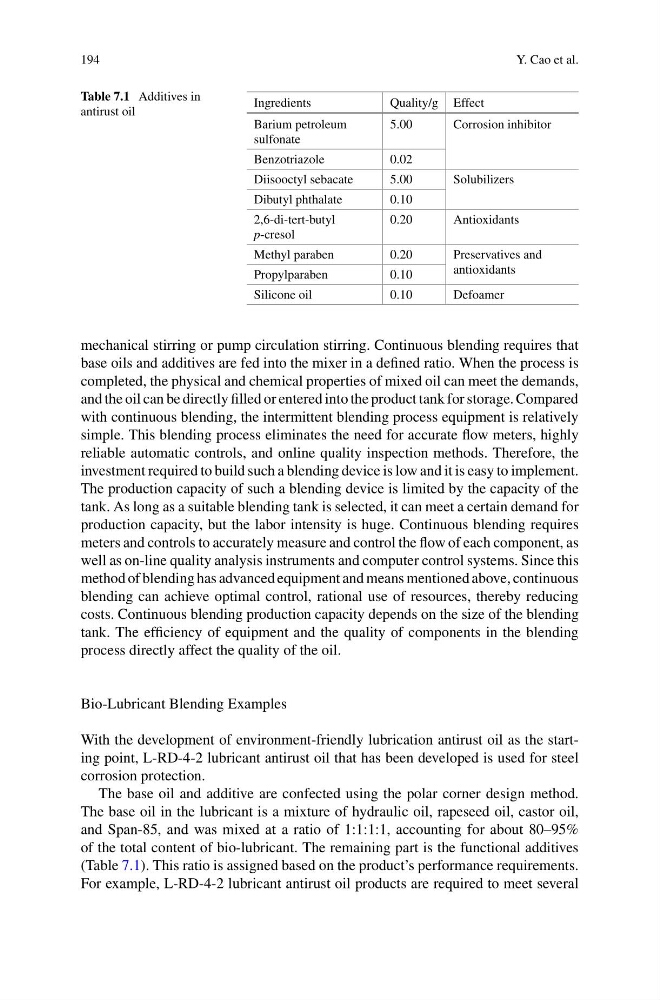
of the total content of bio-lubricant. The remaining part is the functional additives
(Table 7.1). This ratio is assigned based on the product’s performance requirements.
For example, L-RD-4-2 lubricant antirust oil products are required to meet several
Y. Cao et al.
Table 7.1 Additives in
antirust oil
Ingredients
Quality/g Effect
Barium petroleum
sulfonate
5.00
Corrosion inhibitor
Benzotriazole
0.02
Diisooctyl sebacate
5.00
Solubilizers
Dibutyl phthalate
0.10
2,6-di-tert-butyl
p-cresol
0.20
Antioxidants
Methyl paraben
0.20
Preservatives and
antioxidants
Propylparaben
0.10
Silicone oil
0.10
Defoamer
mechanical stirring or pump circulation stirring. Continuous blending requires that
base oils and additives are fed into the mixer in a defined ratio. When the process is
completed, the physical and chemical properties of mixed oil can meet the demands,
and the oil can be directly filled or entered into the product tank for storage. Compared
with continuous blending, the intermittent blending process equipment is relatively
simple. This blending process eliminates the need for accurate flow meters, highly
reliable automatic controls, and online quality inspection methods. Therefore, the
investment required to build such a blending device is low and it is easy to implement.
The production capacity of such a blending device is limited by the capacity of the
tank. As long as a suitable blending tank is selected, it can meet a certain demand for
production capacity, but the labor intensity is huge. Continuous blending requires
meters and controls to accurately measure and control the flow of each component, as
well as on-line quality analysis instruments and computer control systems. Since this
method of blending has advanced equipment and means mentioned above, continuous
blending can achieve optimal control, rational use of resources, thereby reducing
costs. Continuous blending production capacity depends on the size of the blending
tank. The efficiency of equipment and the quality of components in the blending
process directly affect the quality of the oil.
Bio-Lubricant Blending Examples
With the development of environment-friendly lubrication antirust oil as the starting point, L-RD-4-2 lubricant antirust oil that has been developed is used for steel
corrosion protection.
The base oil and additive are confected using the polar corner design method.
The base oil in the lubricant is a mixture of hydraulic oil, rapeseed oil, castor oil,
and Span-85, and was mixed at a ratio of 1:1:1:1, accounting for about 80–95%
of the total content of bio-lubricant. The remaining part is the functional additives
(Table 7.1). This ratio is assigned based on the product’s performance requirements.
For example, L-RD-4-2 lubricant antirust oil products are required to meet several