

1 Introduction
13
susceptible varieties, and the standard of induction intensity is less than 100%. When
the difference between resistance and susceptible varieties is the most obvious, after
transforming the disease number into relative disease resistance index (rrd), the effect
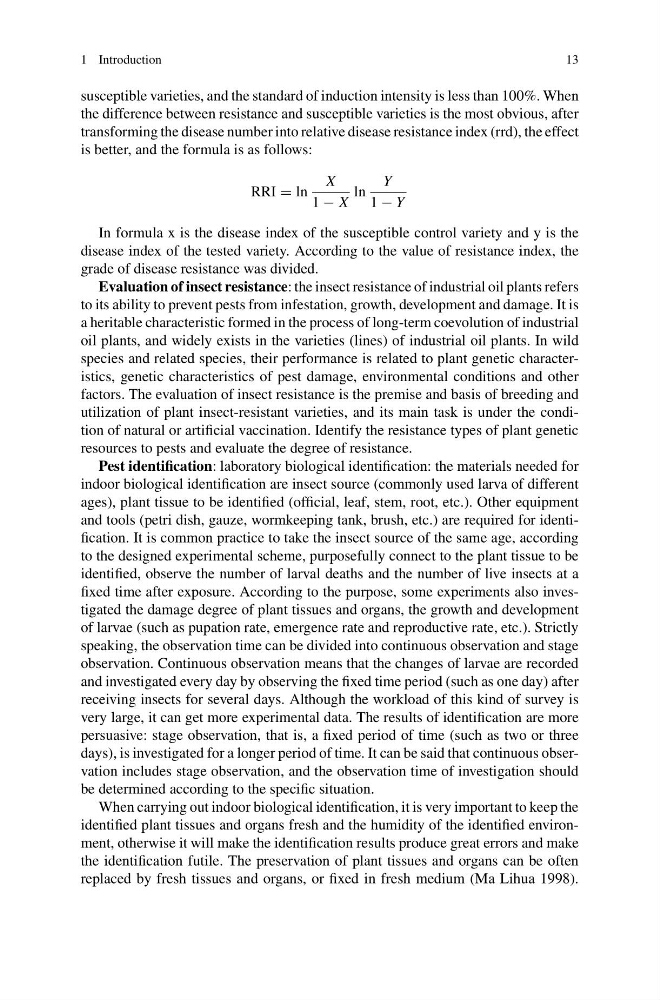
is better, and the formula is as follows:
RRI = ln
X
1 − X
ln
Y
1 − Y
In formula x is the disease index of the susceptible control variety and y is the
disease index of the tested variety. According to the value of resistance index, the
grade of disease resistance was divided.
Evaluation of insect resistance: the insect resistance of industrial oil plants refers
to its ability to prevent pests from infestation, growth, development and damage. It is
a heritable characteristic formed in the process of long-term coevolution of industrial
oil plants, and widely exists in the varieties (lines) of industrial oil plants. In wild
species and related species, their performance is related to plant genetic characteristics, genetic characteristics of pest damage, environmental conditions and other
factors. The evaluation of insect resistance is the premise and basis of breeding and
utilization of plant insect-resistant varieties, and its main task is under the condition of natural or artificial vaccination. Identify the resistance types of plant genetic
resources to pests and evaluate the degree of resistance.
Pest identification: laboratory biological identification: the materials needed for
indoor biological identification are insect source (commonly used larva of different
ages), plant tissue to be identified (official, leaf, stem, root, etc.). Other equipment
and tools (petri dish, gauze, wormkeeping tank, brush, etc.) are required for identification. It is common practice to take the insect source of the same age, according
to the designed experimental scheme, purposefully connect to the plant tissue to be
identified, observe the number of larval deaths and the number of live insects at a
fixed time after exposure. According to the purpose, some experiments also investigated the damage degree of plant tissues and organs, the growth and development
of larvae (such as pupation rate, emergence rate and reproductive rate, etc.). Strictly
speaking, the observation time can be divided into continuous observation and stage
observation. Continuous observation means that the changes of larvae are recorded
and investigated every day by observing the fixed time period (such as one day) after
receiving insects for several days. Although the workload of this kind of survey is
very large, it can get more experimental data. The results of identification are more
persuasive: stage observation, that is, a fixed period of time (such as two or three
days), is investigated for a longer period of time. It can be said that continuous observation includes stage observation, and the observation time of investigation should
be determined according to the specific situation.
When carrying out indoor biological identification, it is very important to keep the
identified plant tissues and organs fresh and the humidity of the identified environment, otherwise it will make the identification results produce great errors and make
the identification futile. The preservation of plant tissues and organs can be often
replaced by fresh tissues and organs, or fixed in fresh medium (Ma Lihua 1998).
13
susceptible varieties, and the standard of induction intensity is less than 100%. When
the difference between resistance and susceptible varieties is the most obvious, after
transforming the disease number into relative disease resistance index (rrd), the effect
is better, and the formula is as follows:
RRI = ln
X
1 − X
ln
Y
1 − Y
In formula x is the disease index of the susceptible control variety and y is the
disease index of the tested variety. According to the value of resistance index, the
grade of disease resistance was divided.
Evaluation of insect resistance: the insect resistance of industrial oil plants refers
to its ability to prevent pests from infestation, growth, development and damage. It is
a heritable characteristic formed in the process of long-term coevolution of industrial
oil plants, and widely exists in the varieties (lines) of industrial oil plants. In wild
species and related species, their performance is related to plant genetic characteristics, genetic characteristics of pest damage, environmental conditions and other
factors. The evaluation of insect resistance is the premise and basis of breeding and
utilization of plant insect-resistant varieties, and its main task is under the condition of natural or artificial vaccination. Identify the resistance types of plant genetic
resources to pests and evaluate the degree of resistance.
Pest identification: laboratory biological identification: the materials needed for
indoor biological identification are insect source (commonly used larva of different
ages), plant tissue to be identified (official, leaf, stem, root, etc.). Other equipment
and tools (petri dish, gauze, wormkeeping tank, brush, etc.) are required for identification. It is common practice to take the insect source of the same age, according
to the designed experimental scheme, purposefully connect to the plant tissue to be
identified, observe the number of larval deaths and the number of live insects at a
fixed time after exposure. According to the purpose, some experiments also investigated the damage degree of plant tissues and organs, the growth and development
of larvae (such as pupation rate, emergence rate and reproductive rate, etc.). Strictly
speaking, the observation time can be divided into continuous observation and stage
observation. Continuous observation means that the changes of larvae are recorded
and investigated every day by observing the fixed time period (such as one day) after
receiving insects for several days. Although the workload of this kind of survey is
very large, it can get more experimental data. The results of identification are more
persuasive: stage observation, that is, a fixed period of time (such as two or three
days), is investigated for a longer period of time. It can be said that continuous observation includes stage observation, and the observation time of investigation should
be determined according to the specific situation.
When carrying out indoor biological identification, it is very important to keep the
identified plant tissues and organs fresh and the humidity of the identified environment, otherwise it will make the identification results produce great errors and make
the identification futile. The preservation of plant tissues and organs can be often
replaced by fresh tissues and organs, or fixed in fresh medium (Ma Lihua 1998).