

12
J. Chen et al.
blight is related to catalase activity in leaves. There was also a certain correlation
between the activity of polyphenol oxidase and its disease resistance in the field.
Whether the enzymes in other plants are also related to their resistance needs further biochemical analysis. At present, the differences of isozymes (such as peroxide
isozymes and esterase isozymes) between resistant plants and controls were studied.
Molecular identification and screening: The resistant genes of resistant plants
were cloned and identified by PCR, RAPD and RFLP molecular biological techniques, and the differences between them and susceptible plants were analyzed to
determine whether the resistance identification and screening of resistant plants
could be carried out by gene molecular method. At present, it is still in the stage
of exploration.
Disease resistance classification: the main basis for evaluating plant disease
resistance is the performance of the disease. The disease investigation can adopt
the established index and standard, so the disease resistance can also be graded or
quantitatively graded.
Qualitative classification: to the disease resistance of allergic necrosis reaction,
or to the disease resistance which is mainly resistant to expansion, the method of
grading according to the reaction type is generally adopted. The classification of
the reaction type is mainly based on the strength of the infection point necrosis
reaction, the size of the disease spot, the shape and color of the disease. The degree
of development of fruiting body and the thickness of mycelium layer on the lesion
spot were divided into two parts: the degree of development of fruiting body and the
thickness of mycelium layer.
Quantitative grading: quantitative classification is the basis of most resistance
identification, and the most commonly used quantitative survey indexes are incidence, severity and disease index. The incidence rate refers to the diseased plant
rate, diseased leaf rate, diseased stem rate, diseased fruit rate and so on. The number
of infected individuals accounts for the percentage of the total number of patients
investigated, which is used to indicate the degree of prevalence of the disease. The
severity indicates the severity of the disease, and the severity grade can be divided
according to the incidence degree of a single leaf, plant or whole field, or can be
divided into comprehensive consideration, and a grading standard index table or a
grading standard chart can be made. According to the visual estimation, the severity
of leaf disease can be graded according to the percentage of spot area in the total area,
and the distance between severity and severity can be equal distance or equal ratio
sequence. The disease index is the comprehensive value of incidence and severity,
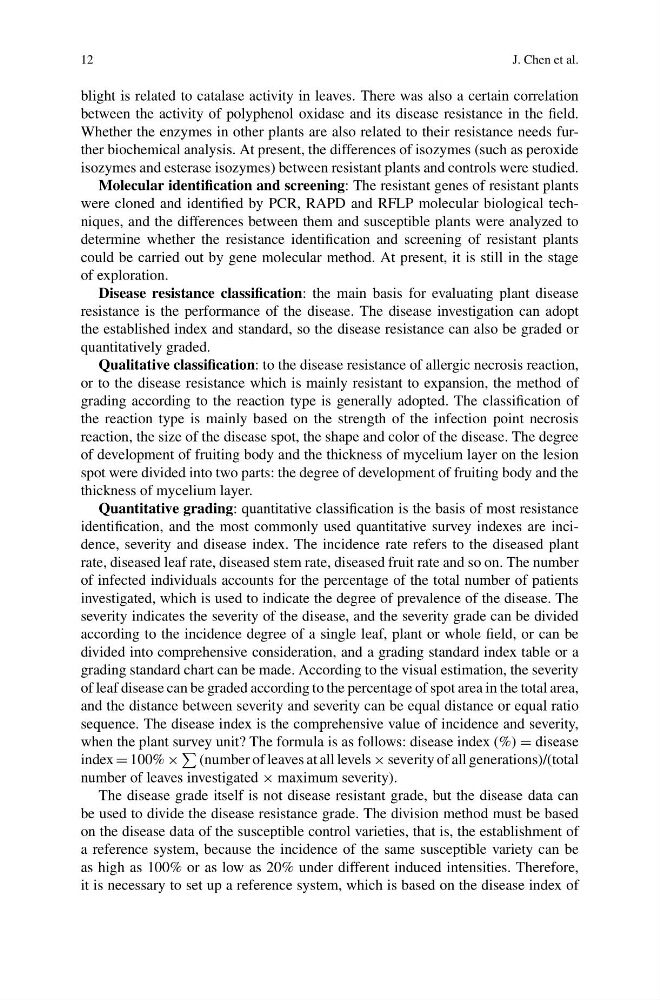
when the plant survey unit? The formula is as follows: disease index (%) = disease
index = 100% ×
(number of leaves at all levels × severity of all generations)/(total
number of leaves investigated × maximum severity).
The disease grade itself is not disease resistant grade, but the disease data can
be used to divide the disease resistance grade. The division method must be based
on the disease data of the susceptible control varieties, that is, the establishment of
a reference system, because the incidence of the same susceptible variety can be
as high as 100% or as low as 20% under different induced intensities. Therefore,
it is necessary to set up a reference system, which is based on the disease index of
J. Chen et al.
blight is related to catalase activity in leaves. There was also a certain correlation
between the activity of polyphenol oxidase and its disease resistance in the field.
Whether the enzymes in other plants are also related to their resistance needs further biochemical analysis. At present, the differences of isozymes (such as peroxide
isozymes and esterase isozymes) between resistant plants and controls were studied.
Molecular identification and screening: The resistant genes of resistant plants
were cloned and identified by PCR, RAPD and RFLP molecular biological techniques, and the differences between them and susceptible plants were analyzed to
determine whether the resistance identification and screening of resistant plants
could be carried out by gene molecular method. At present, it is still in the stage
of exploration.
Disease resistance classification: the main basis for evaluating plant disease
resistance is the performance of the disease. The disease investigation can adopt
the established index and standard, so the disease resistance can also be graded or
quantitatively graded.
Qualitative classification: to the disease resistance of allergic necrosis reaction,
or to the disease resistance which is mainly resistant to expansion, the method of
grading according to the reaction type is generally adopted. The classification of
the reaction type is mainly based on the strength of the infection point necrosis
reaction, the size of the disease spot, the shape and color of the disease. The degree
of development of fruiting body and the thickness of mycelium layer on the lesion
spot were divided into two parts: the degree of development of fruiting body and the
thickness of mycelium layer.
Quantitative grading: quantitative classification is the basis of most resistance
identification, and the most commonly used quantitative survey indexes are incidence, severity and disease index. The incidence rate refers to the diseased plant
rate, diseased leaf rate, diseased stem rate, diseased fruit rate and so on. The number
of infected individuals accounts for the percentage of the total number of patients
investigated, which is used to indicate the degree of prevalence of the disease. The
severity indicates the severity of the disease, and the severity grade can be divided
according to the incidence degree of a single leaf, plant or whole field, or can be
divided into comprehensive consideration, and a grading standard index table or a
grading standard chart can be made. According to the visual estimation, the severity
of leaf disease can be graded according to the percentage of spot area in the total area,
and the distance between severity and severity can be equal distance or equal ratio
sequence. The disease index is the comprehensive value of incidence and severity,
when the plant survey unit? The formula is as follows: disease index (%) = disease
index = 100% ×
(number of leaves at all levels × severity of all generations)/(total
number of leaves investigated × maximum severity).
The disease grade itself is not disease resistant grade, but the disease data can
be used to divide the disease resistance grade. The division method must be based
on the disease data of the susceptible control varieties, that is, the establishment of
a reference system, because the incidence of the same susceptible variety can be
as high as 100% or as low as 20% under different induced intensities. Therefore,
it is necessary to set up a reference system, which is based on the disease index of