

188
Y. Cao et al.
CH 2 O C
O
CH 2 CH 2 CH 2 CH 2 CH 2 CH 2 CH 2 CH CH CH 2 CH CH 2 CH 2 CH 2 CH 2 CH 2 CH 3
C O C
O
CH 2 CH 2 CH 2 CH 2 CH 2 CH 2 CH 2 CH CH CH 2 CH CH 2 CH 2 CH 2 CH 2 CH 2 CH 3
CH 2 O C
O
CH 2 CH 2 CH 2 CH 2 CH 2 CH 2 CH 2 CH CH CH 2 CH CH 2 CH 2 CH 2 CH 2 CH 2 CH 3
OH
OH
H 2 C
H 3 C
OH
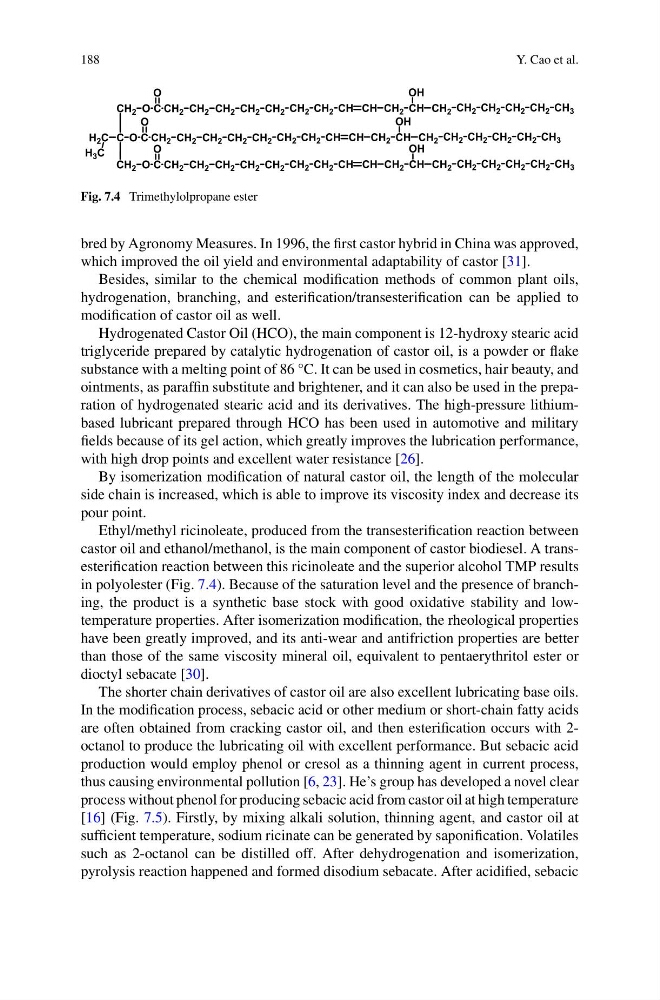
Fig. 7.4 Trimethylolpropane ester
bred by Agronomy Measures. In 1996, the first castor hybrid in China was approved,
which improved the oil yield and environmental adaptability of castor [31].
Besides, similar to the chemical modification methods of common plant oils,
hydrogenation, branching, and esterification/transesterification can be applied to
modification of castor oil as well.
Hydrogenated Castor Oil (HCO), the main component is 12-hydroxy stearic acid
triglyceride prepared by catalytic hydrogenation of castor oil, is a powder or flake
substance with a melting point of 86 °C. It can be used in cosmetics, hair beauty, and
ointments, as paraffin substitute and brightener, and it can also be used in the preparation of hydrogenated stearic acid and its derivatives. The high-pressure lithiumbased lubricant prepared through HCO has been used in automotive and military
fields because of its gel action, which greatly improves the lubrication performance,
with high drop points and excellent water resistance [26].
By isomerization modification of natural castor oil, the length of the molecular
side chain is increased, which is able to improve its viscosity index and decrease its
pour point.
Ethyl/methyl ricinoleate, produced from the transesterification reaction between
castor oil and ethanol/methanol, is the main component of castor biodiesel. A transesterification reaction between this ricinoleate and the superior alcohol TMP results
in polyolester (Fig. 7.4). Because of the saturation level and the presence of branching, the product is a synthetic base stock with good oxidative stability and lowtemperature properties. After isomerization modification, the rheological properties
have been greatly improved, and its anti-wear and antifriction properties are better
than those of the same viscosity mineral oil, equivalent to pentaerythritol ester or
dioctyl sebacate [30].
The shorter chain derivatives of castor oil are also excellent lubricating base oils.
In the modification process, sebacic acid or other medium or short-chain fatty acids
are often obtained from cracking castor oil, and then esterification occurs with 2octanol to produce the lubricating oil with excellent performance. But sebacic acid
production would employ phenol or cresol as a thinning agent in current process,
thus causing environmental pollution [6, 23]. He’s group has developed a novel clear
process without phenol for producing sebacic acid from castor oil at high temperature
[16] (Fig. 7.5). Firstly, by mixing alkali solution, thinning agent, and castor oil at
sufficient temperature, sodium ricinate can be generated by saponification. Volatiles
such as 2-octanol can be distilled off. After dehydrogenation and isomerization,
pyrolysis reaction happened and formed disodium sebacate. After acidified, sebacic
Y. Cao et al.
CH 2 O C
O
CH 2 CH 2 CH 2 CH 2 CH 2 CH 2 CH 2 CH CH CH 2 CH CH 2 CH 2 CH 2 CH 2 CH 2 CH 3
C O C
O
CH 2 CH 2 CH 2 CH 2 CH 2 CH 2 CH 2 CH CH CH 2 CH CH 2 CH 2 CH 2 CH 2 CH 2 CH 3
CH 2 O C
O
CH 2 CH 2 CH 2 CH 2 CH 2 CH 2 CH 2 CH CH CH 2 CH CH 2 CH 2 CH 2 CH 2 CH 2 CH 3
OH
OH
H 2 C
H 3 C
OH
Fig. 7.4 Trimethylolpropane ester
bred by Agronomy Measures. In 1996, the first castor hybrid in China was approved,
which improved the oil yield and environmental adaptability of castor [31].
Besides, similar to the chemical modification methods of common plant oils,
hydrogenation, branching, and esterification/transesterification can be applied to
modification of castor oil as well.
Hydrogenated Castor Oil (HCO), the main component is 12-hydroxy stearic acid
triglyceride prepared by catalytic hydrogenation of castor oil, is a powder or flake
substance with a melting point of 86 °C. It can be used in cosmetics, hair beauty, and
ointments, as paraffin substitute and brightener, and it can also be used in the preparation of hydrogenated stearic acid and its derivatives. The high-pressure lithiumbased lubricant prepared through HCO has been used in automotive and military
fields because of its gel action, which greatly improves the lubrication performance,
with high drop points and excellent water resistance [26].
By isomerization modification of natural castor oil, the length of the molecular
side chain is increased, which is able to improve its viscosity index and decrease its
pour point.
Ethyl/methyl ricinoleate, produced from the transesterification reaction between
castor oil and ethanol/methanol, is the main component of castor biodiesel. A transesterification reaction between this ricinoleate and the superior alcohol TMP results
in polyolester (Fig. 7.4). Because of the saturation level and the presence of branching, the product is a synthetic base stock with good oxidative stability and lowtemperature properties. After isomerization modification, the rheological properties
have been greatly improved, and its anti-wear and antifriction properties are better
than those of the same viscosity mineral oil, equivalent to pentaerythritol ester or
dioctyl sebacate [30].
The shorter chain derivatives of castor oil are also excellent lubricating base oils.
In the modification process, sebacic acid or other medium or short-chain fatty acids
are often obtained from cracking castor oil, and then esterification occurs with 2octanol to produce the lubricating oil with excellent performance. But sebacic acid
production would employ phenol or cresol as a thinning agent in current process,
thus causing environmental pollution [6, 23]. He’s group has developed a novel clear
process without phenol for producing sebacic acid from castor oil at high temperature
[16] (Fig. 7.5). Firstly, by mixing alkali solution, thinning agent, and castor oil at
sufficient temperature, sodium ricinate can be generated by saponification. Volatiles
such as 2-octanol can be distilled off. After dehydrogenation and isomerization,
pyrolysis reaction happened and formed disodium sebacate. After acidified, sebacic