

6 By-Products of Biodiesel and Their Recycling
161
III. Base treatment [18]. After degumming and filtration, the acidic filtrate still
contains an excessive amount of ferric chloride. Base treatment is applied to neutralize acid and reduce corrosion on the equipment. It also transforms ferric chloride
into ferric hydroxide precipitate and absorbs impurities that can be removed through
filtration.
Normally, caustic soda solution is used for this purpose. The amount of base
solution used in base treatment is crucial to glycerol quality, recycling, and evaporation procedures. Since acidic solution also contains a little lower fatty acid soap,
the amount of base added should be controlled to avoid foam during evaporation
and facilitate the hydrolysis process of soap solution as it turns into fatty acids.
Besides, part of the lower fatty acids will escape during the evaporation process,
which enhances the glycerol quality. Otherwise, soap tends to foam during the evaporation, which will cause unnecessary loss of substances including glycerol, and lead
to salt coagulation in the heating pipe, which decreases the efficiency of evaporation
equipment and adds to the burden of equipment washing. Moreover, excessive bases
will lead to extra losses due to glycerol polymerization during distillation. However,
insufficient base will cause the solution to become acidic. For base treatment, the pH
value should be strictly maintained between 8 and 9, particularly not exceeding 9.
b. Purification of oils and fats hydrolysis wastewater [19]. The glycerol concentration in oils and fats hydrolysis wastewater is usually between 10 and 15%. The
composition and amount of its impurities are relevant to the hydrolysis method.
Whatever method is used, the impurities in wastewater affects the concentration and
distillation operations, as well as the quality and recycling percentage of glycerol.
Therefore, oils and fats hydrolysis wastewater should also be purified.
Catalytic hydrolysis of oils and fats produces more impurities in its wastewater
[20], including sulfuric acid, sulphonic acid, low molecular weight organic acids,
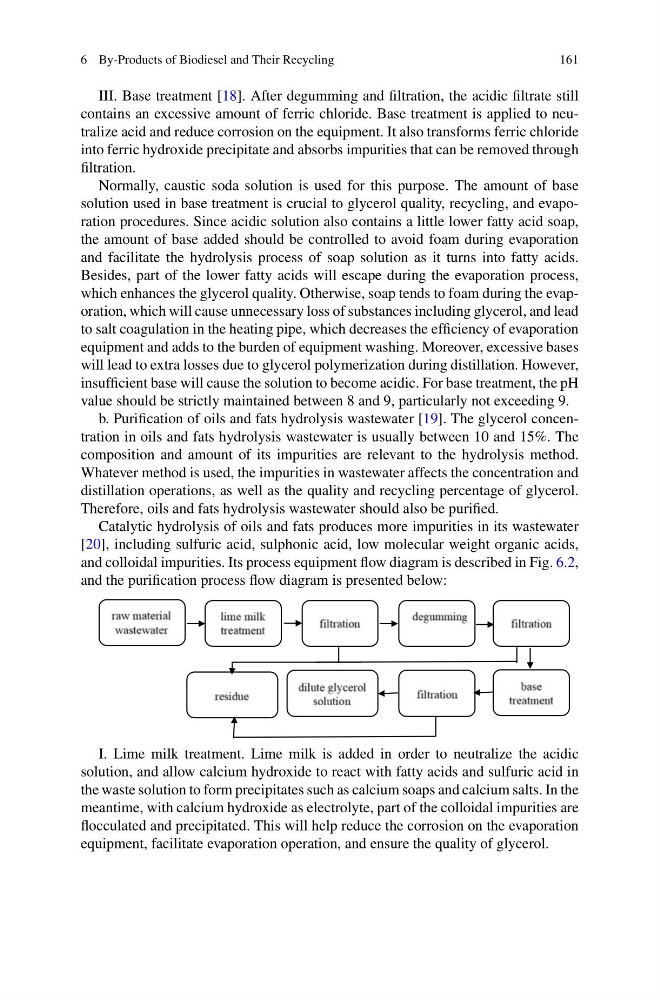
and colloidal impurities. Its process equipment flow diagram is described in Fig. 6.2,
and the purification process flow diagram is presented below:
I. Lime milk treatment. Lime milk is added in order to neutralize the acidic
solution, and allow calcium hydroxide to react with fatty acids and sulfuric acid in
the waste solution to form precipitates such as calcium soaps and calcium salts. In the
meantime, with calcium hydroxide as electrolyte, part of the colloidal impurities are
flocculated and precipitated. This will help reduce the corrosion on the evaporation
equipment, facilitate evaporation operation, and ensure the quality of glycerol.
161
III. Base treatment [18]. After degumming and filtration, the acidic filtrate still
contains an excessive amount of ferric chloride. Base treatment is applied to neutralize acid and reduce corrosion on the equipment. It also transforms ferric chloride
into ferric hydroxide precipitate and absorbs impurities that can be removed through
filtration.
Normally, caustic soda solution is used for this purpose. The amount of base
solution used in base treatment is crucial to glycerol quality, recycling, and evaporation procedures. Since acidic solution also contains a little lower fatty acid soap,
the amount of base added should be controlled to avoid foam during evaporation
and facilitate the hydrolysis process of soap solution as it turns into fatty acids.
Besides, part of the lower fatty acids will escape during the evaporation process,
which enhances the glycerol quality. Otherwise, soap tends to foam during the evaporation, which will cause unnecessary loss of substances including glycerol, and lead
to salt coagulation in the heating pipe, which decreases the efficiency of evaporation
equipment and adds to the burden of equipment washing. Moreover, excessive bases
will lead to extra losses due to glycerol polymerization during distillation. However,
insufficient base will cause the solution to become acidic. For base treatment, the pH
value should be strictly maintained between 8 and 9, particularly not exceeding 9.
b. Purification of oils and fats hydrolysis wastewater [19]. The glycerol concentration in oils and fats hydrolysis wastewater is usually between 10 and 15%. The
composition and amount of its impurities are relevant to the hydrolysis method.
Whatever method is used, the impurities in wastewater affects the concentration and
distillation operations, as well as the quality and recycling percentage of glycerol.
Therefore, oils and fats hydrolysis wastewater should also be purified.
Catalytic hydrolysis of oils and fats produces more impurities in its wastewater
[20], including sulfuric acid, sulphonic acid, low molecular weight organic acids,
and colloidal impurities. Its process equipment flow diagram is described in Fig. 6.2,
and the purification process flow diagram is presented below:
I. Lime milk treatment. Lime milk is added in order to neutralize the acidic
solution, and allow calcium hydroxide to react with fatty acids and sulfuric acid in
the waste solution to form precipitates such as calcium soaps and calcium salts. In the
meantime, with calcium hydroxide as electrolyte, part of the colloidal impurities are
flocculated and precipitated. This will help reduce the corrosion on the evaporation
equipment, facilitate evaporation operation, and ensure the quality of glycerol.