

160
L. Lin et al.
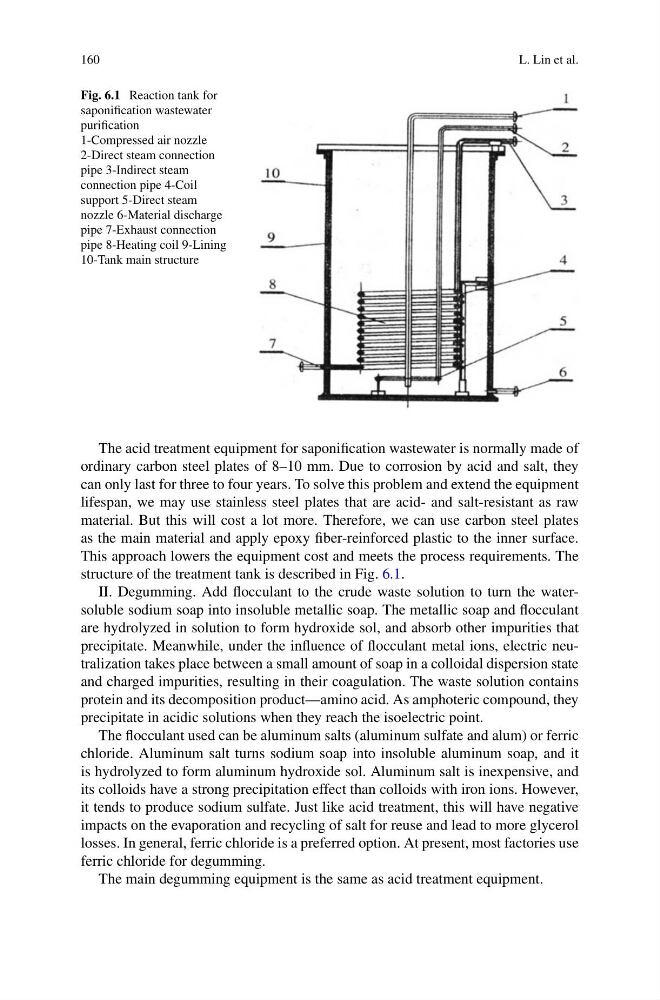
Fig. 6.1 Reaction tank for
saponification wastewater
purification
1-Compressed air nozzle
2-Direct steam connection
pipe 3-Indirect steam
connection pipe 4-Coil
support 5-Direct steam
nozzle 6-Material discharge
pipe 7-Exhaust connection
pipe 8-Heating coil 9-Lining
10-Tank main structure
The acid treatment equipment for saponification wastewater is normally made of
ordinary carbon steel plates of 8–10 mm. Due to corrosion by acid and salt, they
can only last for three to four years. To solve this problem and extend the equipment
lifespan, we may use stainless steel plates that are acid- and salt-resistant as raw
material. But this will cost a lot more. Therefore, we can use carbon steel plates
as the main material and apply epoxy fiber-reinforced plastic to the inner surface.
This approach lowers the equipment cost and meets the process requirements. The
structure of the treatment tank is described in Fig. 6.1.
II. Degumming. Add flocculant to the crude waste solution to turn the watersoluble sodium soap into insoluble metallic soap. The metallic soap and flocculant
are hydrolyzed in solution to form hydroxide sol, and absorb other impurities that
precipitate. Meanwhile, under the influence of flocculant metal ions, electric neutralization takes place between a small amount of soap in a colloidal dispersion state
and charged impurities, resulting in their coagulation. The waste solution contains
protein and its decomposition product—amino acid. As amphoteric compound, they
precipitate in acidic solutions when they reach the isoelectric point.
The flocculant used can be aluminum salts (aluminum sulfate and alum) or ferric
chloride. Aluminum salt turns sodium soap into insoluble aluminum soap, and it
is hydrolyzed to form aluminum hydroxide sol. Aluminum salt is inexpensive, and
its colloids have a strong precipitation effect than colloids with iron ions. However,
it tends to produce sodium sulfate. Just like acid treatment, this will have negative
impacts on the evaporation and recycling of salt for reuse and lead to more glycerol
losses. In general, ferric chloride is a preferred option. At present, most factories use
ferric chloride for degumming.
The main degumming equipment is the same as acid treatment equipment.
L. Lin et al.
Fig. 6.1 Reaction tank for
saponification wastewater
purification
1-Compressed air nozzle
2-Direct steam connection
pipe 3-Indirect steam
connection pipe 4-Coil
support 5-Direct steam
nozzle 6-Material discharge
pipe 7-Exhaust connection
pipe 8-Heating coil 9-Lining
10-Tank main structure
The acid treatment equipment for saponification wastewater is normally made of
ordinary carbon steel plates of 8–10 mm. Due to corrosion by acid and salt, they
can only last for three to four years. To solve this problem and extend the equipment
lifespan, we may use stainless steel plates that are acid- and salt-resistant as raw
material. But this will cost a lot more. Therefore, we can use carbon steel plates
as the main material and apply epoxy fiber-reinforced plastic to the inner surface.
This approach lowers the equipment cost and meets the process requirements. The
structure of the treatment tank is described in Fig. 6.1.
II. Degumming. Add flocculant to the crude waste solution to turn the watersoluble sodium soap into insoluble metallic soap. The metallic soap and flocculant
are hydrolyzed in solution to form hydroxide sol, and absorb other impurities that
precipitate. Meanwhile, under the influence of flocculant metal ions, electric neutralization takes place between a small amount of soap in a colloidal dispersion state
and charged impurities, resulting in their coagulation. The waste solution contains
protein and its decomposition product—amino acid. As amphoteric compound, they
precipitate in acidic solutions when they reach the isoelectric point.
The flocculant used can be aluminum salts (aluminum sulfate and alum) or ferric
chloride. Aluminum salt turns sodium soap into insoluble aluminum soap, and it
is hydrolyzed to form aluminum hydroxide sol. Aluminum salt is inexpensive, and
its colloids have a strong precipitation effect than colloids with iron ions. However,
it tends to produce sodium sulfate. Just like acid treatment, this will have negative
impacts on the evaporation and recycling of salt for reuse and lead to more glycerol
losses. In general, ferric chloride is a preferred option. At present, most factories use
ferric chloride for degumming.
The main degumming equipment is the same as acid treatment equipment.