

6 By-Products of Biodiesel and Their Recycling
159
At present, the main raw materials of natural glycerol originate from the oils and
fats hydrolysis wastewater and saponification wastewater. The production process
is as follows: raw material wastewater → wastewater purification → concentrated
dilute glycerol solution → crude glycerol → refining → finished glycerol product.
(2) Purification of raw material wastewater
In the oils and fats hydrolysis wastewater and saponification wastewater, there are
many types of impurities in addition to glycerol. Raw material wastewater must be
purified before concentration to remove the impurities. This approach can help avoid
glycerol losses due to solution fermentation, reduce corrosion of glycerol solution
on evaporation equipment, reduce fouling on equipment, improve heat transfer efficiency, facilitate evaporation and distillation, and enhance the quality and recovery
percentage of glycerol.
For different glycerol production techniques [12–15], the impurities in wastewater have various properties and amounts. Therefore, different purification methods
are needed, including chemical purification, ion-exchange purification, and electric
purification.
➀ Chemical purification
a. Purification of oils and fats saponification wastewater. Oils and fats are saponified
and salted out to produce wastewater that contains 10–15% of salt, 5–10% of glycerol, 0.1–0.5% of total alkali (sodium hydroxide and sodium carbonate), less than
0.25% of soap and other trace components including protein, mucus substances,
resin, hydrocarbons, pigment, fermentation products, and sediments [16, 17]. The
wastewater must first be purified to ensure the quality of glycerol, and the operation
conditions of evaporation and distillation must be improved as much as possible.
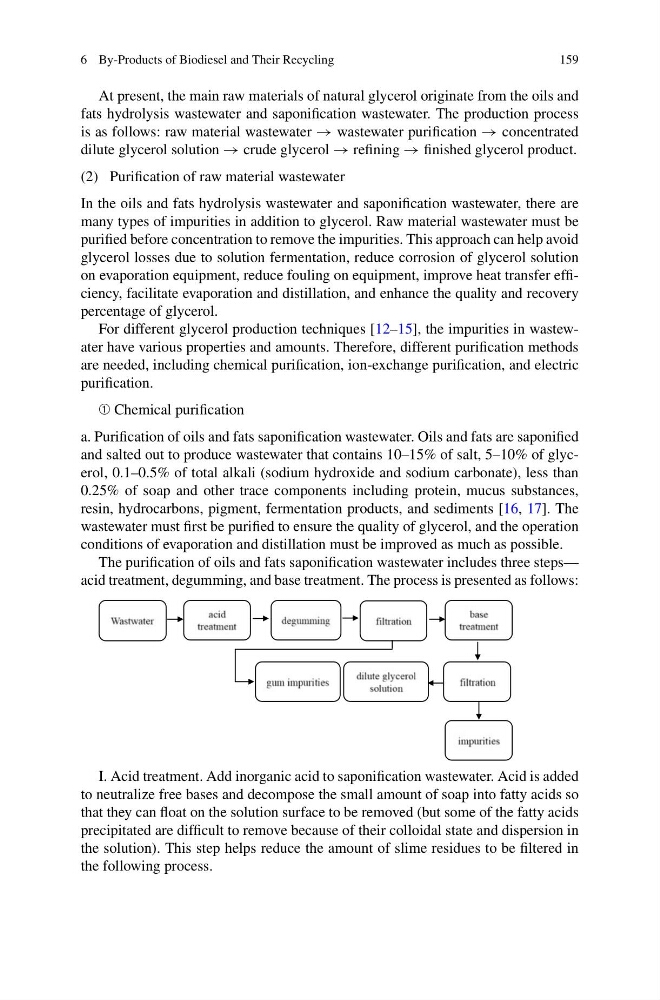
The purification of oils and fats saponification wastewater includes three steps—
acid treatment, degumming, and base treatment. The process is presented as follows:
I. Acid treatment. Add inorganic acid to saponification wastewater. Acid is added
to neutralize free bases and decompose the small amount of soap into fatty acids so
that they can float on the solution surface to be removed (but some of the fatty acids
precipitated are difficult to remove because of their colloidal state and dispersion in
the solution). This step helps reduce the amount of slime residues to be filtered in
the following process.
159
At present, the main raw materials of natural glycerol originate from the oils and
fats hydrolysis wastewater and saponification wastewater. The production process
is as follows: raw material wastewater → wastewater purification → concentrated
dilute glycerol solution → crude glycerol → refining → finished glycerol product.
(2) Purification of raw material wastewater
In the oils and fats hydrolysis wastewater and saponification wastewater, there are
many types of impurities in addition to glycerol. Raw material wastewater must be
purified before concentration to remove the impurities. This approach can help avoid
glycerol losses due to solution fermentation, reduce corrosion of glycerol solution
on evaporation equipment, reduce fouling on equipment, improve heat transfer efficiency, facilitate evaporation and distillation, and enhance the quality and recovery
percentage of glycerol.
For different glycerol production techniques [12–15], the impurities in wastewater have various properties and amounts. Therefore, different purification methods
are needed, including chemical purification, ion-exchange purification, and electric
purification.
➀ Chemical purification
a. Purification of oils and fats saponification wastewater. Oils and fats are saponified
and salted out to produce wastewater that contains 10–15% of salt, 5–10% of glycerol, 0.1–0.5% of total alkali (sodium hydroxide and sodium carbonate), less than
0.25% of soap and other trace components including protein, mucus substances,
resin, hydrocarbons, pigment, fermentation products, and sediments [16, 17]. The
wastewater must first be purified to ensure the quality of glycerol, and the operation
conditions of evaporation and distillation must be improved as much as possible.
The purification of oils and fats saponification wastewater includes three steps—
acid treatment, degumming, and base treatment. The process is presented as follows:
I. Acid treatment. Add inorganic acid to saponification wastewater. Acid is added
to neutralize free bases and decompose the small amount of soap into fatty acids so
that they can float on the solution surface to be removed (but some of the fatty acids
precipitated are difficult to remove because of their colloidal state and dispersion in
the solution). This step helps reduce the amount of slime residues to be filtered in
the following process.