

154
C. Li et al.
that inexpensive textiles are easy to recycle and reuse. The corresponding immobilized enzyme has a long lifespan and can be used continuously. For esterification of
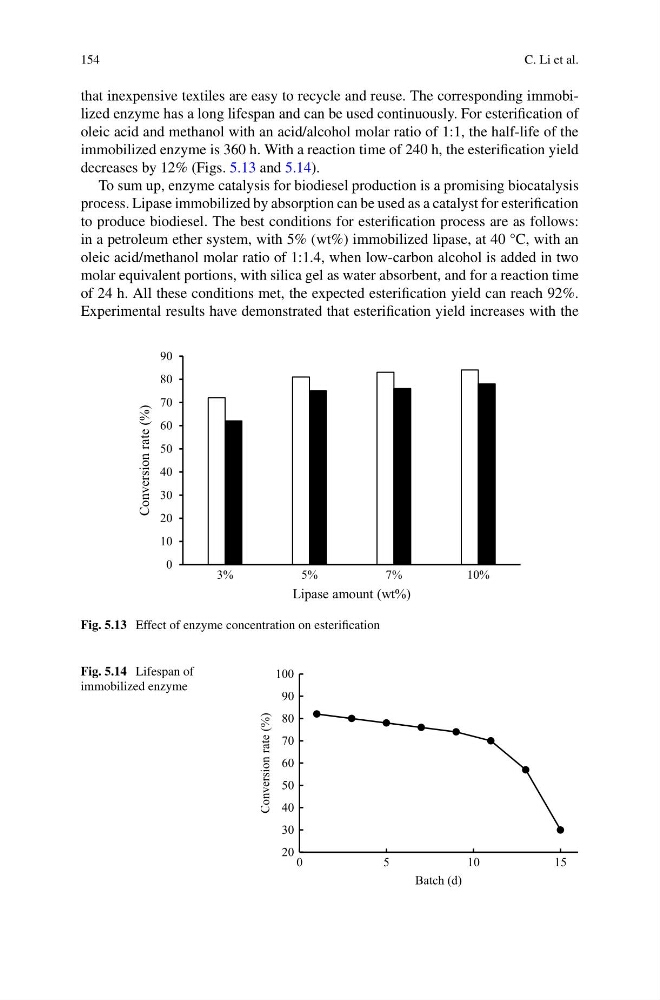
oleic acid and methanol with an acid/alcohol molar ratio of 1:1, the half-life of the
immobilized enzyme is 360 h. With a reaction time of 240 h, the esterification yield
decreases by 12% (Figs. 5.13 and 5.14).
To sum up, enzyme catalysis for biodiesel production is a promising biocatalysis
process. Lipase immobilized by absorption can be used as a catalyst for esterification
to produce biodiesel. The best conditions for esterification process are as follows:
in a petroleum ether system, with 5% (wt%) immobilized lipase, at 40 °C, with an
oleic acid/methanol molar ratio of 1:1.4, when low-carbon alcohol is added in two
molar equivalent portions, with silica gel as water absorbent, and for a reaction time
of 24 h. All these conditions met, the expected esterification yield can reach 92%.
Experimental results have demonstrated that esterification yield increases with the
0
10
20
30
40
50
60
70
80
90
3%
5%
7%
10%
Conversion rate (%)
Lipase amount (wt%)
Fig. 5.13 Effect of enzyme concentration on esterification
Fig. 5.14 Lifespan of
immobilized enzyme
20
30
40
50
60
70
80
90
100
0
5
10
15
Conversion rate (%)
Batch (d)
C. Li et al.
that inexpensive textiles are easy to recycle and reuse. The corresponding immobilized enzyme has a long lifespan and can be used continuously. For esterification of
oleic acid and methanol with an acid/alcohol molar ratio of 1:1, the half-life of the
immobilized enzyme is 360 h. With a reaction time of 240 h, the esterification yield
decreases by 12% (Figs. 5.13 and 5.14).
To sum up, enzyme catalysis for biodiesel production is a promising biocatalysis
process. Lipase immobilized by absorption can be used as a catalyst for esterification
to produce biodiesel. The best conditions for esterification process are as follows:
in a petroleum ether system, with 5% (wt%) immobilized lipase, at 40 °C, with an
oleic acid/methanol molar ratio of 1:1.4, when low-carbon alcohol is added in two
molar equivalent portions, with silica gel as water absorbent, and for a reaction time
of 24 h. All these conditions met, the expected esterification yield can reach 92%.
Experimental results have demonstrated that esterification yield increases with the
0
10
20
30
40
50
60
70
80
90
3%
5%
7%
10%
Conversion rate (%)
Lipase amount (wt%)
Fig. 5.13 Effect of enzyme concentration on esterification
Fig. 5.14 Lifespan of
immobilized enzyme
20
30
40
50
60
70
80
90
100
0
5
10
15
Conversion rate (%)
Batch (d)