

152
C. Li et al.
Table 5.6 Effect of various
lipase on esterification
Lipase
Conversion rate/%
Procine Pancreas (from Sigma Co.)
22.45
Immobilized Porcine Pancreas
13.79
Lipolase 100T (from Novo Co.)
(immobilized lipase)
42.17
Free lipase from Rhizoups arrhizus
(from our lab)
66.39
Immobilized lipase from Rhizoups
arrhizus
26.31
Free lipase from Rhizoups usamil (from
our lab)
61.18
Immobilized lipase from Rhizoups
usamil
20.60
Free Candida Cylindracea (from Sigma) 19.72
Immobilized Candida Cylindracea
17.20
Free lipase from Candida sp. 99–125
(from our lab)
80.50
Immobilized lipase from Candida
sp. 99–125
81.51
Amount of lipase; 3% (free), 5% (IM); other conditions are same
as 1.3.2; to add methanol stepwise
5.2.9 Effect of Various Lipase on Reaction
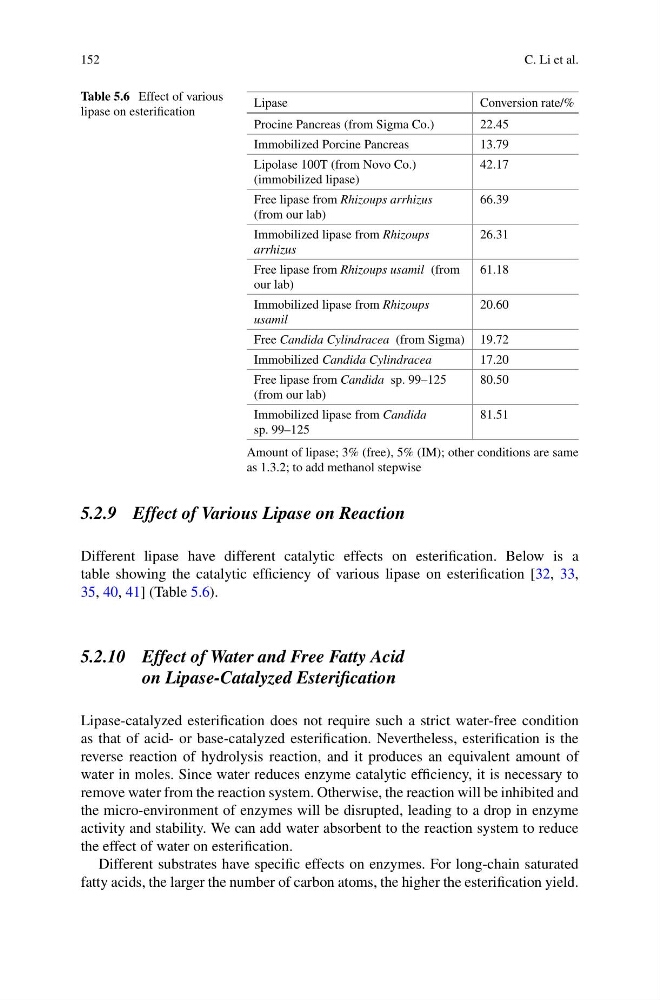
Different lipase have different catalytic effects on esterification. Below is a
table showing the catalytic efficiency of various lipase on esterification [32, 33,
35, 40, 41] (Table 5.6).
5.2.10 Effect of Water and Free Fatty Acid
on Lipase-Catalyzed Esterification
Lipase-catalyzed esterification does not require such a strict water-free condition
as that of acid- or base-catalyzed esterification. Nevertheless, esterification is the
reverse reaction of hydrolysis reaction, and it produces an equivalent amount of
water in moles. Since water reduces enzyme catalytic efficiency, it is necessary to
remove water from the reaction system. Otherwise, the reaction will be inhibited and
the micro-environment of enzymes will be disrupted, leading to a drop in enzyme
activity and stability. We can add water absorbent to the reaction system to reduce
the effect of water on esterification.
Different substrates have specific effects on enzymes. For long-chain saturated
fatty acids, the larger the number of carbon atoms, the higher the esterification yield.
C. Li et al.
Table 5.6 Effect of various
lipase on esterification
Lipase
Conversion rate/%
Procine Pancreas (from Sigma Co.)
22.45
Immobilized Porcine Pancreas
13.79
Lipolase 100T (from Novo Co.)
(immobilized lipase)
42.17
Free lipase from Rhizoups arrhizus
(from our lab)
66.39
Immobilized lipase from Rhizoups
arrhizus
26.31
Free lipase from Rhizoups usamil (from
our lab)
61.18
Immobilized lipase from Rhizoups
usamil
20.60
Free Candida Cylindracea (from Sigma) 19.72
Immobilized Candida Cylindracea
17.20
Free lipase from Candida sp. 99–125
(from our lab)
80.50
Immobilized lipase from Candida
sp. 99–125
81.51
Amount of lipase; 3% (free), 5% (IM); other conditions are same
as 1.3.2; to add methanol stepwise
5.2.9 Effect of Various Lipase on Reaction
Different lipase have different catalytic effects on esterification. Below is a
table showing the catalytic efficiency of various lipase on esterification [32, 33,
35, 40, 41] (Table 5.6).
5.2.10 Effect of Water and Free Fatty Acid
on Lipase-Catalyzed Esterification
Lipase-catalyzed esterification does not require such a strict water-free condition
as that of acid- or base-catalyzed esterification. Nevertheless, esterification is the
reverse reaction of hydrolysis reaction, and it produces an equivalent amount of
water in moles. Since water reduces enzyme catalytic efficiency, it is necessary to
remove water from the reaction system. Otherwise, the reaction will be inhibited and
the micro-environment of enzymes will be disrupted, leading to a drop in enzyme
activity and stability. We can add water absorbent to the reaction system to reduce
the effect of water on esterification.
Different substrates have specific effects on enzymes. For long-chain saturated
fatty acids, the larger the number of carbon atoms, the higher the esterification yield.