

5 Principle and Processing of Biodiesel Production
151
5.2.8.1 Inhibition Effect of Substrates
Enzyme-catalyzed transesterification for biodiesel production uses methanol,
ethanol, propanol, and butanol, among others, as substrates. These short-chain alcohols can cause protein denaturalization [35–38]. An excessive amount of these
substrates will have a strong inhibition effect on the catalysis of lipase. For reactions in the methanol-oleic acid system (solvent system) with a theoretical optimal molar ratio of substrates at 1:1, the equivalent substrates inhibition weight
of methanol is 1 mol (0.2406 ml). However, if 1 molar equivalent of methanol is
added all at once, the reaction efficiency will be substantially reduced [39]. This is
because the excessive methanol concentration has a strong inhibition effect on lipase.
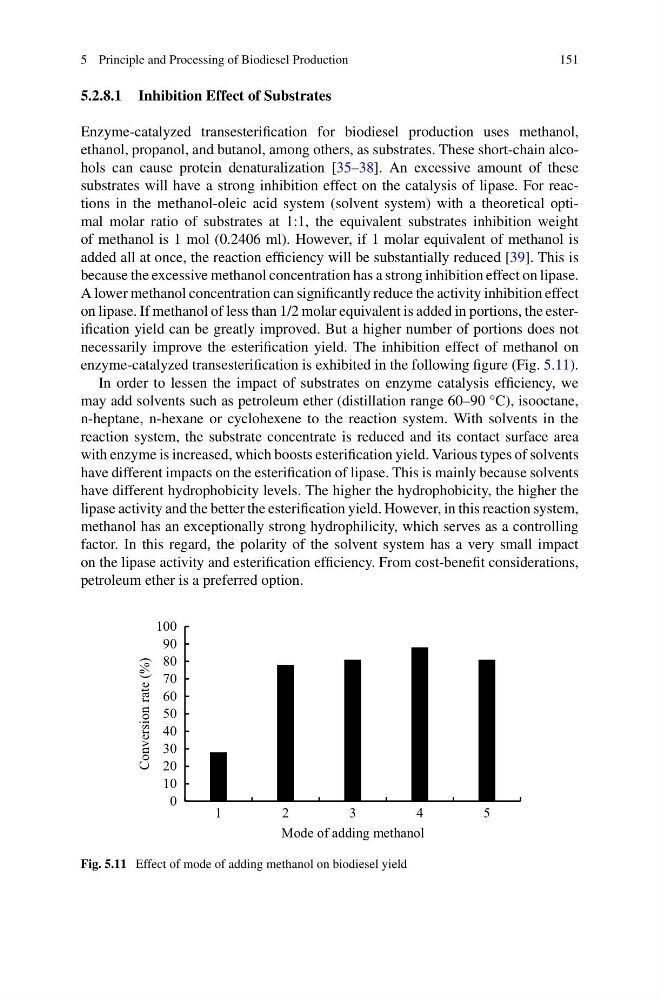
A lower methanol concentration can significantly reduce the activity inhibition effect
on lipase. If methanol of less than 1/2 molar equivalent is added in portions, the esterification yield can be greatly improved. But a higher number of portions does not
necessarily improve the esterification yield. The inhibition effect of methanol on
enzyme-catalyzed transesterification is exhibited in the following figure (Fig. 5.11).
In order to lessen the impact of substrates on enzyme catalysis efficiency, we
may add solvents such as petroleum ether (distillation range 60–90 °C), isooctane,
n-heptane, n-hexane or cyclohexene to the reaction system. With solvents in the
reaction system, the substrate concentrate is reduced and its contact surface area
with enzyme is increased, which boosts esterification yield. Various types of solvents
have different impacts on the esterification of lipase. This is mainly because solvents
have different hydrophobicity levels. The higher the hydrophobicity, the higher the
lipase activity and the better the esterification yield. However, in this reaction system,
methanol has an exceptionally strong hydrophilicity, which serves as a controlling
factor. In this regard, the polarity of the solvent system has a very small impact
on the lipase activity and esterification efficiency. From cost-benefit considerations,
petroleum ether is a preferred option.
0
10
20
30
40
50
60
70
80
90
100
1
2
3
4
5
Conversion rate (%)
Mode of adding methanol
Fig. 5.11 Effect of mode of adding methanol on biodiesel yield
151
5.2.8.1 Inhibition Effect of Substrates
Enzyme-catalyzed transesterification for biodiesel production uses methanol,
ethanol, propanol, and butanol, among others, as substrates. These short-chain alcohols can cause protein denaturalization [35–38]. An excessive amount of these
substrates will have a strong inhibition effect on the catalysis of lipase. For reactions in the methanol-oleic acid system (solvent system) with a theoretical optimal molar ratio of substrates at 1:1, the equivalent substrates inhibition weight
of methanol is 1 mol (0.2406 ml). However, if 1 molar equivalent of methanol is
added all at once, the reaction efficiency will be substantially reduced [39]. This is
because the excessive methanol concentration has a strong inhibition effect on lipase.
A lower methanol concentration can significantly reduce the activity inhibition effect
on lipase. If methanol of less than 1/2 molar equivalent is added in portions, the esterification yield can be greatly improved. But a higher number of portions does not
necessarily improve the esterification yield. The inhibition effect of methanol on
enzyme-catalyzed transesterification is exhibited in the following figure (Fig. 5.11).
In order to lessen the impact of substrates on enzyme catalysis efficiency, we
may add solvents such as petroleum ether (distillation range 60–90 °C), isooctane,
n-heptane, n-hexane or cyclohexene to the reaction system. With solvents in the
reaction system, the substrate concentrate is reduced and its contact surface area
with enzyme is increased, which boosts esterification yield. Various types of solvents
have different impacts on the esterification of lipase. This is mainly because solvents
have different hydrophobicity levels. The higher the hydrophobicity, the higher the
lipase activity and the better the esterification yield. However, in this reaction system,
methanol has an exceptionally strong hydrophilicity, which serves as a controlling
factor. In this regard, the polarity of the solvent system has a very small impact
on the lipase activity and esterification efficiency. From cost-benefit considerations,
petroleum ether is a preferred option.
0
10
20
30
40
50
60
70
80
90
100
1
2
3
4
5
Conversion rate (%)
Mode of adding methanol
Fig. 5.11 Effect of mode of adding methanol on biodiesel yield