

5 Principle and Processing of Biodiesel Production
147
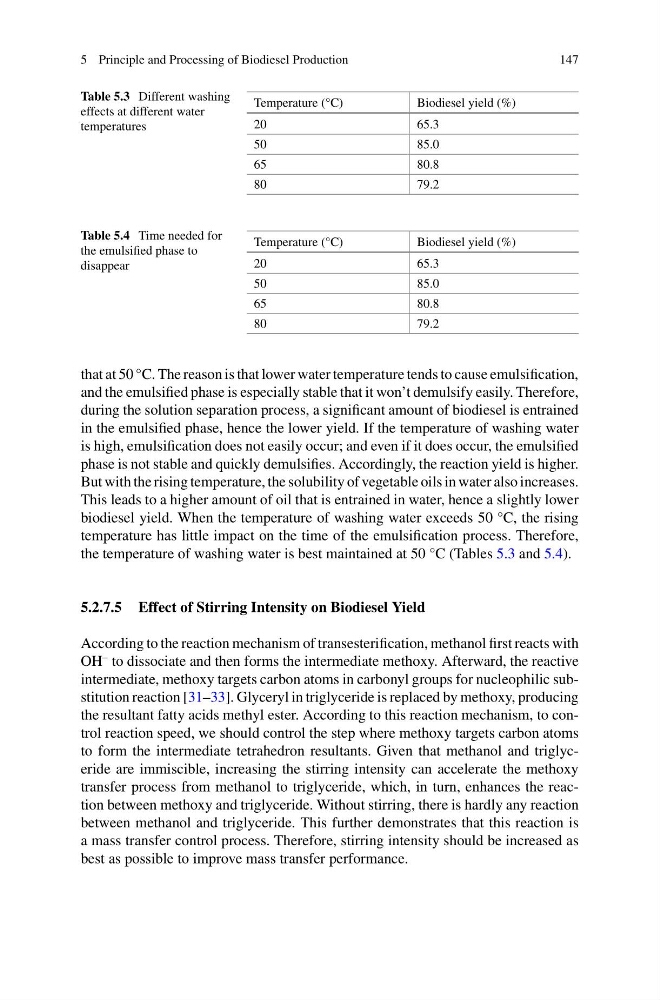
Table 5.3 Different washing
effects at different water
temperatures
Temperature (°C)
Biodiesel yield (%)
20
65.3
50
85.0
65
80.8
80
79.2
Table 5.4 Time needed for
the emulsified phase to
disappear
Temperature (°C)
Biodiesel yield (%)
20
65.3
50
85.0
65
80.8
80
79.2
that at 50 °C. The reason is that lower water temperature tends to cause emulsification,
and the emulsified phase is especially stable that it won’t demulsify easily. Therefore,
during the solution separation process, a significant amount of biodiesel is entrained
in the emulsified phase, hence the lower yield. If the temperature of washing water
is high, emulsification does not easily occur; and even if it does occur, the emulsified
phase is not stable and quickly demulsifies. Accordingly, the reaction yield is higher.
But with the rising temperature, the solubility of vegetable oils in water also increases.
This leads to a higher amount of oil that is entrained in water, hence a slightly lower
biodiesel yield. When the temperature of washing water exceeds 50 °C, the rising
temperature has little impact on the time of the emulsification process. Therefore,
the temperature of washing water is best maintained at 50 °C (Tables 5.3 and 5.4).
5.2.7.5 Effect of Stirring Intensity on Biodiesel Yield
According to the reaction mechanism of transesterification, methanol first reacts with
OH
– to dissociate and then forms the intermediate methoxy. Afterward, the reactive
intermediate, methoxy targets carbon atoms in carbonyl groups for nucleophilic substitution reaction [31–33]. Glyceryl in triglyceride is replaced by methoxy, producing
the resultant fatty acids methyl ester. According to this reaction mechanism, to control reaction speed, we should control the step where methoxy targets carbon atoms
to form the intermediate tetrahedron resultants. Given that methanol and triglyceride are immiscible, increasing the stirring intensity can accelerate the methoxy
transfer process from methanol to triglyceride, which, in turn, enhances the reaction between methoxy and triglyceride. Without stirring, there is hardly any reaction
between methanol and triglyceride. This further demonstrates that this reaction is
a mass transfer control process. Therefore, stirring intensity should be increased as
best as possible to improve mass transfer performance.
147
Table 5.3 Different washing
effects at different water
temperatures
Temperature (°C)
Biodiesel yield (%)
20
65.3
50
85.0
65
80.8
80
79.2
Table 5.4 Time needed for
the emulsified phase to
disappear
Temperature (°C)
Biodiesel yield (%)
20
65.3
50
85.0
65
80.8
80
79.2
that at 50 °C. The reason is that lower water temperature tends to cause emulsification,
and the emulsified phase is especially stable that it won’t demulsify easily. Therefore,
during the solution separation process, a significant amount of biodiesel is entrained
in the emulsified phase, hence the lower yield. If the temperature of washing water
is high, emulsification does not easily occur; and even if it does occur, the emulsified
phase is not stable and quickly demulsifies. Accordingly, the reaction yield is higher.
But with the rising temperature, the solubility of vegetable oils in water also increases.
This leads to a higher amount of oil that is entrained in water, hence a slightly lower
biodiesel yield. When the temperature of washing water exceeds 50 °C, the rising
temperature has little impact on the time of the emulsification process. Therefore,
the temperature of washing water is best maintained at 50 °C (Tables 5.3 and 5.4).
5.2.7.5 Effect of Stirring Intensity on Biodiesel Yield
According to the reaction mechanism of transesterification, methanol first reacts with
OH
– to dissociate and then forms the intermediate methoxy. Afterward, the reactive
intermediate, methoxy targets carbon atoms in carbonyl groups for nucleophilic substitution reaction [31–33]. Glyceryl in triglyceride is replaced by methoxy, producing
the resultant fatty acids methyl ester. According to this reaction mechanism, to control reaction speed, we should control the step where methoxy targets carbon atoms
to form the intermediate tetrahedron resultants. Given that methanol and triglyceride are immiscible, increasing the stirring intensity can accelerate the methoxy
transfer process from methanol to triglyceride, which, in turn, enhances the reaction between methoxy and triglyceride. Without stirring, there is hardly any reaction
between methanol and triglyceride. This further demonstrates that this reaction is
a mass transfer control process. Therefore, stirring intensity should be increased as
best as possible to improve mass transfer performance.