

148
C. Li et al.
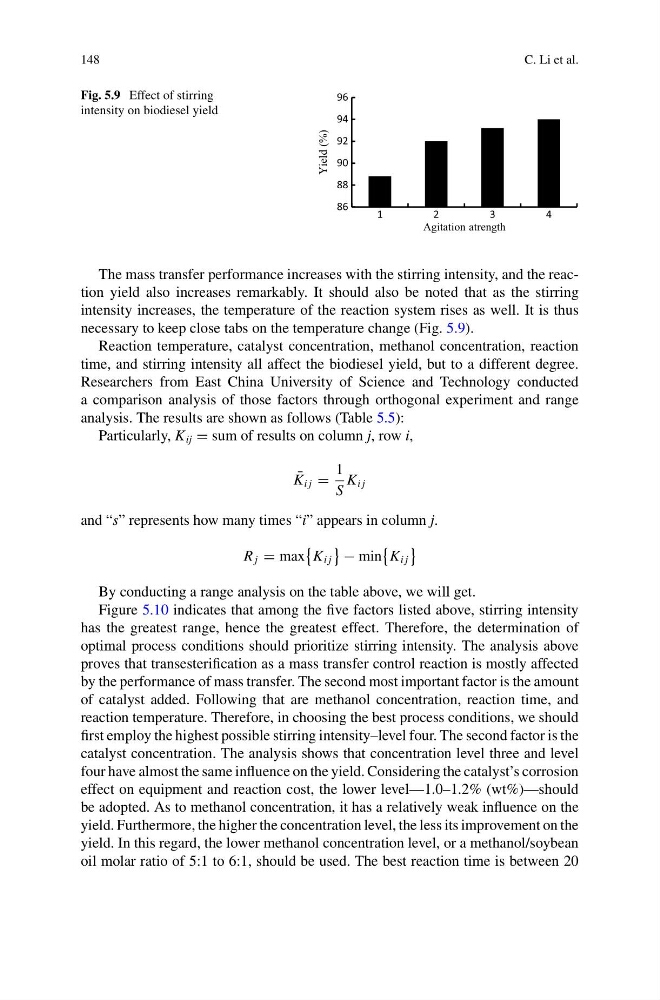
Fig. 5.9 Effect of stirring
intensity on biodiesel yield
86
88
90
92
94
96
1
2
3
4
Yield (%)
Agitation atrength
The mass transfer performance increases with the stirring intensity, and the reaction yield also increases remarkably. It should also be noted that as the stirring
intensity increases, the temperature of the reaction system rises as well. It is thus
necessary to keep close tabs on the temperature change (Fig. 5.9).
Reaction temperature, catalyst concentration, methanol concentration, reaction
time, and stirring intensity all affect the biodiesel yield, but to a different degree.
Researchers from East China University of Science and Technology conducted
a comparison analysis of those factors through orthogonal experiment and range
analysis. The results are shown as follows (Table 5.5):
Particularly, K ij = sum of results on column j, row i,
¯
K i j =
1
S
K i j
and “s” represents how many times “i” appears in column j.
R j = max
K i j
− min
K i j
By conducting a range analysis on the table above, we will get.
Figure 5.10 indicates that among the five factors listed above, stirring intensity
has the greatest range, hence the greatest effect. Therefore, the determination of
optimal process conditions should prioritize stirring intensity. The analysis above
proves that transesterification as a mass transfer control reaction is mostly affected
by the performance of mass transfer. The second most important factor is the amount
of catalyst added. Following that are methanol concentration, reaction time, and
reaction temperature. Therefore, in choosing the best process conditions, we should
first employ the highest possible stirring intensity–level four. The second factor is the
catalyst concentration. The analysis shows that concentration level three and level
four have almost the same influence on the yield. Considering the catalyst’s corrosion
effect on equipment and reaction cost, the lower level—1.0–1.2% (wt%)—should
be adopted. As to methanol concentration, it has a relatively weak influence on the
yield. Furthermore, the higher the concentration level, the less its improvement on the
yield. In this regard, the lower methanol concentration level, or a methanol/soybean
oil molar ratio of 5:1 to 6:1, should be used. The best reaction time is between 20
C. Li et al.
Fig. 5.9 Effect of stirring
intensity on biodiesel yield
86
88
90
92
94
96
1
2
3
4
Yield (%)
Agitation atrength
The mass transfer performance increases with the stirring intensity, and the reaction yield also increases remarkably. It should also be noted that as the stirring
intensity increases, the temperature of the reaction system rises as well. It is thus
necessary to keep close tabs on the temperature change (Fig. 5.9).
Reaction temperature, catalyst concentration, methanol concentration, reaction
time, and stirring intensity all affect the biodiesel yield, but to a different degree.
Researchers from East China University of Science and Technology conducted
a comparison analysis of those factors through orthogonal experiment and range
analysis. The results are shown as follows (Table 5.5):
Particularly, K ij = sum of results on column j, row i,
¯
K i j =
1
S
K i j
and “s” represents how many times “i” appears in column j.
R j = max
K i j
− min
K i j
By conducting a range analysis on the table above, we will get.
Figure 5.10 indicates that among the five factors listed above, stirring intensity
has the greatest range, hence the greatest effect. Therefore, the determination of
optimal process conditions should prioritize stirring intensity. The analysis above
proves that transesterification as a mass transfer control reaction is mostly affected
by the performance of mass transfer. The second most important factor is the amount
of catalyst added. Following that are methanol concentration, reaction time, and
reaction temperature. Therefore, in choosing the best process conditions, we should
first employ the highest possible stirring intensity–level four. The second factor is the
catalyst concentration. The analysis shows that concentration level three and level
four have almost the same influence on the yield. Considering the catalyst’s corrosion
effect on equipment and reaction cost, the lower level—1.0–1.2% (wt%)—should
be adopted. As to methanol concentration, it has a relatively weak influence on the
yield. Furthermore, the higher the concentration level, the less its improvement on the
yield. In this regard, the lower methanol concentration level, or a methanol/soybean
oil molar ratio of 5:1 to 6:1, should be used. The best reaction time is between 20