

146
C. Li et al.
Fig. 5.8 Reaction yield
changes with catalyst
(NaOH) concentration
R C OCH 3 + NaOH
O
R C O
O
Na + CH 3 OH
that this is a fast reaction as the transesterification process is generally completed
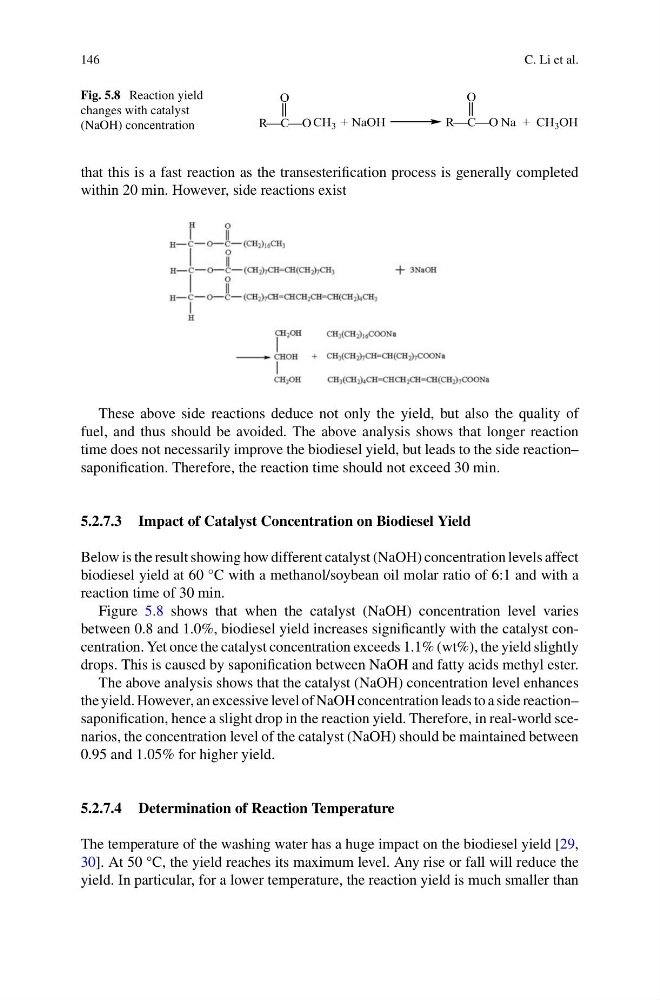
within 20 min. However, side reactions exist
These above side reactions deduce not only the yield, but also the quality of
fuel, and thus should be avoided. The above analysis shows that longer reaction
time does not necessarily improve the biodiesel yield, but leads to the side reaction–
saponification. Therefore, the reaction time should not exceed 30 min.
5.2.7.3 Impact of Catalyst Concentration on Biodiesel Yield
Below is the result showing how different catalyst (NaOH) concentration levels affect
biodiesel yield at 60 °C with a methanol/soybean oil molar ratio of 6:1 and with a
reaction time of 30 min.
Figure 5.8 shows that when the catalyst (NaOH) concentration level varies
between 0.8 and 1.0%, biodiesel yield increases significantly with the catalyst concentration. Yet once the catalyst concentration exceeds 1.1% (wt%), the yield slightly
drops. This is caused by saponification between NaOH and fatty acids methyl ester.
The above analysis shows that the catalyst (NaOH) concentration level enhances
the yield. However, an excessive level of NaOH concentration leads to a side reaction–
saponification, hence a slight drop in the reaction yield. Therefore, in real-world scenarios, the concentration level of the catalyst (NaOH) should be maintained between
0.95 and 1.05% for higher yield.
5.2.7.4 Determination of Reaction Temperature
The temperature of the washing water has a huge impact on the biodiesel yield [29,
30]. At 50 °C, the yield reaches its maximum level. Any rise or fall will reduce the
yield. In particular, for a lower temperature, the reaction yield is much smaller than
C. Li et al.
Fig. 5.8 Reaction yield
changes with catalyst
(NaOH) concentration
R C OCH 3 + NaOH
O
R C O
O
Na + CH 3 OH
that this is a fast reaction as the transesterification process is generally completed
within 20 min. However, side reactions exist
These above side reactions deduce not only the yield, but also the quality of
fuel, and thus should be avoided. The above analysis shows that longer reaction
time does not necessarily improve the biodiesel yield, but leads to the side reaction–
saponification. Therefore, the reaction time should not exceed 30 min.
5.2.7.3 Impact of Catalyst Concentration on Biodiesel Yield
Below is the result showing how different catalyst (NaOH) concentration levels affect
biodiesel yield at 60 °C with a methanol/soybean oil molar ratio of 6:1 and with a
reaction time of 30 min.
Figure 5.8 shows that when the catalyst (NaOH) concentration level varies
between 0.8 and 1.0%, biodiesel yield increases significantly with the catalyst concentration. Yet once the catalyst concentration exceeds 1.1% (wt%), the yield slightly
drops. This is caused by saponification between NaOH and fatty acids methyl ester.
The above analysis shows that the catalyst (NaOH) concentration level enhances
the yield. However, an excessive level of NaOH concentration leads to a side reaction–
saponification, hence a slight drop in the reaction yield. Therefore, in real-world scenarios, the concentration level of the catalyst (NaOH) should be maintained between
0.95 and 1.05% for higher yield.
5.2.7.4 Determination of Reaction Temperature
The temperature of the washing water has a huge impact on the biodiesel yield [29,
30]. At 50 °C, the yield reaches its maximum level. Any rise or fall will reduce the
yield. In particular, for a lower temperature, the reaction yield is much smaller than