

5 Principle and Processing of Biodiesel Production
129
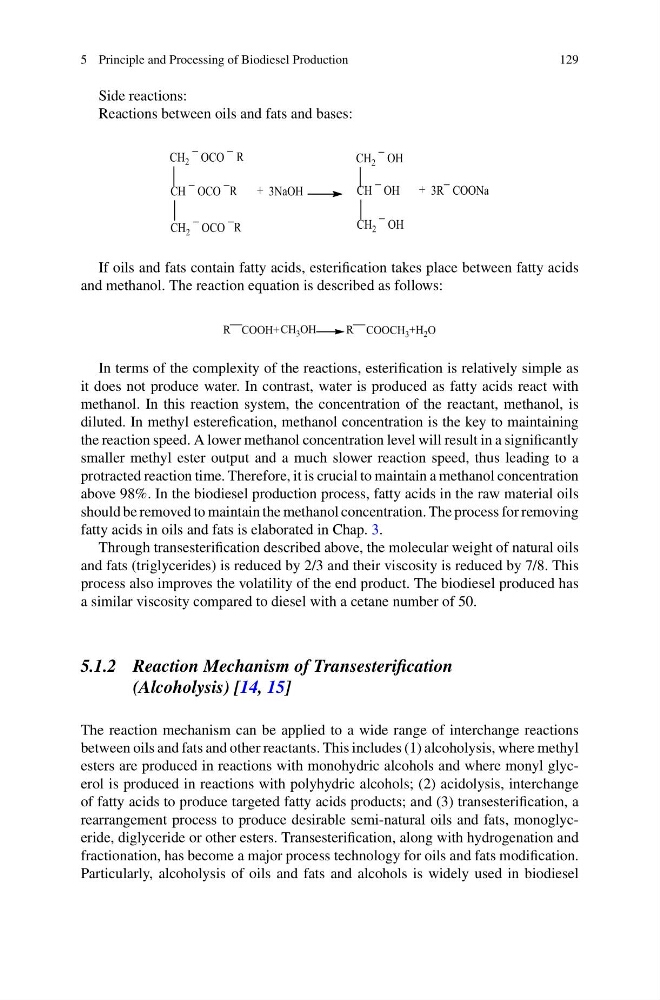
Side reactions:
Reactions between oils and fats and bases:
CH 2
− OCO
− R
CH
− OCO
− R
CH 2
− OCO
− R
+ 3NaOH
+ 3R − COONa
CH 2
− OH
CH
− OH
CH 2
− OH
If oils and fats contain fatty acids, esterification takes place between fatty acids
and methanol. The reaction equation is described as follows:
R
COOH+CH 3 OH
R COOCH 3 +H 2 O
In terms of the complexity of the reactions, esterification is relatively simple as
it does not produce water. In contrast, water is produced as fatty acids react with
methanol. In this reaction system, the concentration of the reactant, methanol, is
diluted. In methyl esterefication, methanol concentration is the key to maintaining
the reaction speed. A lower methanol concentration level will result in a significantly
smaller methyl ester output and a much slower reaction speed, thus leading to a
protracted reaction time. Therefore, it is crucial to maintain a methanol concentration
above 98%. In the biodiesel production process, fatty acids in the raw material oils
should be removed to maintain the methanol concentration. The process for removing
fatty acids in oils and fats is elaborated in Chap. 3.
Through transesterification described above, the molecular weight of natural oils
and fats (triglycerides) is reduced by 2/3 and their viscosity is reduced by 7/8. This
process also improves the volatility of the end product. The biodiesel produced has
a similar viscosity compared to diesel with a cetane number of 50.
5.1.2 Reaction Mechanism of Transesterification
(Alcoholysis) [14, 15]
The reaction mechanism can be applied to a wide range of interchange reactions
between oils and fats and other reactants. This includes (1) alcoholysis, where methyl
esters are produced in reactions with monohydric alcohols and where monyl glycerol is produced in reactions with polyhydric alcohols; (2) acidolysis, interchange
of fatty acids to produce targeted fatty acids products; and (3) transesterification, a
rearrangement process to produce desirable semi-natural oils and fats, monoglyceride, diglyceride or other esters. Transesterification, along with hydrogenation and
fractionation, has become a major process technology for oils and fats modification.
Particularly, alcoholysis of oils and fats and alcohols is widely used in biodiesel
129
Side reactions:
Reactions between oils and fats and bases:
CH 2
− OCO
− R
CH
− OCO
− R
CH 2
− OCO
− R
+ 3NaOH
+ 3R − COONa
CH 2
− OH
CH
− OH
CH 2
− OH
If oils and fats contain fatty acids, esterification takes place between fatty acids
and methanol. The reaction equation is described as follows:
R
COOH+CH 3 OH
R COOCH 3 +H 2 O
In terms of the complexity of the reactions, esterification is relatively simple as
it does not produce water. In contrast, water is produced as fatty acids react with
methanol. In this reaction system, the concentration of the reactant, methanol, is
diluted. In methyl esterefication, methanol concentration is the key to maintaining
the reaction speed. A lower methanol concentration level will result in a significantly
smaller methyl ester output and a much slower reaction speed, thus leading to a
protracted reaction time. Therefore, it is crucial to maintain a methanol concentration
above 98%. In the biodiesel production process, fatty acids in the raw material oils
should be removed to maintain the methanol concentration. The process for removing
fatty acids in oils and fats is elaborated in Chap. 3.
Through transesterification described above, the molecular weight of natural oils
and fats (triglycerides) is reduced by 2/3 and their viscosity is reduced by 7/8. This
process also improves the volatility of the end product. The biodiesel produced has
a similar viscosity compared to diesel with a cetane number of 50.
5.1.2 Reaction Mechanism of Transesterification
(Alcoholysis) [14, 15]
The reaction mechanism can be applied to a wide range of interchange reactions
between oils and fats and other reactants. This includes (1) alcoholysis, where methyl
esters are produced in reactions with monohydric alcohols and where monyl glycerol is produced in reactions with polyhydric alcohols; (2) acidolysis, interchange
of fatty acids to produce targeted fatty acids products; and (3) transesterification, a
rearrangement process to produce desirable semi-natural oils and fats, monoglyceride, diglyceride or other esters. Transesterification, along with hydrogenation and
fractionation, has become a major process technology for oils and fats modification.
Particularly, alcoholysis of oils and fats and alcohols is widely used in biodiesel