

128
C. Li et al.
The researchers developed the VN process to produce high quality biodiesel and
purify glycerol, the by-product of the reactions, for medical use [1–3]. This process enhanced the practical value of raw materials and reduced cost. Other studies
discovered that branched fatty acid esters have better low-temperature performance
than straight fatty acid esters [4–7]. Therefore, products using biodiesel produced
from branched alcohols have significantly better low-temperature performance. The
scientists managed to use saponite as raw material to produce high-performance
biodiesel through enzymatic reaction [8–11]. A two-stage reaction device to achieve
a high output, as well as low energy consumption in producing biodiesel by transesterification at a low-temperature [12]. In addition, Denoo (Germany) developed a
two-stage catalytic technology that transforms waste oils and fats emitted from the
catering industry, food industry, and paper industry into biodiesel [13].
At present, a major industrial technology for producing biodiesel is transesterification. The large-scale production of biodiesel mainly relies on soybean oil [14],
rapeseed oil [15], palm oil [16], and waste cooking oil [17, 18] as raw materials.
Transesterification takes place between these raw material oils and methanol with
the help of catalytic agents, which produced biodiesel. This chapter elaborates on
the principle and process of biodiesel production by transesterification.
5.1.1 Principle and Reaction Mechanism
of Transesterification
5.1.1.1 Introduction to the Principle of Transesterification
Oils and fats transesterification is the process of ester groups interchange or intermolecular rearrangement as triglyceride in oils and fats reacts with fatty acids, alcohols, itself or other esters. It is a process technology to change the characteristics of
oils and fats without chemically altering the composition of fatty acids.
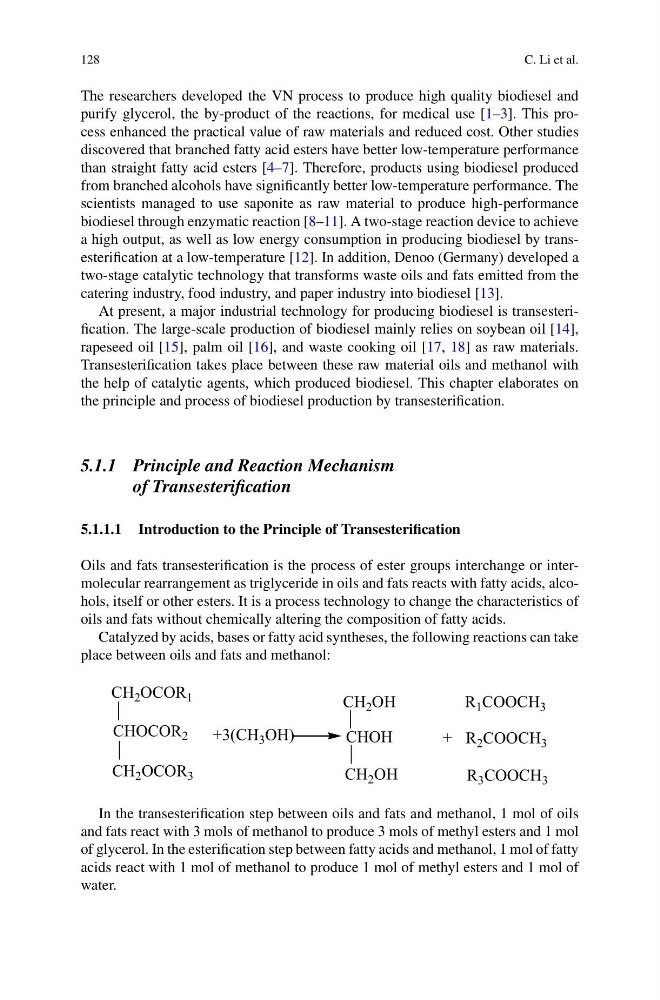
Catalyzed by acids, bases or fatty acid syntheses, the following reactions can take
place between oils and fats and methanol:
CH 2 OCOR 1
CHOCOR 2
CH 2 OCOR 3
+3(CH 3 OH)
CH 2 OH
CHOH
R 1 COOCH 3
CH 2 OH
R 2 COOCH 3
R 3 COOCH 3
+
In the transesterification step between oils and fats and methanol, 1 mol of oils
and fats react with 3 mols of methanol to produce 3 mols of methyl esters and 1 mol
of glycerol. In the esterification step between fatty acids and methanol, 1 mol of fatty
acids react with 1 mol of methanol to produce 1 mol of methyl esters and 1 mol of
water.
C. Li et al.
The researchers developed the VN process to produce high quality biodiesel and
purify glycerol, the by-product of the reactions, for medical use [1–3]. This process enhanced the practical value of raw materials and reduced cost. Other studies
discovered that branched fatty acid esters have better low-temperature performance
than straight fatty acid esters [4–7]. Therefore, products using biodiesel produced
from branched alcohols have significantly better low-temperature performance. The
scientists managed to use saponite as raw material to produce high-performance
biodiesel through enzymatic reaction [8–11]. A two-stage reaction device to achieve
a high output, as well as low energy consumption in producing biodiesel by transesterification at a low-temperature [12]. In addition, Denoo (Germany) developed a
two-stage catalytic technology that transforms waste oils and fats emitted from the
catering industry, food industry, and paper industry into biodiesel [13].
At present, a major industrial technology for producing biodiesel is transesterification. The large-scale production of biodiesel mainly relies on soybean oil [14],
rapeseed oil [15], palm oil [16], and waste cooking oil [17, 18] as raw materials.
Transesterification takes place between these raw material oils and methanol with
the help of catalytic agents, which produced biodiesel. This chapter elaborates on
the principle and process of biodiesel production by transesterification.
5.1.1 Principle and Reaction Mechanism
of Transesterification
5.1.1.1 Introduction to the Principle of Transesterification
Oils and fats transesterification is the process of ester groups interchange or intermolecular rearrangement as triglyceride in oils and fats reacts with fatty acids, alcohols, itself or other esters. It is a process technology to change the characteristics of
oils and fats without chemically altering the composition of fatty acids.
Catalyzed by acids, bases or fatty acid syntheses, the following reactions can take
place between oils and fats and methanol:
CH 2 OCOR 1
CHOCOR 2
CH 2 OCOR 3
+3(CH 3 OH)
CH 2 OH
CHOH
R 1 COOCH 3
CH 2 OH
R 2 COOCH 3
R 3 COOCH 3
+
In the transesterification step between oils and fats and methanol, 1 mol of oils
and fats react with 3 mols of methanol to produce 3 mols of methyl esters and 1 mol
of glycerol. In the esterification step between fatty acids and methanol, 1 mol of fatty
acids react with 1 mol of methanol to produce 1 mol of methyl esters and 1 mol of
water.