

130
C. Li et al.
production. In the following section, unless otherwise noted, the transesterification
reaction in biodiesel production refers to alcoholysis reaction.
Natural vegetable oils, animal fats, and waste oils of the food industry can be used
as raw materials for the production of biodiesel by transesterification. Alcohols that
can be used for transesterification include methanol, ethanol, propanol, butanol, and
pentanol. Among them, methanol is the most common because it is an inexpensive,
short-chain, and strong polar raw material that can readily react with fatty acid glycerides. Moreover, base catalysts are freely soluble in methanol. In this reaction, acid,
base or enzyme can be used as a catalytic agent. Base catalysts include NaOH, KOH,
carbonate, and sodium and potassium alkoxides. Acid catalysts include sulfuric acid,
hydrochloric acid or phosphoric acid. Lipase is an ideal catalyst for transesterification
between alcohols and fatty acid glycerides.
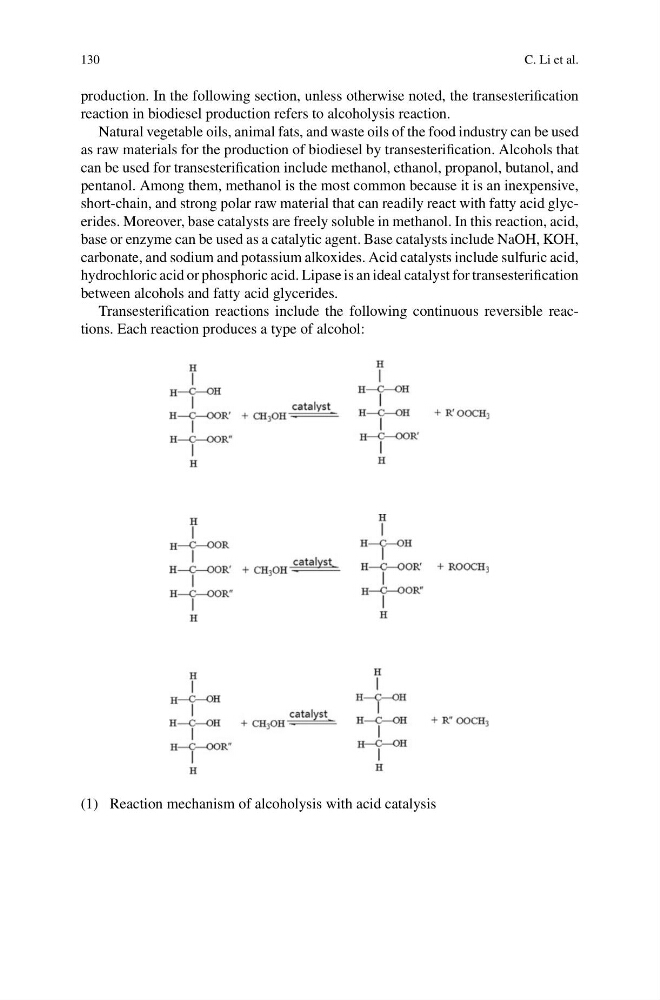
Transesterification reactions include the following continuous reversible reactions. Each reaction produces a type of alcohol:
(1) Reaction mechanism of alcoholysis with acid catalysis
C. Li et al.
production. In the following section, unless otherwise noted, the transesterification
reaction in biodiesel production refers to alcoholysis reaction.
Natural vegetable oils, animal fats, and waste oils of the food industry can be used
as raw materials for the production of biodiesel by transesterification. Alcohols that
can be used for transesterification include methanol, ethanol, propanol, butanol, and
pentanol. Among them, methanol is the most common because it is an inexpensive,
short-chain, and strong polar raw material that can readily react with fatty acid glycerides. Moreover, base catalysts are freely soluble in methanol. In this reaction, acid,
base or enzyme can be used as a catalytic agent. Base catalysts include NaOH, KOH,
carbonate, and sodium and potassium alkoxides. Acid catalysts include sulfuric acid,
hydrochloric acid or phosphoric acid. Lipase is an ideal catalyst for transesterification
between alcohols and fatty acid glycerides.
Transesterification reactions include the following continuous reversible reactions. Each reaction produces a type of alcohol:
(1) Reaction mechanism of alcoholysis with acid catalysis