

106
A. Zhang and C. Li
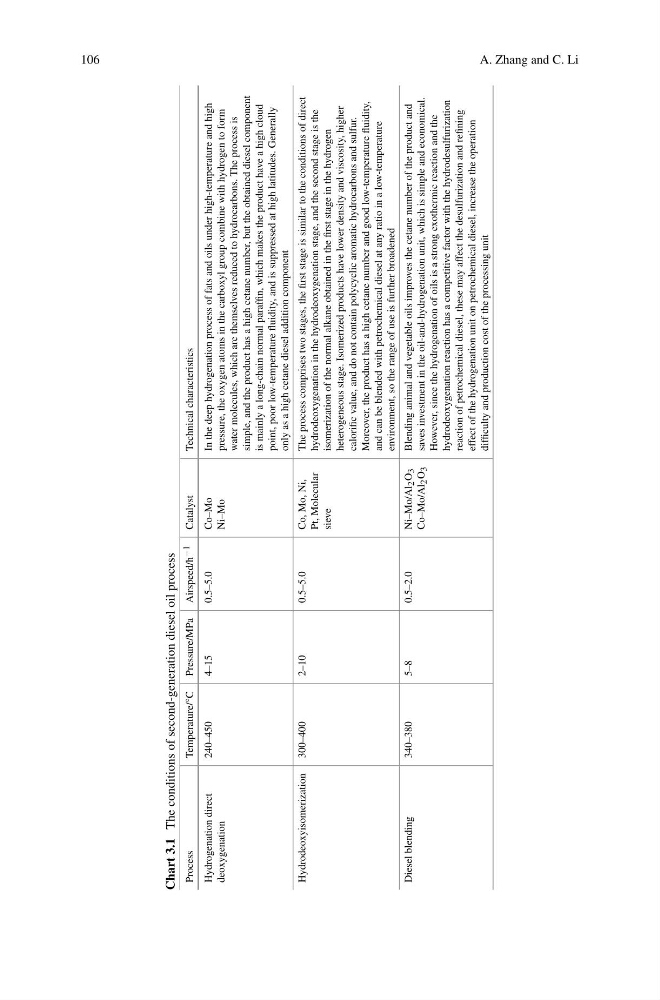
Chart 3.1
The conditions of second-generation diesel oil process
Process
Temperature/°C Pressure/MPa Airspeed/h −1
Catalyst
Technical characteristics
Hydrogenation direct
deoxygenation
240–450
4–15
0.5–5.0
Co–Mo
Ni–Mo
In the deep hydrogenation process of fats and oils under high-temperature and high
pressure, the oxygen atoms in the carboxyl group combine with hydrogen to form
water molecules, which are themselves reduced to hydrocarbons. The process is
simple, and the product has a high cetane number, but the obtained diesel component
is mainly a long-chain normal paraffin, which makes the product have a high cloud
point, poor low-temperature fluidity, and is suppressed at high latitudes. Generally
only as a high cetane diesel addition component
Hydrodeoxyisomerization 300–400
2–10
0.5–5.0
Co, Mo, Ni,
Pt, Molecular
sieve
The process comprises two stages, the first stage is similar to the conditions of direct
hydrodeoxygenation in the hydrodeoxygenation stage, and the second stage is the
isomerization of the normal alkane obtained in the first stage in the hydrogen
heterogeneous stage. Isomerized products have lower density and viscosity, higher
calorific value, and do not contain polycyclic aromatic hydrocarbons and sulfur.
Moreover, the product has a high cetane number and good low-temperature fluidity,
and can be blended with petrochemical diesel at any ratio in a low-temperature
environment, so the range of use is further broadened
Diesel blending
340–380
5–8
0.5–2.0
Ni–Mo/Al
2 O
3
Co–Mo/Al
2 O
3
Blending animal and vegetable oils improves the cetane number of the product and
saves investment in the oil-and-hydrogenation unit, which is simple and economical.
However, since the hydrogenation of oils is a strong exothermic reaction and the
hydrodeoxygenation reaction has a competitive factor with the hydrodesulfurization
reaction of petrochemical diesel, these may affect the desulfurization and refining
effect of the hydrogenation unit on petrochemical diesel, increase the operation
difficulty and production cost of the processing unit
A. Zhang and C. Li
Chart 3.1
The conditions of second-generation diesel oil process
Process
Temperature/°C Pressure/MPa Airspeed/h −1
Catalyst
Technical characteristics
Hydrogenation direct
deoxygenation
240–450
4–15
0.5–5.0
Co–Mo
Ni–Mo
In the deep hydrogenation process of fats and oils under high-temperature and high
pressure, the oxygen atoms in the carboxyl group combine with hydrogen to form
water molecules, which are themselves reduced to hydrocarbons. The process is
simple, and the product has a high cetane number, but the obtained diesel component
is mainly a long-chain normal paraffin, which makes the product have a high cloud
point, poor low-temperature fluidity, and is suppressed at high latitudes. Generally
only as a high cetane diesel addition component
Hydrodeoxyisomerization 300–400
2–10
0.5–5.0
Co, Mo, Ni,
Pt, Molecular
sieve
The process comprises two stages, the first stage is similar to the conditions of direct
hydrodeoxygenation in the hydrodeoxygenation stage, and the second stage is the
isomerization of the normal alkane obtained in the first stage in the hydrogen
heterogeneous stage. Isomerized products have lower density and viscosity, higher
calorific value, and do not contain polycyclic aromatic hydrocarbons and sulfur.
Moreover, the product has a high cetane number and good low-temperature fluidity,
and can be blended with petrochemical diesel at any ratio in a low-temperature
environment, so the range of use is further broadened
Diesel blending
340–380
5–8
0.5–2.0
Ni–Mo/Al
2 O
3
Co–Mo/Al
2 O
3
Blending animal and vegetable oils improves the cetane number of the product and
saves investment in the oil-and-hydrogenation unit, which is simple and economical.
However, since the hydrogenation of oils is a strong exothermic reaction and the
hydrodeoxygenation reaction has a competitive factor with the hydrodesulfurization
reaction of petrochemical diesel, these may affect the desulfurization and refining
effect of the hydrogenation unit on petrochemical diesel, increase the operation
difficulty and production cost of the processing unit