

3 Bio-liquid Fuels in Industrial Plant Oil
105
3.4.1 Second-Generation Biodiesel Synthesis Technology
Second-generation biodiesel does not contain oxygen and sulfur, It has a lower density and viscosity, a high cetane number and a lower cloud point, and a higher calorific
value in the same mass unit.
The second-generation biodiesel uses a catalytic hydrogenation technology to
hydrotreat animal and vegetable oils to obtain alkanes similar to diesel components.
The preparation process comprises various chemical reactions, mainly including
hydrogenation saturation, hydrodeoxygenation, hydrodecarboxylation, hydrodecarbonylation reaction, and hydrogen isomerization reaction of unsaturated fatty acids
in animal and vegetable oils. The main component of animal and vegetable fats and
oils is a fatty acid triglyceride, in which the fatty acid chain length is generally C12–
24, Most of C16 and C18, the typical fatty acids in fats and oils include saturated
acids, monounsaturated acids, and polyunsaturated acids, the degree of unsaturation
varies greatly depending on the type of oil. Under catalytic hydrogenation conditions,
the triglyceride will first undergo a hydrosaturation reaction of the unsaturated acid
and further cracking to form an intermediate product including diglyceride, monoglyceride, and carboxylic acid. After hydrodecarboxylation, hydrodecarbonylation,
and hydrodeoxygenation the final product of the normal paraffin reaction is mainly
C12–24 normal paraffins, by-products including propane, water, and a small amount
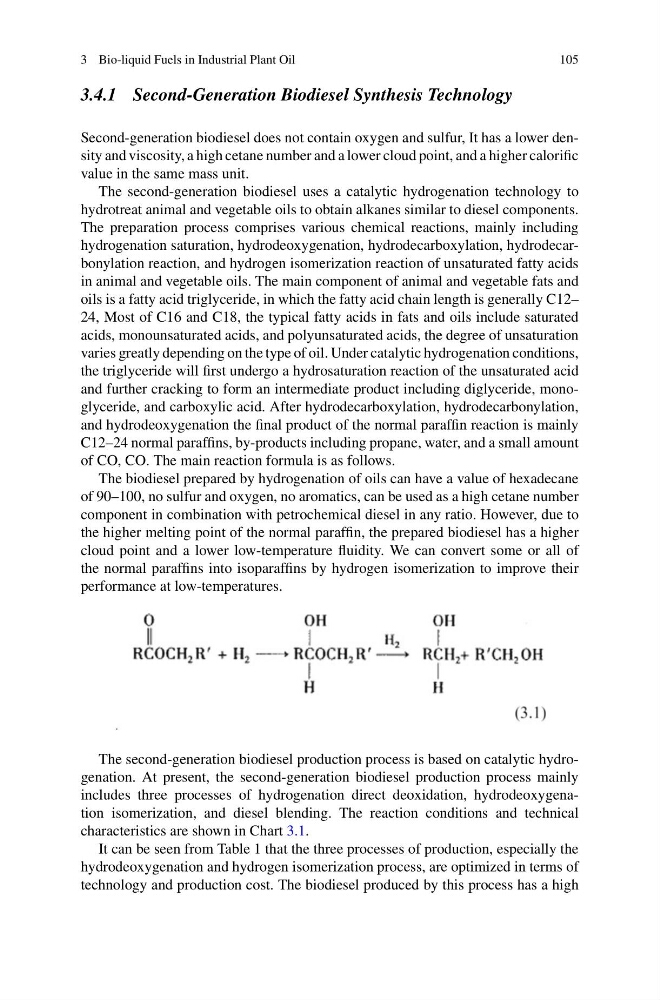
of CO, CO. The main reaction formula is as follows.
The biodiesel prepared by hydrogenation of oils can have a value of hexadecane
of 90–100, no sulfur and oxygen, no aromatics, can be used as a high cetane number
component in combination with petrochemical diesel in any ratio. However, due to
the higher melting point of the normal paraffin, the prepared biodiesel has a higher
cloud point and a lower low-temperature fluidity. We can convert some or all of
the normal paraffins into isoparaffins by hydrogen isomerization to improve their
performance at low-temperatures.
The second-generation biodiesel production process is based on catalytic hydrogenation. At present, the second-generation biodiesel production process mainly
includes three processes of hydrogenation direct deoxidation, hydrodeoxygenation isomerization, and diesel blending. The reaction conditions and technical
characteristics are shown in Chart 3.1.
It can be seen from Table 1 that the three processes of production, especially the
hydrodeoxygenation and hydrogen isomerization process, are optimized in terms of
technology and production cost. The biodiesel produced by this process has a high
105
3.4.1 Second-Generation Biodiesel Synthesis Technology
Second-generation biodiesel does not contain oxygen and sulfur, It has a lower density and viscosity, a high cetane number and a lower cloud point, and a higher calorific
value in the same mass unit.
The second-generation biodiesel uses a catalytic hydrogenation technology to
hydrotreat animal and vegetable oils to obtain alkanes similar to diesel components.
The preparation process comprises various chemical reactions, mainly including
hydrogenation saturation, hydrodeoxygenation, hydrodecarboxylation, hydrodecarbonylation reaction, and hydrogen isomerization reaction of unsaturated fatty acids
in animal and vegetable oils. The main component of animal and vegetable fats and
oils is a fatty acid triglyceride, in which the fatty acid chain length is generally C12–
24, Most of C16 and C18, the typical fatty acids in fats and oils include saturated
acids, monounsaturated acids, and polyunsaturated acids, the degree of unsaturation
varies greatly depending on the type of oil. Under catalytic hydrogenation conditions,
the triglyceride will first undergo a hydrosaturation reaction of the unsaturated acid
and further cracking to form an intermediate product including diglyceride, monoglyceride, and carboxylic acid. After hydrodecarboxylation, hydrodecarbonylation,
and hydrodeoxygenation the final product of the normal paraffin reaction is mainly
C12–24 normal paraffins, by-products including propane, water, and a small amount
of CO, CO. The main reaction formula is as follows.
The biodiesel prepared by hydrogenation of oils can have a value of hexadecane
of 90–100, no sulfur and oxygen, no aromatics, can be used as a high cetane number
component in combination with petrochemical diesel in any ratio. However, due to
the higher melting point of the normal paraffin, the prepared biodiesel has a higher
cloud point and a lower low-temperature fluidity. We can convert some or all of
the normal paraffins into isoparaffins by hydrogen isomerization to improve their
performance at low-temperatures.
The second-generation biodiesel production process is based on catalytic hydrogenation. At present, the second-generation biodiesel production process mainly
includes three processes of hydrogenation direct deoxidation, hydrodeoxygenation isomerization, and diesel blending. The reaction conditions and technical
characteristics are shown in Chart 3.1.
It can be seen from Table 1 that the three processes of production, especially the
hydrodeoxygenation and hydrogen isomerization process, are optimized in terms of
technology and production cost. The biodiesel produced by this process has a high