

98
A. Zhang and C. Li
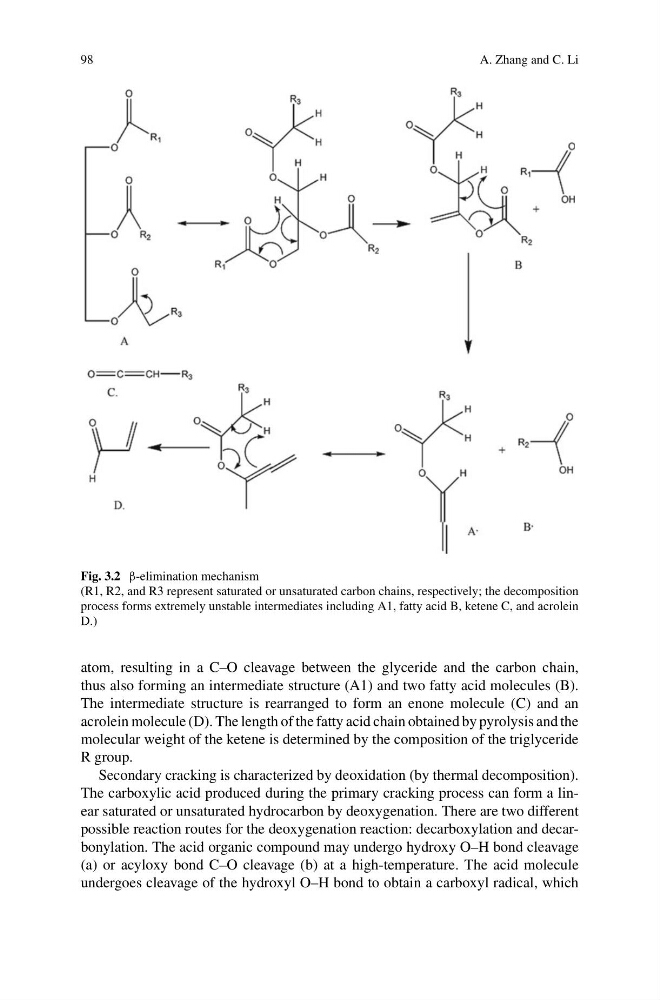
Fig. 3.2 β-elimination mechanism
(R1, R2, and R3 represent saturated or unsaturated carbon chains, respectively; the decomposition
process forms extremely unstable intermediates including A1, fatty acid B, ketene C, and acrolein
D.)
atom, resulting in a C–O cleavage between the glyceride and the carbon chain,
thus also forming an intermediate structure (A1) and two fatty acid molecules (B).
The intermediate structure is rearranged to form an enone molecule (C) and an
acrolein molecule (D). The length of the fatty acid chain obtained by pyrolysis and the
molecular weight of the ketene is determined by the composition of the triglyceride
R group.
Secondary cracking is characterized by deoxidation (by thermal decomposition).
The carboxylic acid produced during the primary cracking process can form a linear saturated or unsaturated hydrocarbon by deoxygenation. There are two different
possible reaction routes for the deoxygenation reaction: decarboxylation and decarbonylation. The acid organic compound may undergo hydroxy O–H bond cleavage
(a) or acyloxy bond C–O cleavage (b) at a high-temperature. The acid molecule
undergoes cleavage of the hydroxyl O–H bond to obtain a carboxyl radical, which
A. Zhang and C. Li
Fig. 3.2 β-elimination mechanism
(R1, R2, and R3 represent saturated or unsaturated carbon chains, respectively; the decomposition
process forms extremely unstable intermediates including A1, fatty acid B, ketene C, and acrolein
D.)
atom, resulting in a C–O cleavage between the glyceride and the carbon chain,
thus also forming an intermediate structure (A1) and two fatty acid molecules (B).
The intermediate structure is rearranged to form an enone molecule (C) and an
acrolein molecule (D). The length of the fatty acid chain obtained by pyrolysis and the
molecular weight of the ketene is determined by the composition of the triglyceride
R group.
Secondary cracking is characterized by deoxidation (by thermal decomposition).
The carboxylic acid produced during the primary cracking process can form a linear saturated or unsaturated hydrocarbon by deoxygenation. There are two different
possible reaction routes for the deoxygenation reaction: decarboxylation and decarbonylation. The acid organic compound may undergo hydroxy O–H bond cleavage
(a) or acyloxy bond C–O cleavage (b) at a high-temperature. The acid molecule
undergoes cleavage of the hydroxyl O–H bond to obtain a carboxyl radical, which