

3 Bio-liquid Fuels in Industrial Plant Oil
99
Fig. 3.3 Hydroxyl bond and
acyloxy bond cleavage
R
C
O
O
H
b
a
releases a molecule of carbon dioxide, and R and H combine to form a hydrocarbon
compound. This reaction process is called decarboxylation. The acid organic compound is cleavable by an acyloxy bond to obtain an acyl radical, and a molecule of
carbon monoxide is released, and R and H combine to form a hydrocarbon compound,
and the reaction process is called a decarbonylation reaction. Since decarboxylation
or decarbonylation of an acid compound is required to be carried out at a hightemperature, the decarboxylation or decarbonylation reaction is often accompanied
by one of the reactions and the other reaction is accompanied by the other reaction
(Fig. 3.3).
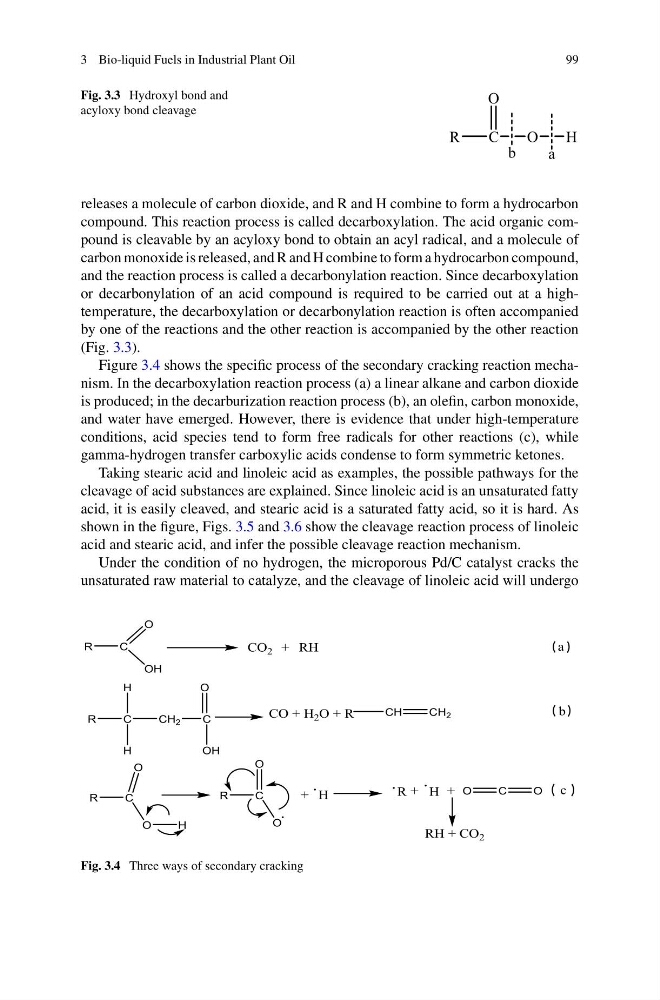
Figure 3.4 shows the specific process of the secondary cracking reaction mechanism. In the decarboxylation reaction process (a) a linear alkane and carbon dioxide
is produced; in the decarburization reaction process (b), an olefin, carbon monoxide,
and water have emerged. However, there is evidence that under high-temperature
conditions, acid species tend to form free radicals for other reactions (c), while
gamma-hydrogen transfer carboxylic acids condense to form symmetric ketones.
Taking stearic acid and linoleic acid as examples, the possible pathways for the
cleavage of acid substances are explained. Since linoleic acid is an unsaturated fatty
acid, it is easily cleaved, and stearic acid is a saturated fatty acid, so it is hard. As
shown in the figure, Figs. 3.5 and 3.6 show the cleavage reaction process of linoleic
acid and stearic acid, and infer the possible cleavage reaction mechanism.
Under the condition of no hydrogen, the microporous Pd/C catalyst cracks the
unsaturated raw material to catalyze, and the cleavage of linoleic acid will undergo
R
C
O
OH
CO 2 + RH
R
C
H
H
CH 2
C
O
OH
CO + H 2 O + R
CH
CH 2
R
C
O
O
H
C
R
O
O
+ H
R + H + O
C
O
RH + CO 2
a
b
c
Fig. 3.4 Three ways of secondary cracking
99
Fig. 3.3 Hydroxyl bond and
acyloxy bond cleavage
R
C
O
O
H
b
a
releases a molecule of carbon dioxide, and R and H combine to form a hydrocarbon
compound. This reaction process is called decarboxylation. The acid organic compound is cleavable by an acyloxy bond to obtain an acyl radical, and a molecule of
carbon monoxide is released, and R and H combine to form a hydrocarbon compound,
and the reaction process is called a decarbonylation reaction. Since decarboxylation
or decarbonylation of an acid compound is required to be carried out at a hightemperature, the decarboxylation or decarbonylation reaction is often accompanied
by one of the reactions and the other reaction is accompanied by the other reaction
(Fig. 3.3).
Figure 3.4 shows the specific process of the secondary cracking reaction mechanism. In the decarboxylation reaction process (a) a linear alkane and carbon dioxide
is produced; in the decarburization reaction process (b), an olefin, carbon monoxide,
and water have emerged. However, there is evidence that under high-temperature
conditions, acid species tend to form free radicals for other reactions (c), while
gamma-hydrogen transfer carboxylic acids condense to form symmetric ketones.
Taking stearic acid and linoleic acid as examples, the possible pathways for the
cleavage of acid substances are explained. Since linoleic acid is an unsaturated fatty
acid, it is easily cleaved, and stearic acid is a saturated fatty acid, so it is hard. As
shown in the figure, Figs. 3.5 and 3.6 show the cleavage reaction process of linoleic
acid and stearic acid, and infer the possible cleavage reaction mechanism.
Under the condition of no hydrogen, the microporous Pd/C catalyst cracks the
unsaturated raw material to catalyze, and the cleavage of linoleic acid will undergo
R
C
O
OH
CO 2 + RH
R
C
H
H
CH 2
C
O
OH
CO + H 2 O + R
CH
CH 2
R
C
O
O
H
C
R
O
O
+ H
R + H + O
C
O
RH + CO 2
a
b
c
Fig. 3.4 Three ways of secondary cracking