

3 Bio-liquid Fuels in Industrial Plant Oil
97
Vegetable oil pyrolysis has been studied for many years. Due to the existence
of multiple secondary reactions and different reaction channels, the exact reaction
mechanism of the pyrolysis mechanism of triglycerides remains unclear. The products obtained by catalytic cracking of oils are relatively complex organic hydrocarbons and other organic mixtures. Under high-temperature catalytic cracking, the
C–C bond cleavage of triglycerides is the most basic first reaction, and then various
monomers are undergoing many interlacing reactions, i.e., the second reaction. In
two pyrolysis reaction, increasing the pyrolysis temperature will increase the yield
of gas products and form a more complex reaction system.
Although the pyrolysis mechanism is somewhat complicated, there are still some
studies suggesting that there are two different steps in the cleavage reaction. The
first step is that the triglyceride breaks first at high-temperatures, producing the
corresponding acidic substances (mainly carboxylic acids) and others. This step is
called the main cracking. The second step, also known as secondary cracking, is the
decomposition of the material obtained in the first step, thus forming hydrocarbons
with shorter carbon chains, including saturated and unsaturated.
Due to the complex reaction of catalytic cracking, there are few studies at home
and abroad. Here, only the main thermal cracking mechanism of vegetable oil is
expounded. The main processes are as follows.
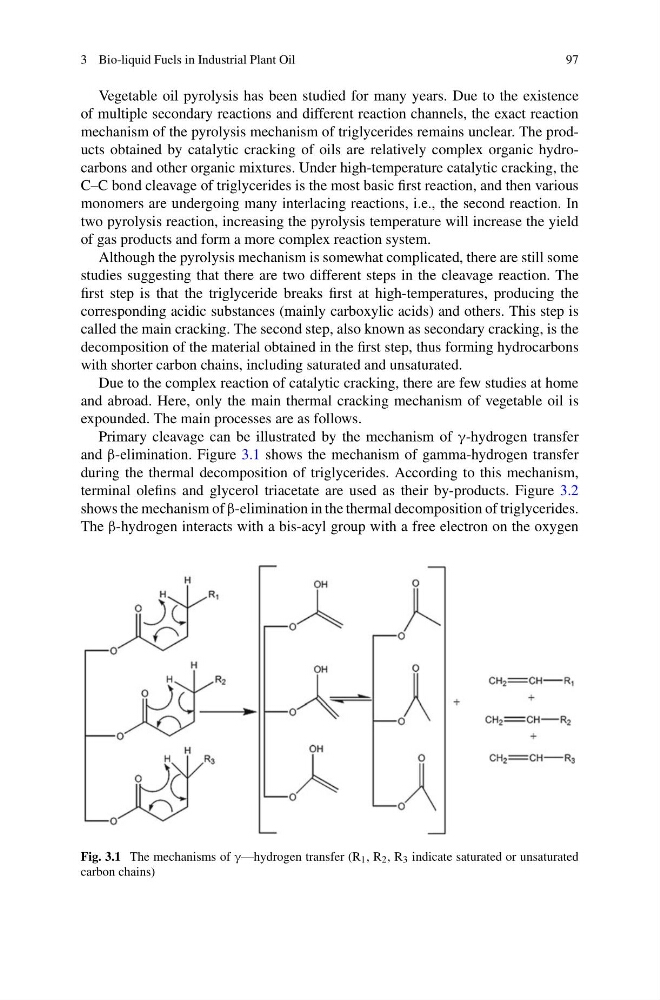
Primary cleavage can be illustrated by the mechanism of γ-hydrogen transfer
and β-elimination. Figure 3.1 shows the mechanism of gamma-hydrogen transfer
during the thermal decomposition of triglycerides. According to this mechanism,
terminal olefins and glycerol triacetate are used as their by-products. Figure 3.2
shows the mechanism of β-elimination in the thermal decomposition of triglycerides.
The β-hydrogen interacts with a bis-acyl group with a free electron on the oxygen
Fig. 3.1 The mechanisms of γ—hydrogen transfer (R 1 , R 2 , R 3 indicate saturated or unsaturated
carbon chains)
97
Vegetable oil pyrolysis has been studied for many years. Due to the existence
of multiple secondary reactions and different reaction channels, the exact reaction
mechanism of the pyrolysis mechanism of triglycerides remains unclear. The products obtained by catalytic cracking of oils are relatively complex organic hydrocarbons and other organic mixtures. Under high-temperature catalytic cracking, the
C–C bond cleavage of triglycerides is the most basic first reaction, and then various
monomers are undergoing many interlacing reactions, i.e., the second reaction. In
two pyrolysis reaction, increasing the pyrolysis temperature will increase the yield
of gas products and form a more complex reaction system.
Although the pyrolysis mechanism is somewhat complicated, there are still some
studies suggesting that there are two different steps in the cleavage reaction. The
first step is that the triglyceride breaks first at high-temperatures, producing the
corresponding acidic substances (mainly carboxylic acids) and others. This step is
called the main cracking. The second step, also known as secondary cracking, is the
decomposition of the material obtained in the first step, thus forming hydrocarbons
with shorter carbon chains, including saturated and unsaturated.
Due to the complex reaction of catalytic cracking, there are few studies at home
and abroad. Here, only the main thermal cracking mechanism of vegetable oil is
expounded. The main processes are as follows.
Primary cleavage can be illustrated by the mechanism of γ-hydrogen transfer
and β-elimination. Figure 3.1 shows the mechanism of gamma-hydrogen transfer
during the thermal decomposition of triglycerides. According to this mechanism,
terminal olefins and glycerol triacetate are used as their by-products. Figure 3.2
shows the mechanism of β-elimination in the thermal decomposition of triglycerides.
The β-hydrogen interacts with a bis-acyl group with a free electron on the oxygen
Fig. 3.1 The mechanisms of γ—hydrogen transfer (R 1 , R 2 , R 3 indicate saturated or unsaturated
carbon chains)