

8.1 A Brief History of Weapons
739
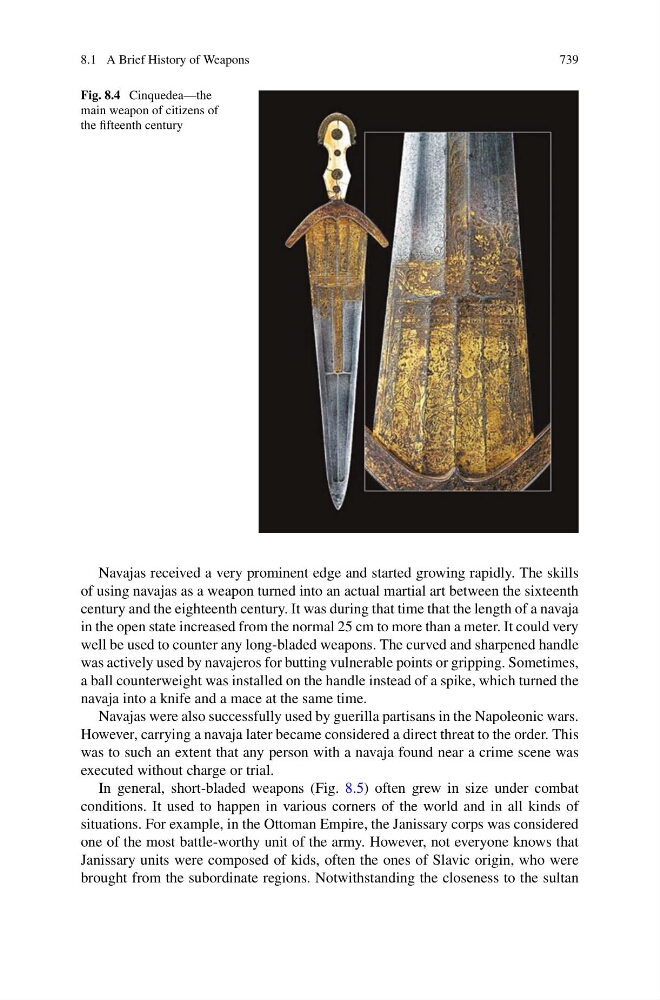
Fig. 8.4 Cinquedea—the
main weapon of citizens of
the fifteenth century
Navajas received a very prominent edge and started growing rapidly. The skills
of using navajas as a weapon turned into an actual martial art between the sixteenth
century and the eighteenth century. It was during that time that the length of a navaja
in the open state increased from the normal 25 cm to more than a meter. It could very
well be used to counter any long-bladed weapons. The curved and sharpened handle
was actively used by navajeros for butting vulnerable points or gripping. Sometimes,
a ball counterweight was installed on the handle instead of a spike, which turned the
navaja into a knife and a mace at the same time.
Navajas were also successfully used by guerilla partisans in the Napoleonic wars.
However, carrying a navaja later became considered a direct threat to the order. This
was to such an extent that any person with a navaja found near a crime scene was
executed without charge or trial.
In general, short-bladed weapons (Fig. 8.5) often grew in size under combat
conditions. It used to happen in various corners of the world and in all kinds of
situations. For example, in the Ottoman Empire, the Janissary corps was considered
one of the most battle-worthy unit of the army. However, not everyone knows that
Janissary units were composed of kids, often the ones of Slavic origin, who were
brought from the subordinate regions. Notwithstanding the closeness to the sultan