

740
8 Modern Weapons: Possibilities and Limitations
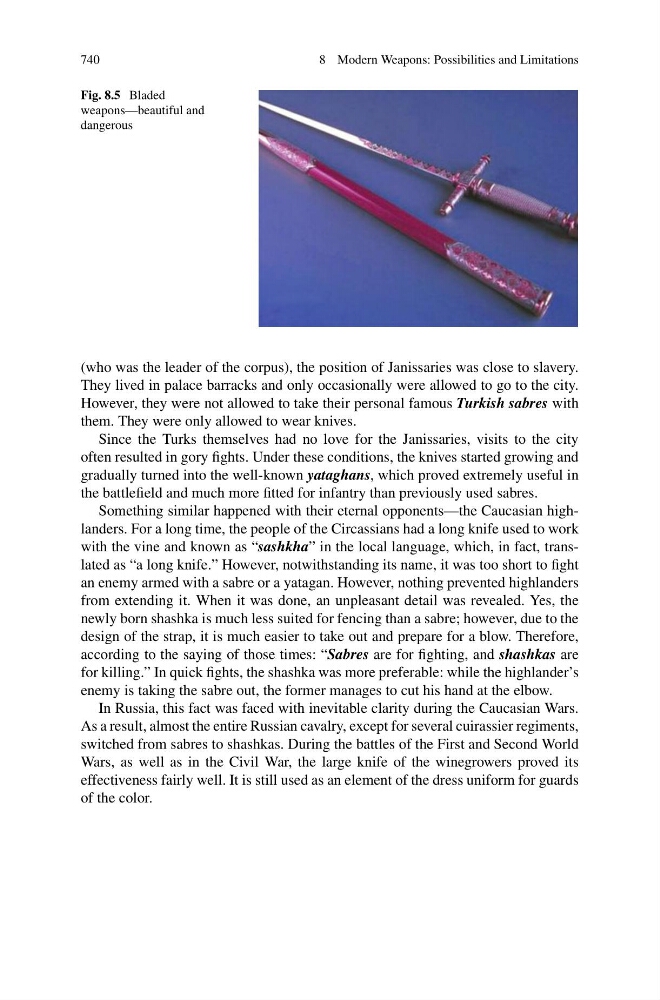
Fig. 8.5 Bladed
weapons—beautiful and
dangerous
(who was the leader of the corpus), the position of Janissaries was close to slavery.
They lived in palace barracks and only occasionally were allowed to go to the city.
However, they were not allowed to take their personal famous Turkish sabres with
them. They were only allowed to wear knives.
Since the Turks themselves had no love for the Janissaries, visits to the city
often resulted in gory fights. Under these conditions, the knives started growing and
gradually turned into the well-known yataghans, which proved extremely useful in
the battlefield and much more fitted for infantry than previously used sabres.
Something similar happened with their eternal opponents—the Caucasian highlanders. For a long time, the people of the Circassians had a long knife used to work
with the vine and known as “sashkha” in the local language, which, in fact, translated as “a long knife.” However, notwithstanding its name, it was too short to fight
an enemy armed with a sabre or a yatagan. However, nothing prevented highlanders
from extending it. When it was done, an unpleasant detail was revealed. Yes, the
newly born shashka is much less suited for fencing than a sabre; however, due to the
design of the strap, it is much easier to take out and prepare for a blow. Therefore,
according to the saying of those times: “Sabres are for fighting, and shashkas are
for killing.” In quick fights, the shashka was more preferable: while the highlander’s
enemy is taking the sabre out, the former manages to cut his hand at the elbow.
In Russia, this fact was faced with inevitable clarity during the Caucasian Wars.
As a result, almost the entire Russian cavalry, except for several cuirassier regiments,
switched from sabres to shashkas. During the battles of the First and Second World
Wars, as well as in the Civil War, the large knife of the winegrowers proved its
effectiveness fairly well. It is still used as an element of the dress uniform for guards
of the color.