

5.4 Specific Examples from the Experience of Belarusian Trojan Hunters
491
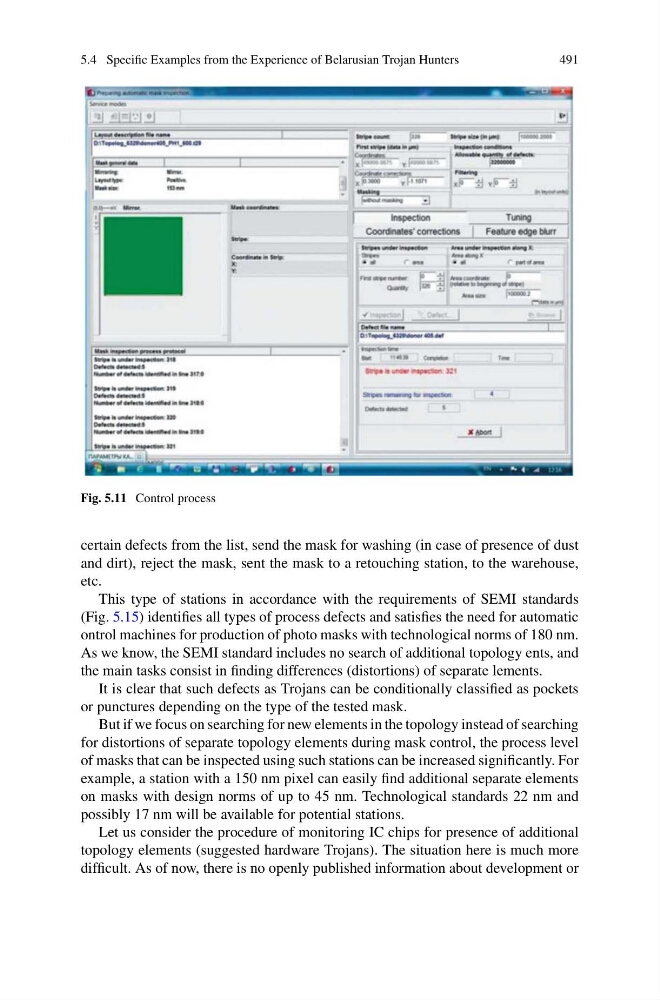
Fig. 5.11 Control process
certain defects from the list, send the mask for washing (in case of presence of dust
and dirt), reject the mask, sent the mask to a retouching station, to the warehouse,
etc.
This type of stations in accordance with the requirements of SEMI standards
(Fig. 5.15) identifies all types of process defects and satisfies the need for automatic
ontrol machines for production of photo masks with technological norms of 180 nm.
As we know, the SEMI standard includes no search of additional topology ents, and
the main tasks consist in finding differences (distortions) of separate lements.
It is clear that such defects as Trojans can be conditionally classified as pockets
or punctures depending on the type of the tested mask.
But if we focus on searching for new elements in the topology instead of searching
for distortions of separate topology elements during mask control, the process level
of masks that can be inspected using such stations can be increased significantly. For
example, a station with a 150 nm pixel can easily find additional separate elements
on masks with design norms of up to 45 nm. Technological standards 22 nm and
possibly 17 nm will be available for potential stations.
Let us consider the procedure of monitoring IC chips for presence of additional
topology elements (suggested hardware Trojans). The situation here is much more
difficult. As of now, there is no openly published information about development or
491
Fig. 5.11 Control process
certain defects from the list, send the mask for washing (in case of presence of dust
and dirt), reject the mask, sent the mask to a retouching station, to the warehouse,
etc.
This type of stations in accordance with the requirements of SEMI standards
(Fig. 5.15) identifies all types of process defects and satisfies the need for automatic
ontrol machines for production of photo masks with technological norms of 180 nm.
As we know, the SEMI standard includes no search of additional topology ents, and
the main tasks consist in finding differences (distortions) of separate lements.
It is clear that such defects as Trojans can be conditionally classified as pockets
or punctures depending on the type of the tested mask.
But if we focus on searching for new elements in the topology instead of searching
for distortions of separate topology elements during mask control, the process level
of masks that can be inspected using such stations can be increased significantly. For
example, a station with a 150 nm pixel can easily find additional separate elements
on masks with design norms of up to 45 nm. Technological standards 22 nm and
possibly 17 nm will be available for potential stations.
Let us consider the procedure of monitoring IC chips for presence of additional
topology elements (suggested hardware Trojans). The situation here is much more
difficult. As of now, there is no openly published information about development or