

476
5 Methods of Detecting Hardware Trojans in Microcircuits
authors for such graphic were made on two different days and at different times of
the day. The authors [1] suggest that large sets of t-vectors cause certain differences
in the room temperature (which forced the researchers to use another scale for these
graphs).
B. Golden reference compared to hardware Trojans
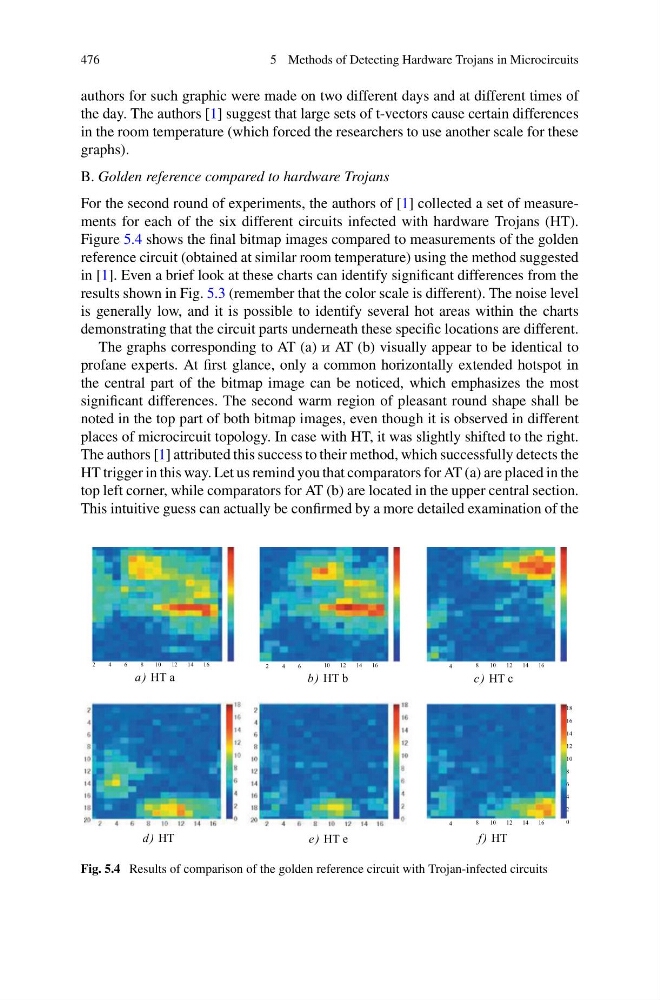
For the second round of experiments, the authors of [1] collected a set of measurements for each of the six different circuits infected with hardware Trojans (HT).
Figure 5.4 shows the final bitmap images compared to measurements of the golden
reference circuit (obtained at similar room temperature) using the method suggested
in [1]. Even a brief look at these charts can identify significant differences from the
results shown in Fig. 5.3 (remember that the color scale is different). The noise level
is generally low, and it is possible to identify several hot areas within the charts
demonstrating that the circuit parts underneath these specific locations are different.
The graphs corresponding to AT (a) i AT (b) visually appear to be identical to
profane experts. At first glance, only a common horizontally extended hotspot in
the central part of the bitmap image can be noticed, which emphasizes the most
significant differences. The second warm region of pleasant round shape shall be
noted in the top part of both bitmap images, even though it is observed in different
places of microcircuit topology. In case with HT, it was slightly shifted to the right.
The authors [1] attributed this success to their method, which successfully detects the
HT trigger in this way. Let us remind you that comparators for AT (a) are placed in the
top left corner, while comparators for AT (b) are located in the upper central section.
This intuitive guess can actually be confirmed by a more detailed examination of the
2
4
6
8
10
12
14
16
a) HT a
10
12
14
16
b) HT b
2
4
6
8
1 0
1 2
1 4
1 6
c ) HT c
4
d) HT
e ) HT e
8
1 0
1 2
1 4
1 6
4
18
16
14
12
10
8
6
4
2
0
f ) HT
Fig. 5.4 Results of comparison of the golden reference circuit with Trojan-infected circuits
5 Methods of Detecting Hardware Trojans in Microcircuits
authors for such graphic were made on two different days and at different times of
the day. The authors [1] suggest that large sets of t-vectors cause certain differences
in the room temperature (which forced the researchers to use another scale for these
graphs).
B. Golden reference compared to hardware Trojans
For the second round of experiments, the authors of [1] collected a set of measurements for each of the six different circuits infected with hardware Trojans (HT).
Figure 5.4 shows the final bitmap images compared to measurements of the golden
reference circuit (obtained at similar room temperature) using the method suggested
in [1]. Even a brief look at these charts can identify significant differences from the
results shown in Fig. 5.3 (remember that the color scale is different). The noise level
is generally low, and it is possible to identify several hot areas within the charts
demonstrating that the circuit parts underneath these specific locations are different.
The graphs corresponding to AT (a) i AT (b) visually appear to be identical to
profane experts. At first glance, only a common horizontally extended hotspot in
the central part of the bitmap image can be noticed, which emphasizes the most
significant differences. The second warm region of pleasant round shape shall be
noted in the top part of both bitmap images, even though it is observed in different
places of microcircuit topology. In case with HT, it was slightly shifted to the right.
The authors [1] attributed this success to their method, which successfully detects the
HT trigger in this way. Let us remind you that comparators for AT (a) are placed in the
top left corner, while comparators for AT (b) are located in the upper central section.
This intuitive guess can actually be confirmed by a more detailed examination of the
2
4
6
8
10
12
14
16
a) HT a
10
12
14
16
b) HT b
2
4
6
8
1 0
1 2
1 4
1 6
c ) HT c
4
d) HT
e ) HT e
8
1 0
1 2
1 4
1 6
4
18
16
14
12
10
8
6
4
2
0
f ) HT
Fig. 5.4 Results of comparison of the golden reference circuit with Trojan-infected circuits