

The Art and Signs of a Few Good Mechanical Designs in MEMS
41
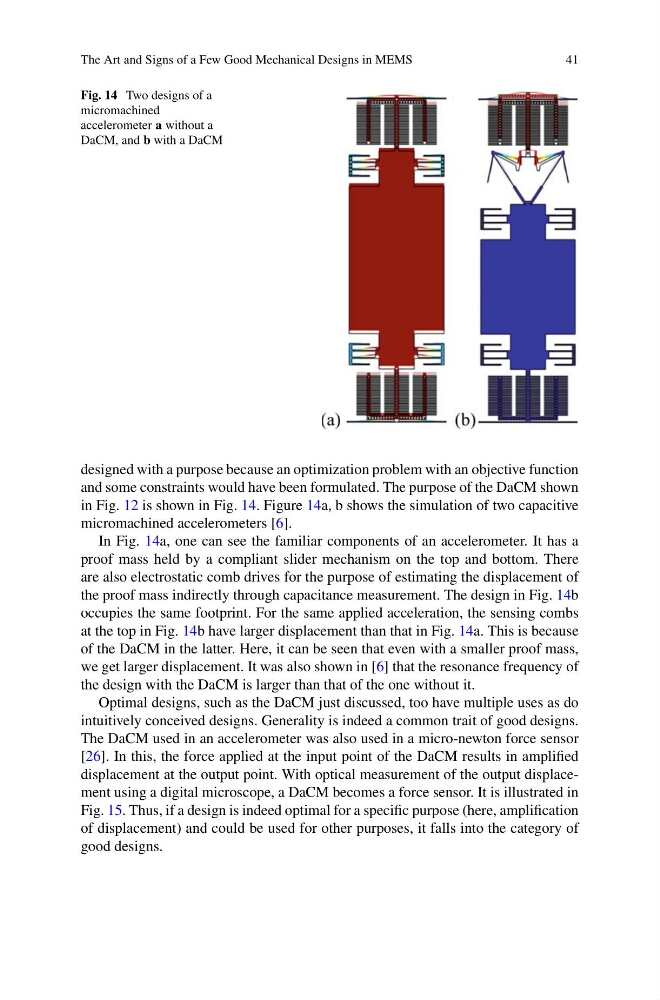
Fig. 14 Two designs of a
micromachined
accelerometer a without a
DaCM, and b with a DaCM
designed with a purpose because an optimization problem with an objective function
and some constraints would have been formulated. The purpose of the DaCM shown
in Fig. 12 is shown in Fig. 14. Figure 14a, b shows the simulation of two capacitive
micromachined accelerometers [6].
In Fig. 14a, one can see the familiar components of an accelerometer. It has a
proof mass held by a compliant slider mechanism on the top and bottom. There
are also electrostatic comb drives for the purpose of estimating the displacement of
the proof mass indirectly through capacitance measurement. The design in Fig. 14b
occupies the same footprint. For the same applied acceleration, the sensing combs
at the top in Fig. 14b have larger displacement than that in Fig. 14a. This is because
of the DaCM in the latter. Here, it can be seen that even with a smaller proof mass,
we get larger displacement. It was also shown in [6] that the resonance frequency of
the design with the DaCM is larger than that of the one without it.
Optimal designs, such as the DaCM just discussed, too have multiple uses as do
intuitively conceived designs. Generality is indeed a common trait of good designs.
The DaCM used in an accelerometer was also used in a micro-newton force sensor
[26]. In this, the force applied at the input point of the DaCM results in amplified
displacement at the output point. With optical measurement of the output displacement using a digital microscope, a DaCM becomes a force sensor. It is illustrated in
Fig. 15. Thus, if a design is indeed optimal for a specific purpose (here, amplification
of displacement) and could be used for other purposes, it falls into the category of
good designs.
41
Fig. 14 Two designs of a
micromachined
accelerometer a without a
DaCM, and b with a DaCM
designed with a purpose because an optimization problem with an objective function
and some constraints would have been formulated. The purpose of the DaCM shown
in Fig. 12 is shown in Fig. 14. Figure 14a, b shows the simulation of two capacitive
micromachined accelerometers [6].
In Fig. 14a, one can see the familiar components of an accelerometer. It has a
proof mass held by a compliant slider mechanism on the top and bottom. There
are also electrostatic comb drives for the purpose of estimating the displacement of
the proof mass indirectly through capacitance measurement. The design in Fig. 14b
occupies the same footprint. For the same applied acceleration, the sensing combs
at the top in Fig. 14b have larger displacement than that in Fig. 14a. This is because
of the DaCM in the latter. Here, it can be seen that even with a smaller proof mass,
we get larger displacement. It was also shown in [6] that the resonance frequency of
the design with the DaCM is larger than that of the one without it.
Optimal designs, such as the DaCM just discussed, too have multiple uses as do
intuitively conceived designs. Generality is indeed a common trait of good designs.
The DaCM used in an accelerometer was also used in a micro-newton force sensor
[26]. In this, the force applied at the input point of the DaCM results in amplified
displacement at the output point. With optical measurement of the output displacement using a digital microscope, a DaCM becomes a force sensor. It is illustrated in
Fig. 15. Thus, if a design is indeed optimal for a specific purpose (here, amplification
of displacement) and could be used for other purposes, it falls into the category of
good designs.