

40
G. K. Ananthasuresh
displacements, a lever needs a large space. The question, therefore, is how one can
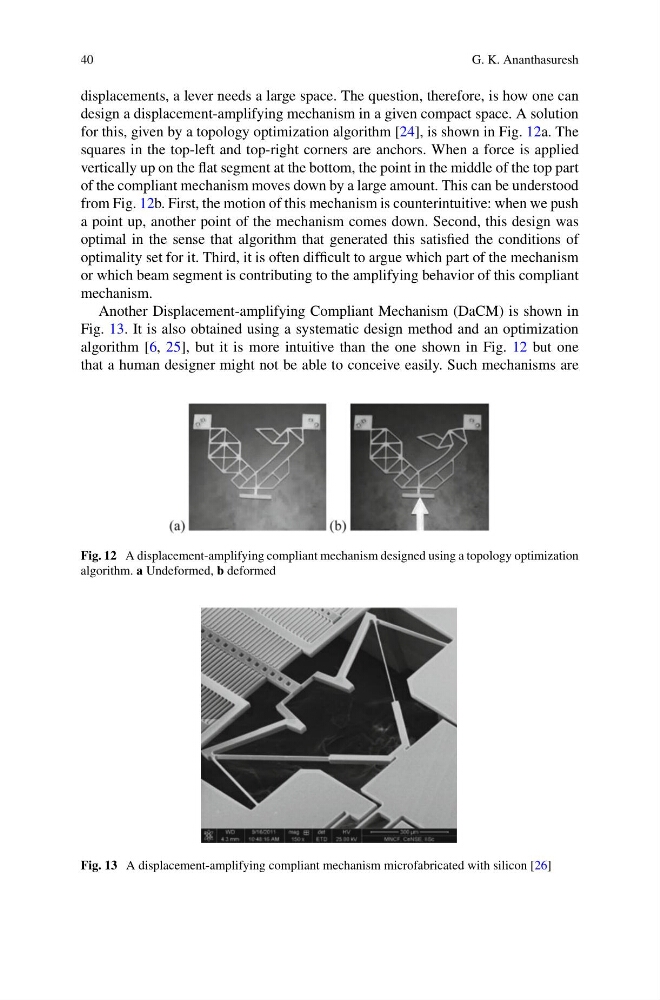
design a displacement-amplifying mechanism in a given compact space. A solution
for this, given by a topology optimization algorithm [24], is shown in Fig. 12a. The
squares in the top-left and top-right corners are anchors. When a force is applied
vertically up on the flat segment at the bottom, the point in the middle of the top part
of the compliant mechanism moves down by a large amount. This can be understood
from Fig. 12b. First, the motion of this mechanism is counterintuitive: when we push
a point up, another point of the mechanism comes down. Second, this design was
optimal in the sense that algorithm that generated this satisfied the conditions of
optimality set for it. Third, it is often difficult to argue which part of the mechanism
or which beam segment is contributing to the amplifying behavior of this compliant
mechanism.
Another Displacement-amplifying Compliant Mechanism (DaCM) is shown in
Fig. 13. It is also obtained using a systematic design method and an optimization
algorithm [6, 25], but it is more intuitive than the one shown in Fig. 12 but one
that a human designer might not be able to conceive easily. Such mechanisms are
Fig. 12 A displacement-amplifying compliant mechanism designed using a topology optimization
algorithm. a Undeformed, b deformed
Fig. 13 A displacement-amplifying compliant mechanism microfabricated with silicon [26]
G. K. Ananthasuresh
displacements, a lever needs a large space. The question, therefore, is how one can
design a displacement-amplifying mechanism in a given compact space. A solution
for this, given by a topology optimization algorithm [24], is shown in Fig. 12a. The
squares in the top-left and top-right corners are anchors. When a force is applied
vertically up on the flat segment at the bottom, the point in the middle of the top part
of the compliant mechanism moves down by a large amount. This can be understood
from Fig. 12b. First, the motion of this mechanism is counterintuitive: when we push
a point up, another point of the mechanism comes down. Second, this design was
optimal in the sense that algorithm that generated this satisfied the conditions of
optimality set for it. Third, it is often difficult to argue which part of the mechanism
or which beam segment is contributing to the amplifying behavior of this compliant
mechanism.
Another Displacement-amplifying Compliant Mechanism (DaCM) is shown in
Fig. 13. It is also obtained using a systematic design method and an optimization
algorithm [6, 25], but it is more intuitive than the one shown in Fig. 12 but one
that a human designer might not be able to conceive easily. Such mechanisms are
Fig. 12 A displacement-amplifying compliant mechanism designed using a topology optimization
algorithm. a Undeformed, b deformed
Fig. 13 A displacement-amplifying compliant mechanism microfabricated with silicon [26]