

252
A. Roy et al.
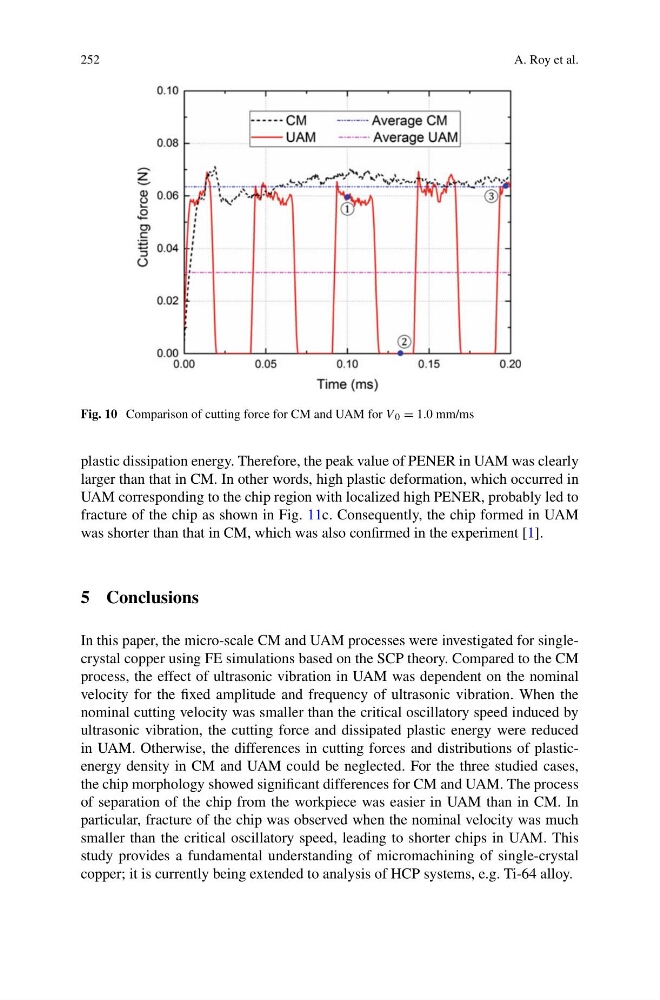
Fig. 10 Comparison of cutting force for CM and UAM for V 0 = 1.0 mm/ms
plastic dissipation energy. Therefore, the peak value of PENER in UAM was clearly
larger than that in CM. In other words, high plastic deformation, which occurred in
UAM corresponding to the chip region with localized high PENER, probably led to
fracture of the chip as shown in Fig. 11c. Consequently, the chip formed in UAM
was shorter than that in CM, which was also confirmed in the experiment [1].
5 Conclusions
In this paper, the micro-scale CM and UAM processes were investigated for singlecrystal copper using FE simulations based on the SCP theory. Compared to the CM
process, the effect of ultrasonic vibration in UAM was dependent on the nominal
velocity for the fixed amplitude and frequency of ultrasonic vibration. When the
nominal cutting velocity was smaller than the critical oscillatory speed induced by
ultrasonic vibration, the cutting force and dissipated plastic energy were reduced
in UAM. Otherwise, the differences in cutting forces and distributions of plasticenergy density in CM and UAM could be neglected. For the three studied cases,
the chip morphology showed significant differences for CM and UAM. The process
of separation of the chip from the workpiece was easier in UAM than in CM. In
particular, fracture of the chip was observed when the nominal velocity was much
smaller than the critical oscillatory speed, leading to shorter chips in UAM. This
study provides a fundamental understanding of micromachining of single-crystal
copper; it is currently being extended to analysis of HCP systems, e.g. Ti-64 alloy.
A. Roy et al.
Fig. 10 Comparison of cutting force for CM and UAM for V 0 = 1.0 mm/ms
plastic dissipation energy. Therefore, the peak value of PENER in UAM was clearly
larger than that in CM. In other words, high plastic deformation, which occurred in
UAM corresponding to the chip region with localized high PENER, probably led to
fracture of the chip as shown in Fig. 11c. Consequently, the chip formed in UAM
was shorter than that in CM, which was also confirmed in the experiment [1].
5 Conclusions
In this paper, the micro-scale CM and UAM processes were investigated for singlecrystal copper using FE simulations based on the SCP theory. Compared to the CM
process, the effect of ultrasonic vibration in UAM was dependent on the nominal
velocity for the fixed amplitude and frequency of ultrasonic vibration. When the
nominal cutting velocity was smaller than the critical oscillatory speed induced by
ultrasonic vibration, the cutting force and dissipated plastic energy were reduced
in UAM. Otherwise, the differences in cutting forces and distributions of plasticenergy density in CM and UAM could be neglected. For the three studied cases,
the chip morphology showed significant differences for CM and UAM. The process
of separation of the chip from the workpiece was easier in UAM than in CM. In
particular, fracture of the chip was observed when the nominal velocity was much
smaller than the critical oscillatory speed, leading to shorter chips in UAM. This
study provides a fundamental understanding of micromachining of single-crystal
copper; it is currently being extended to analysis of HCP systems, e.g. Ti-64 alloy.