

244
A. Roy et al.
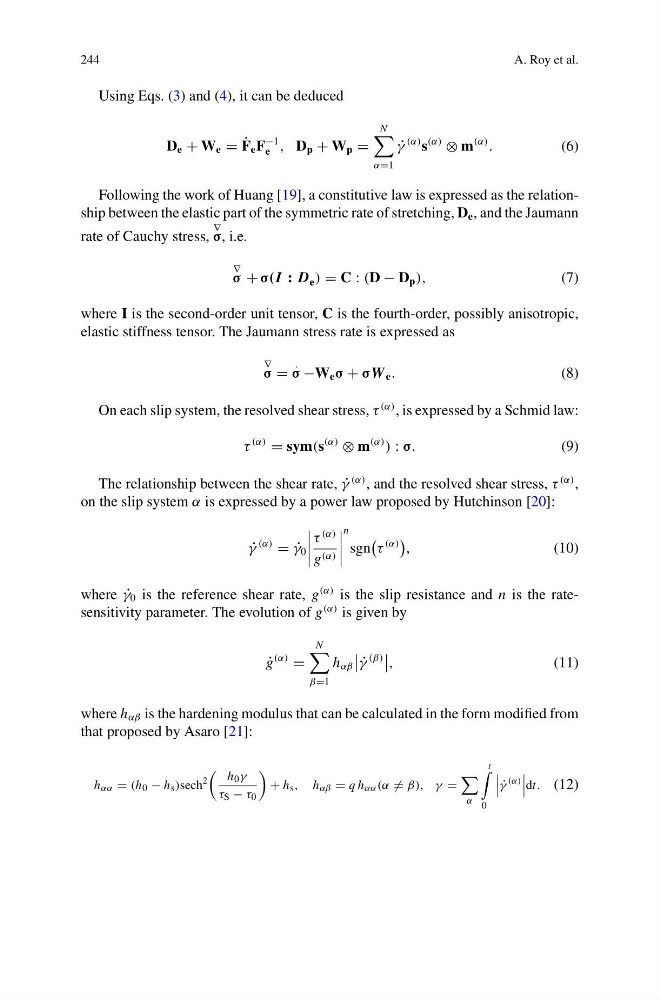
Using Eqs. (3) and (4), it can be deduced
D e + W e = ˙
F e F
−1
e , D p + W p =
N
α=1
˙
γ
(α) s
(α)
⊗ m
(α)
.
(6)
Following the work of Huang [19], a constitutive law is expressed as the relationship between the elastic part of the symmetric rate of stretching, D e , and the Jaumann
rate of Cauchy stress,
∇
σ, i.e.
∇
σ + σ(I : D e ) = C : (D − D p ),
(7)
where I is the second-order unit tensor, C is the fourth-order, possibly anisotropic,
elastic stiffness tensor. The Jaumann stress rate is expressed as
∇
σ =
.
σ −W e σ + σW e .
(8)
On each slip system, the resolved shear stress, τ
(α) , is expressed by a Schmid law:
τ
(α)
= sym(s
(α)
⊗ m
(α)
) : σ.
(9)
The relationship between the shear rate, ˙
γ
(α) , and the resolved shear stress, τ
(α) ,
on the slip system α is expressed by a power law proposed by Hutchinson [20]:
˙
γ
(α)
= ˙
γ 0
τ
(α)
g (α)
n
sgn
τ
(α)
,
(10)
where ˙
γ 0 is the reference shear rate, g
(α) is the slip resistance and n is the ratesensitivity parameter. The evolution of g
(α) is given by
˙
g
(α)
=
N
β=1
h αβ
˙
γ
(β)
,
(11)
where h αβ is the hardening modulus that can be calculated in the form modified from
that proposed by Asaro [21]:
h αα = (h 0 − h s )sech
2
h 0 γ
τ S − τ 0
+ h s , h αβ = q h αα (α = β), γ =
α
t
0
˙
γ
(α)
dt. (12)
A. Roy et al.
Using Eqs. (3) and (4), it can be deduced
D e + W e = ˙
F e F
−1
e , D p + W p =
N
α=1
˙
γ
(α) s
(α)
⊗ m
(α)
.
(6)
Following the work of Huang [19], a constitutive law is expressed as the relationship between the elastic part of the symmetric rate of stretching, D e , and the Jaumann
rate of Cauchy stress,
∇
σ, i.e.
∇
σ + σ(I : D e ) = C : (D − D p ),
(7)
where I is the second-order unit tensor, C is the fourth-order, possibly anisotropic,
elastic stiffness tensor. The Jaumann stress rate is expressed as
∇
σ =
.
σ −W e σ + σW e .
(8)
On each slip system, the resolved shear stress, τ
(α) , is expressed by a Schmid law:
τ
(α)
= sym(s
(α)
⊗ m
(α)
) : σ.
(9)
The relationship between the shear rate, ˙
γ
(α) , and the resolved shear stress, τ
(α) ,
on the slip system α is expressed by a power law proposed by Hutchinson [20]:
˙
γ
(α)
= ˙
γ 0
τ
(α)
g (α)
n
sgn
τ
(α)
,
(10)
where ˙
γ 0 is the reference shear rate, g
(α) is the slip resistance and n is the ratesensitivity parameter. The evolution of g
(α) is given by
˙
g
(α)
=
N
β=1
h αβ
˙
γ
(β)
,
(11)
where h αβ is the hardening modulus that can be calculated in the form modified from
that proposed by Asaro [21]:
h αα = (h 0 − h s )sech
2
h 0 γ
τ S − τ 0
+ h s , h αβ = q h αα (α = β), γ =
α
t
0
˙
γ
(α)
dt. (12)