

Simulations of Machining Processes at Small …
243
and chip formation for different nominal cutting velocities. This paper is organized
as follows: a theoretical framework of the SCP theory is summarized in Sect. 2,
followed by a description of the FE modelling procedure in Sect. 3. Simulation
results are discussed in the subsequent section. We conclude with some remarks in
Sect. 5.
2 Crystal-Plasticity Theory
In this section, the classical crystal-plasticity theory adopted in this study is reviewed.
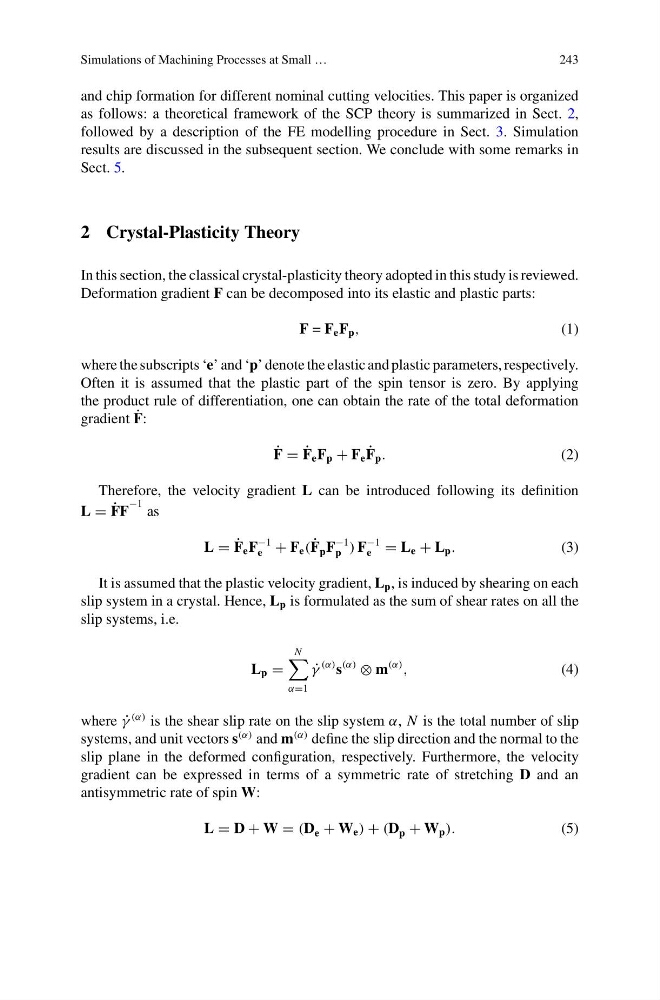
Deformation gradient F can be decomposed into its elastic and plastic parts:
F = F e F p ,
(1)
where the subscripts ‘e’ and ‘p’ denote the elastic and plastic parameters, respectively.
Often it is assumed that the plastic part of the spin tensor is zero. By applying
the product rule of differentiation, one can obtain the rate of the total deformation
gradient ˙
F:
˙
F = ˙
F e F p + F e ˙
F p .
(2)
Therefore, the velocity gradient L can be introduced following its definition
L = ˙
FF
−1 as
L = ˙
F e F
−1
e + F e ( ˙
F p F
−1
p ) F
−1
e = L e + L p .
(3)
It is assumed that the plastic velocity gradient, L p , is induced by shearing on each
slip system in a crystal. Hence, L p is formulated as the sum of shear rates on all the
slip systems, i.e.
L p =
N
α=1
˙
γ
(α) s
(α)
⊗ m
(α)
,
(4)
where ˙
γ
(α) is the shear slip rate on the slip system α, N is the total number of slip
systems, and unit vectors s
(α) and m
(α) define the slip direction and the normal to the
slip plane in the deformed configuration, respectively. Furthermore, the velocity
gradient can be expressed in terms of a symmetric rate of stretching D and an
antisymmetric rate of spin W:
L = D + W = (D e + W e ) + (D p + W p ).
(5)
243
and chip formation for different nominal cutting velocities. This paper is organized
as follows: a theoretical framework of the SCP theory is summarized in Sect. 2,
followed by a description of the FE modelling procedure in Sect. 3. Simulation
results are discussed in the subsequent section. We conclude with some remarks in
Sect. 5.
2 Crystal-Plasticity Theory
In this section, the classical crystal-plasticity theory adopted in this study is reviewed.
Deformation gradient F can be decomposed into its elastic and plastic parts:
F = F e F p ,
(1)
where the subscripts ‘e’ and ‘p’ denote the elastic and plastic parameters, respectively.
Often it is assumed that the plastic part of the spin tensor is zero. By applying
the product rule of differentiation, one can obtain the rate of the total deformation
gradient ˙
F:
˙
F = ˙
F e F p + F e ˙
F p .
(2)
Therefore, the velocity gradient L can be introduced following its definition
L = ˙
FF
−1 as
L = ˙
F e F
−1
e + F e ( ˙
F p F
−1
p ) F
−1
e = L e + L p .
(3)
It is assumed that the plastic velocity gradient, L p , is induced by shearing on each
slip system in a crystal. Hence, L p is formulated as the sum of shear rates on all the
slip systems, i.e.
L p =
N
α=1
˙
γ
(α) s
(α)
⊗ m
(α)
,
(4)
where ˙
γ
(α) is the shear slip rate on the slip system α, N is the total number of slip
systems, and unit vectors s
(α) and m
(α) define the slip direction and the normal to the
slip plane in the deformed configuration, respectively. Furthermore, the velocity
gradient can be expressed in terms of a symmetric rate of stretching D and an
antisymmetric rate of spin W:
L = D + W = (D e + W e ) + (D p + W p ).
(5)