

Birth of Mechanical Engineering and a Glimpse …
9
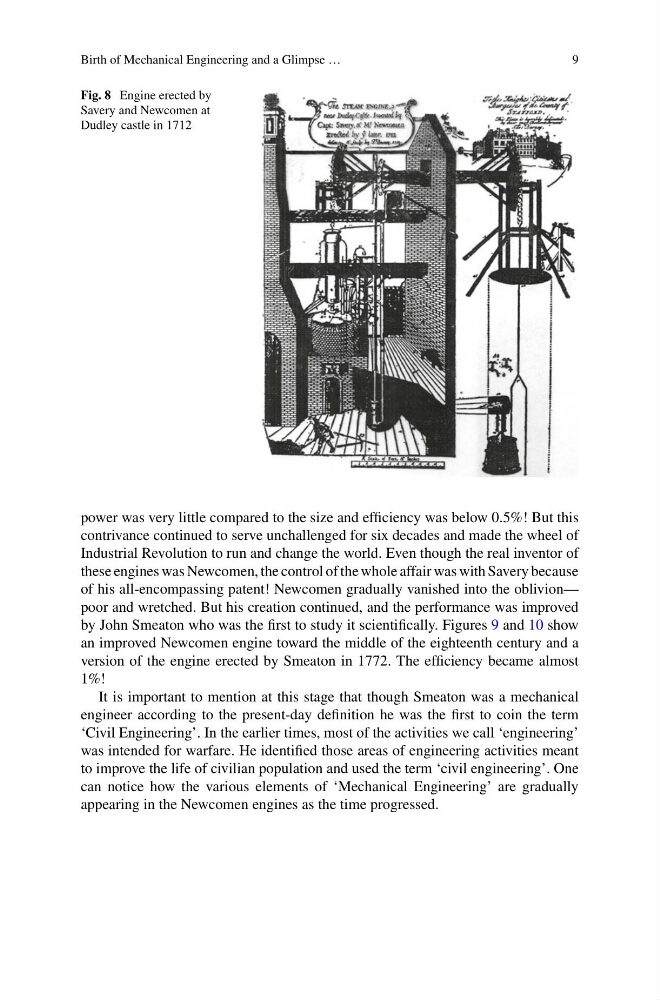
Fig. 8 Engine erected by
Savery and Newcomen at
Dudley castle in 1712
power was very little compared to the size and efficiency was below 0.5%! But this
contrivance continued to serve unchallenged for six decades and made the wheel of
Industrial Revolution to run and change the world. Even though the real inventor of
these engines was Newcomen, the control of the whole affair was with Savery because
of his all-encompassing patent! Newcomen gradually vanished into the oblivion—
poor and wretched. But his creation continued, and the performance was improved
by John Smeaton who was the first to study it scientifically. Figures 9 and 10 show
an improved Newcomen engine toward the middle of the eighteenth century and a
version of the engine erected by Smeaton in 1772. The efficiency became almost
1%!
It is important to mention at this stage that though Smeaton was a mechanical
engineer according to the present-day definition he was the first to coin the term
‘Civil Engineering’. In the earlier times, most of the activities we call ‘engineering’
was intended for warfare. He identified those areas of engineering activities meant
to improve the life of civilian population and used the term ‘civil engineering’. One
can notice how the various elements of ‘Mechanical Engineering’ are gradually
appearing in the Newcomen engines as the time progressed.
9
Fig. 8 Engine erected by
Savery and Newcomen at
Dudley castle in 1712
power was very little compared to the size and efficiency was below 0.5%! But this
contrivance continued to serve unchallenged for six decades and made the wheel of
Industrial Revolution to run and change the world. Even though the real inventor of
these engines was Newcomen, the control of the whole affair was with Savery because
of his all-encompassing patent! Newcomen gradually vanished into the oblivion—
poor and wretched. But his creation continued, and the performance was improved
by John Smeaton who was the first to study it scientifically. Figures 9 and 10 show
an improved Newcomen engine toward the middle of the eighteenth century and a
version of the engine erected by Smeaton in 1772. The efficiency became almost
1%!
It is important to mention at this stage that though Smeaton was a mechanical
engineer according to the present-day definition he was the first to coin the term
‘Civil Engineering’. In the earlier times, most of the activities we call ‘engineering’
was intended for warfare. He identified those areas of engineering activities meant
to improve the life of civilian population and used the term ‘civil engineering’. One
can notice how the various elements of ‘Mechanical Engineering’ are gradually
appearing in the Newcomen engines as the time progressed.