

212
D. George and M. J. Madou
the chains. When reheated, the original shape is recovered. Therefore, bending can
be induced with such a deformed SMP that abuts an undeformed SMP sheet (Fig. 6).
Although we mentioned various techniques where strain mismatch is used for
bending, it must be noted that not any combinations of two materials that are having
different strains offer a uniform bending toward one direction. A thin and stiff material
on top of soft and thick material can result in wrinkled shapes on the thin material
[18]. This kind of deformation is not of interest at the moment for designing origami
fabrication processes. Another peculiar case is when the bilayer is longitudinal rather
than along thickness. The differential strain along the lateral dimension can lead to
curled shapes [17, 51, 69].
3.1.2 From Bending to Folding Using Bimorph Approach
A fold features a large curvature over a length that is considerably smaller than the
overall size to the sheet [84]. Two typical design strategies are followed for fabricating
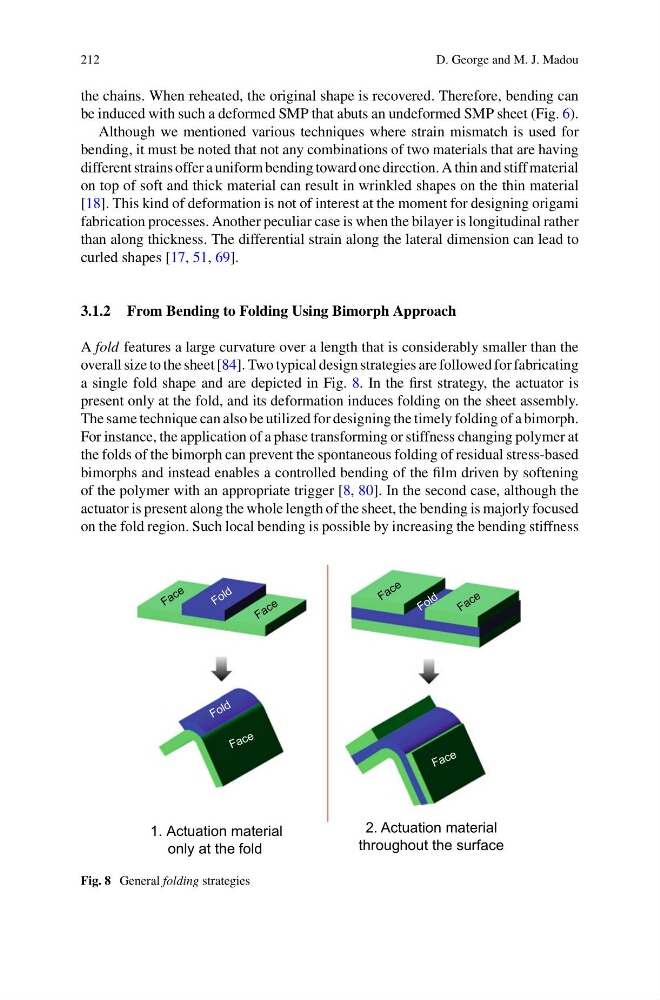
a single fold shape and are depicted in Fig. 8. In the first strategy, the actuator is
present only at the fold, and its deformation induces folding on the sheet assembly.
The same technique can also be utilized for designing the timely folding of a bimorph.
For instance, the application of a phase transforming or stiffness changing polymer at
the folds of the bimorph can prevent the spontaneous folding of residual stress-based
bimorphs and instead enables a controlled bending of the film driven by softening
of the polymer with an appropriate trigger [8, 80]. In the second case, although the
actuator is present along the whole length of the sheet, the bending is majorly focused
on the fold region. Such local bending is possible by increasing the bending stiffness
1. Actuation material
only at the fold
2. Actuation material
throughout the surface
Fig. 8 General folding strategies
D. George and M. J. Madou
the chains. When reheated, the original shape is recovered. Therefore, bending can
be induced with such a deformed SMP that abuts an undeformed SMP sheet (Fig. 6).
Although we mentioned various techniques where strain mismatch is used for
bending, it must be noted that not any combinations of two materials that are having
different strains offer a uniform bending toward one direction. A thin and stiff material
on top of soft and thick material can result in wrinkled shapes on the thin material
[18]. This kind of deformation is not of interest at the moment for designing origami
fabrication processes. Another peculiar case is when the bilayer is longitudinal rather
than along thickness. The differential strain along the lateral dimension can lead to
curled shapes [17, 51, 69].
3.1.2 From Bending to Folding Using Bimorph Approach
A fold features a large curvature over a length that is considerably smaller than the
overall size to the sheet [84]. Two typical design strategies are followed for fabricating
a single fold shape and are depicted in Fig. 8. In the first strategy, the actuator is
present only at the fold, and its deformation induces folding on the sheet assembly.
The same technique can also be utilized for designing the timely folding of a bimorph.
For instance, the application of a phase transforming or stiffness changing polymer at
the folds of the bimorph can prevent the spontaneous folding of residual stress-based
bimorphs and instead enables a controlled bending of the film driven by softening
of the polymer with an appropriate trigger [8, 80]. In the second case, although the
actuator is present along the whole length of the sheet, the bending is majorly focused
on the fold region. Such local bending is possible by increasing the bending stiffness
1. Actuation material
only at the fold
2. Actuation material
throughout the surface
Fig. 8 General folding strategies