

Origami MEMS
211
Thermal or
optical
actuation
LC
Polymer chain
1. Heating
2. Stretching
3. Cooling
Heating
Liquid crystal elastomers
Shape memory polymers
Polymer chain
Crosslinking
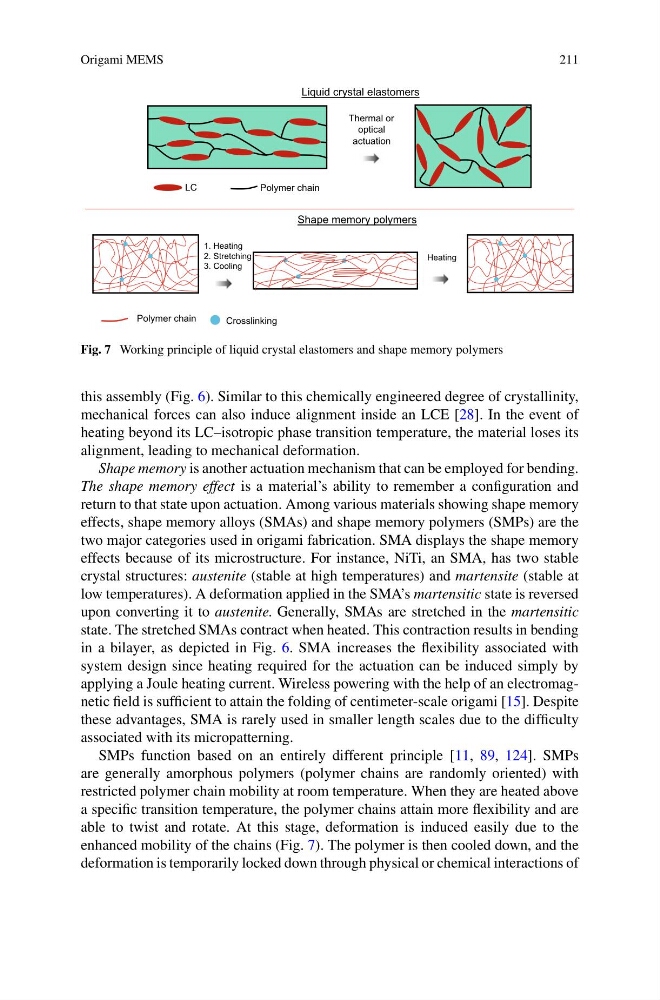
Fig. 7 Working principle of liquid crystal elastomers and shape memory polymers
this assembly (Fig. 6). Similar to this chemically engineered degree of crystallinity,
mechanical forces can also induce alignment inside an LCE [28]. In the event of
heating beyond its LC–isotropic phase transition temperature, the material loses its
alignment, leading to mechanical deformation.
Shape memory is another actuation mechanism that can be employed for bending.
The shape memory effect is a material’s ability to remember a configuration and
return to that state upon actuation. Among various materials showing shape memory
effects, shape memory alloys (SMAs) and shape memory polymers (SMPs) are the
two major categories used in origami fabrication. SMA displays the shape memory
effects because of its microstructure. For instance, NiTi, an SMA, has two stable
crystal structures: austenite (stable at high temperatures) and martensite (stable at
low temperatures). A deformation applied in the SMA’s martensitic state is reversed
upon converting it to austenite. Generally, SMAs are stretched in the martensitic
state. The stretched SMAs contract when heated. This contraction results in bending
in a bilayer, as depicted in Fig. 6. SMA increases the flexibility associated with
system design since heating required for the actuation can be induced simply by
applying a Joule heating current. Wireless powering with the help of an electromagnetic field is sufficient to attain the folding of centimeter-scale origami [15]. Despite
these advantages, SMA is rarely used in smaller length scales due to the difficulty
associated with its micropatterning.
SMPs function based on an entirely different principle [11, 89, 124]. SMPs
are generally amorphous polymers (polymer chains are randomly oriented) with
restricted polymer chain mobility at room temperature. When they are heated above
a specific transition temperature, the polymer chains attain more flexibility and are
able to twist and rotate. At this stage, deformation is induced easily due to the
enhanced mobility of the chains (Fig. 7). The polymer is then cooled down, and the
deformation is temporarily locked down through physical or chemical interactions of
211
Thermal or
optical
actuation
LC
Polymer chain
1. Heating
2. Stretching
3. Cooling
Heating
Liquid crystal elastomers
Shape memory polymers
Polymer chain
Crosslinking
Fig. 7 Working principle of liquid crystal elastomers and shape memory polymers
this assembly (Fig. 6). Similar to this chemically engineered degree of crystallinity,
mechanical forces can also induce alignment inside an LCE [28]. In the event of
heating beyond its LC–isotropic phase transition temperature, the material loses its
alignment, leading to mechanical deformation.
Shape memory is another actuation mechanism that can be employed for bending.
The shape memory effect is a material’s ability to remember a configuration and
return to that state upon actuation. Among various materials showing shape memory
effects, shape memory alloys (SMAs) and shape memory polymers (SMPs) are the
two major categories used in origami fabrication. SMA displays the shape memory
effects because of its microstructure. For instance, NiTi, an SMA, has two stable
crystal structures: austenite (stable at high temperatures) and martensite (stable at
low temperatures). A deformation applied in the SMA’s martensitic state is reversed
upon converting it to austenite. Generally, SMAs are stretched in the martensitic
state. The stretched SMAs contract when heated. This contraction results in bending
in a bilayer, as depicted in Fig. 6. SMA increases the flexibility associated with
system design since heating required for the actuation can be induced simply by
applying a Joule heating current. Wireless powering with the help of an electromagnetic field is sufficient to attain the folding of centimeter-scale origami [15]. Despite
these advantages, SMA is rarely used in smaller length scales due to the difficulty
associated with its micropatterning.
SMPs function based on an entirely different principle [11, 89, 124]. SMPs
are generally amorphous polymers (polymer chains are randomly oriented) with
restricted polymer chain mobility at room temperature. When they are heated above
a specific transition temperature, the polymer chains attain more flexibility and are
able to twist and rotate. At this stage, deformation is induced easily due to the
enhanced mobility of the chains (Fig. 7). The polymer is then cooled down, and the
deformation is temporarily locked down through physical or chemical interactions of